Golden Knights Penalty Kill Collapse in Game 4 Resets Series; Vegas Faces Must-Win Discipline Test in Game 5
By Erik Schwartz ·
The Knights squandered a 2-2 series advantage by surrendering two power-play goals in a 4-3 loss—now their ability to contain Anaheim's elite penalty-kill conversion becomes the hinge on which Game 5 turns.
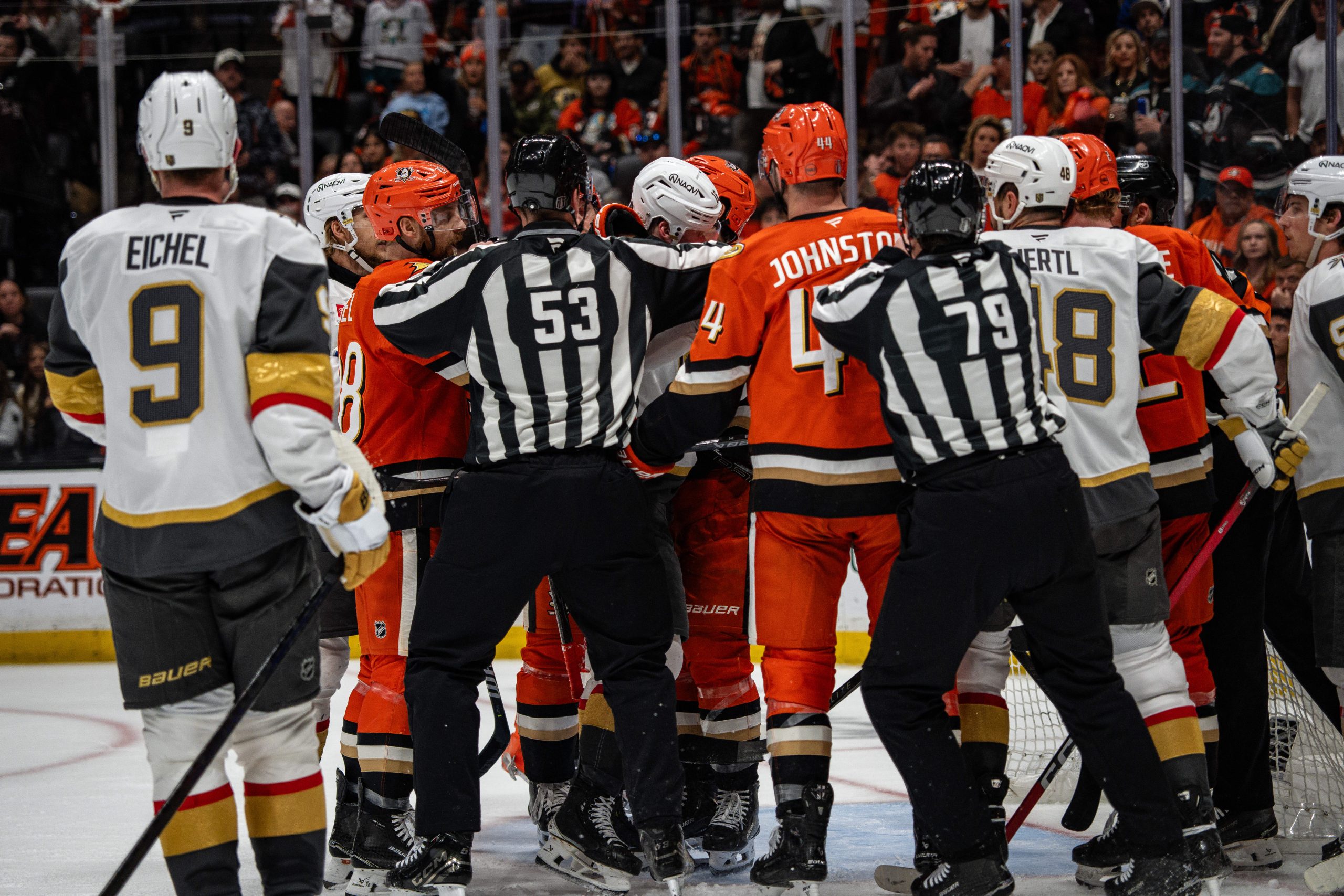
Vegas had Game 4 in hand. The Golden Knights had won convincingly at home in Game 3, had the chance to seize a 3-1 series lead on their own ice, and let it slip through a discipline breach that looked less like a rough patch and more like a structural failure. Two power-play goals—one by Alex Killorn, one assisted by Beckett Sennecke—flipped a close game into a 4-3 Ducks win, knotting the series at 2-2 and erasing the Knights' home-ice cushion. What made it worse: the Golden Knights' penalty kill has been a pillar all season. That unit folding in a moment that mattered most signals either that Anaheim's power play is genuinely elite, or that Vegas has execution issues when the stakes spike. The answer likely involves both.
Mark Stone's absence in Game 4—an undisclosed injury that leaves his Game 5 status murky—forced an already thin roster to lean harder on depth scoring and defensive positioning. Brandon Saad slotted into the lineup as Stone's replacement. Jeremy Lauzon, sidelined since the first round with an injury, remains unavailable. Those gaps matter in a playoff series where every shift compounds. The Knights have offsetting strengths: Brett Howden's seven goals lead the team, Jack Eichel has 12 assists, and Mitch Marner's 16 points and plus-9 rating show depth contributions. Carter Hart's 2.55 goals-against average and .908 save percentage in net are solid, not dominant—workable territory in a tight series, but Hart will need sharper focus if Vegas allows the Ducks to sustain offensive pressure.
Andaléim's power play ranks among the league's best for a reason. They have personnel who thrive on the man-advantage and convert at rates that shift momentum. In Game 4, they proved they're not a one-dimensional threat—they can execute when the Knights give them space. That's the mismatch Vegas must solve. The Ducks' penalty kill has also been reliable, meaning even-strength play and special teams discipline become the tactical fulcrum. If the Knights' penalty kill doesn't tighten, if they ice penalties at a higher rate, or if Anaheim's power play sustains even 25% conversion, Vegas faces a climbing cumulative disadvantage as the series tightens toward a potential Game 7.
For bettors, this penalty-kill collapse reframes how to approach Game 5 totals and team scoring props. A Golden Knights team that was generating consistent 5-on-5 offense is now carrying execution risk on the penalty kill. Expect Vegas to play more defensively, tightening gaps, taking fewer risks to avoid infractions. That style compresses both teams' scoring ceiling. If Stone is out again, depth players like Colton Sissons (who scored clutch goals in the first round and has six playoff goals from his 2017 run with Nashville) will be asked to produce, but that introduces variance into offensive efficiency. Hart's defensive workload may spike if Vegas leans heavier on him to steal a close game.
The practical read: Game 5 unders carry real appeal if Vegas maintains aggressive penalty-kill discipline and both teams adopt a tighter, more conservative approach to avoid power-play situations. Conversely, if the Ducks' power play continues humming at Game 4's conversion rate, overs become vulnerable—but so does the Knights' total in isolation. Marner and Howden player-props lean to the under if Stone is confirmed out, as their offensive load depends on linemate availability and third-line depth compensating. Focus penalty minutes leaders: if Vegas racks up 8+ infractions, the series could swing on special-teams execution alone.