Lyon's collapse triggers Luukkonen rescue—and a Game 7 variance spike for Buffalo
By PropBetEdge Editorial Team ·
When a starter implodes in 10 minutes of playoff hockey, the backup's ceiling becomes the series ceiling, and that uncertainty reshapes every goalie prop on the board.
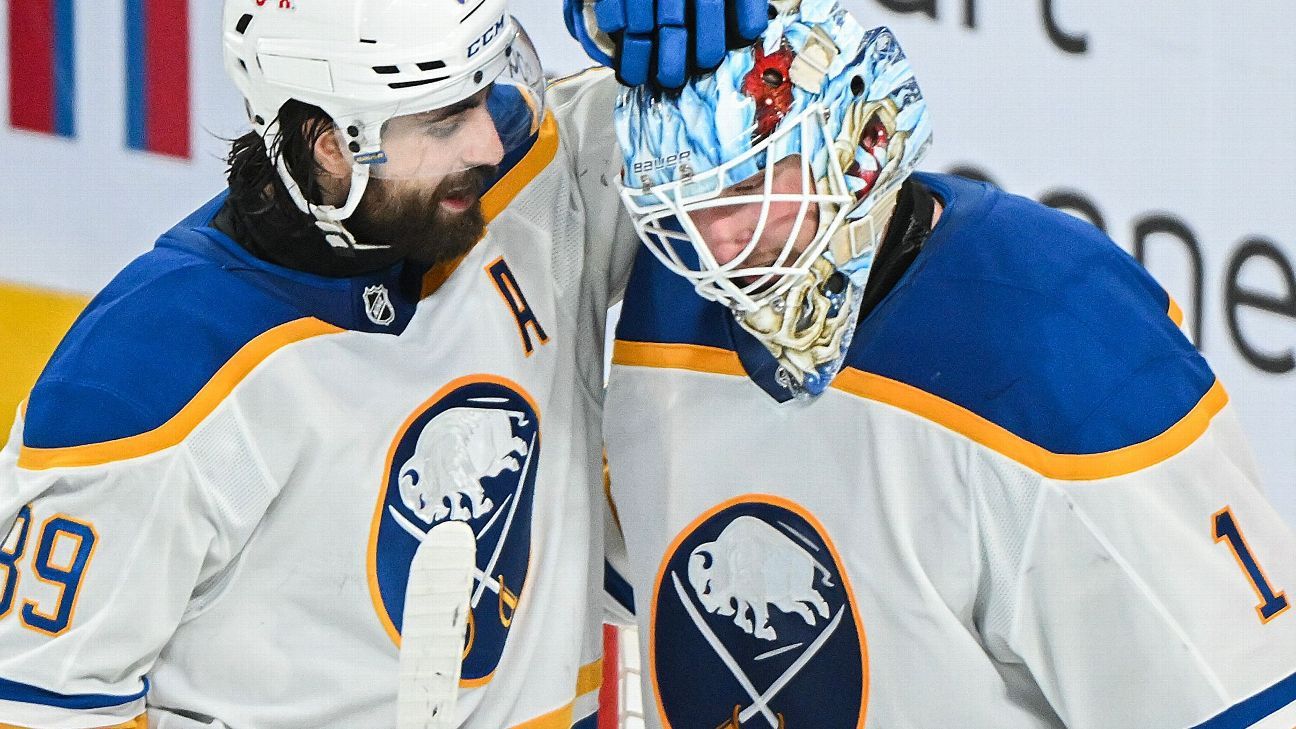
Alex Lyon lasted 10 minutes and 14 seconds in Game 6 against Montreal. In that window, he faced four shots and stopped one. The Sabres were already down 3-1 when Lindy Ruff yanked him and turned to Ukko-Pekka Luukkonen, who then made 17 consecutive saves in a 8-3 Buffalo romp that forced a Game 7. The margin between elimination and survival—between a season ending and a conference final appearance—was a single goaltending decision made before the first period ended.
What makes this swing operationally interesting is that Lyon was installed as the starter precisely because he had replaced Luukkonen in Game 5 and performed adequately. The Sabres had rotated goalies mid-series in response to what Ruff called "slowness" and "indecision" in their top six. Lyon's Game 6 implosion wasn't a rare variance event—stopping one of four is a 25% save percentage, approaching a historic low for a playoff appearance—but it happened at peak leverage. Ruff's tolerance for the experiment evaporated instantly. The decision to go back to Luukkonen mid-game wasn't a gradual realization; it was a panic snap in the first period of an elimination game.
Buffalo's offensive cast delivered the supporting cast they needed: Rasmus Dahlin finished with five points (one goal, four assists), matching a 38-year franchise playoff record, while Tage Thompson added four points after he'd gone scoreless in three of the previous five games. These weren't fluky performances—they were the star players finally accessing the execution Ruff had been demanding all series. The line shuffles and the "go" mentality (shorthand for Ruff's J.F.G. directive) created the conditions for Buffalo's talent to operate. But the goaltending seesaw remains the dominant variable heading into Game 7.
For betting purposes, Luukkonen's 17-save clean slate masks a critical uncertainty: we now have a four-shot sample from Lyon (three goals allowed) and a 17-shot sample from Luukkonen (zero goals allowed) in the same game. The market will have priced Game 7 goalie props based on season-long splits or the first five games of the series, not on this single-period nightmare. If Ruff commits to Luukkonen for Game 7—which his in-game decision strongly suggests—then his save total and unders on Montreal's goal line are anchored to a goalie who just posted a shutout under elimination pressure. That's a different profile than the seasonal average. Conversely, if Montreal forces a back-and-forth offensive game (they scored three goals in 37 minutes of Game 6 before the flood), the margin between a 17-save game and a 25-30 shot night becomes material to both sides' totals. Montreal's depth scoring drought—Cole Caufield and Lane Hutson went quiet when they needed production most—suggests that high-volume shot games favor Buffalo's depth, not Montreal's superstars finding late-game form.
The Game 7 line will likely open with Buffalo favored (after a 5-goal home-ice swing), but the goaltending variance hasn't fully settled. Luukkonen's save percentage over a full seven-game series is still a moving target. If the early-action money sizes Luukkonen's Game 6 as a new floor rather than a ceiling, unders on Montreal's team total and leans toward Luukkonen's saves staying elevated carry edge. If the market overweights the shutout as sustainable, that edge inverts. The directional call depends on whether you trust Luukkonen's poise under pressure as persistent or you see a single 17-save game as a variance spike.