Lyon's Game 6 Collapse Exposes Buffalo's Goaltending Crisis—and a Dangerous Playoff Prop Pattern
By PropBetEdge Editorial Team ·
When a starting goaltender gives up three goals on three shots and gets yanked in the first period of an elimination game, the market typically overreacts to the backup's relief performance.
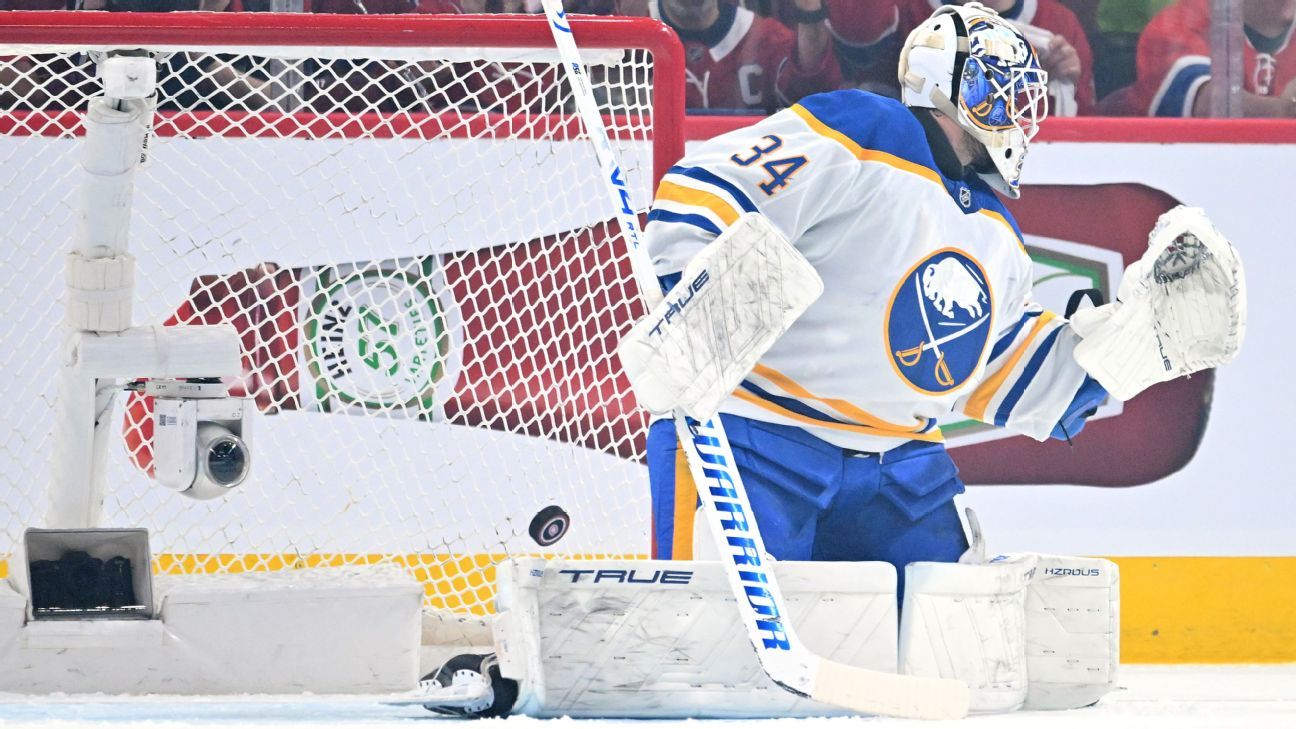
Alex Lyon lasted 10 minutes and 14 seconds of Game 6 against Montreal on Saturday night. In that span, he surrendered three goals on three shots—a .000 save percentage that forced Buffalo coach Lindy Ruff to turn to Ukko-Pekka Luukkonen before the first period ended. The Canadiens had already seized a 3-1 lead through Ivan Demidov and Arber Xhekaj, with Jake Evans capitalizing on the chaos. Rasmus Dahlin had given the Sabres an early lead 32 seconds in, but Lyon's implosion wiped it away.
What matters here isn't the drama of the pull—it's the diagnostic signal it sends. Lyon entered Game 6 carrying a 2.25 goals-against average and a .917 save percentage across six playoff games, respectable credentials for a tandem starter. But context matters: he had allowed five goals in Game 5, also a loss. The pattern suggests not a single bad night but a structural vulnerability under playoff pressure, particularly against teams that generate high-danger chances early. Montreal's first-period assault—three goals on three shots—isn't random. The Canadiens had already shown they could exploit Buffalo's defensive structure and Lyon's rebound control through five games.
Luukkonen, thrust into the fray at 3-1 down, faced an immediate credibility test. His season numbers were grim: 2-2 with a 4.20 GAA and an .851 save percentage. That doesn't look like a saves-plus-stability bet. But relief situations compress narrative. A goaltender pulled in the first period of an elimination game either steals the series or accelerates the exit. There is no middle ground. Luukkonen's save percentage and GAA tell you he's been shaky all series; they don't tell you whether a) he's better suited to the moment, b) he's facing a different shooting volume, or c) he simply got lucky with shot placement.
For prop players tracking goaltender performance lines—saves, goals against, even shots faced—the chaos of a mid-first-period substitution creates a false anchor. Books will price Luukkonen's remaining shots at some baseline tied to his season performance, but that baseline is meaningless in the context of a team already down 3-1 playing desperation hockey. Buffalo will abandon defensive structure. Montreal will lean into transition. The total shots faced by both tenders across the remainder of the game will elevate sharply. What won't necessarily elevate is save percentage, because the quality of chances—already high—will only worsen. Fading Luukkonen's under on saves (anything under 25-27 on the game) isn't a bad instinct, but the real edge is recognizing that his GAA prop and team total props are already mispriced in the direction of Montreal dominance. The market is busy reacting to the symbolism of the pull; sharper money should be pricing the inevitability of the structural collapse that the pull merely confirmed.