Zetterlund's Deployment Problem: The Gap Between Elite and Bottom-Six Doesn't Close
By PropBetEdge Editorial Team ·
Ottawa's deadline acquisition thrives alongside Tkachuk and Stutzle but tanks in the bottom six, leaving the Senators with an expensive depth decision that mirrors a familiar team-construction trap.
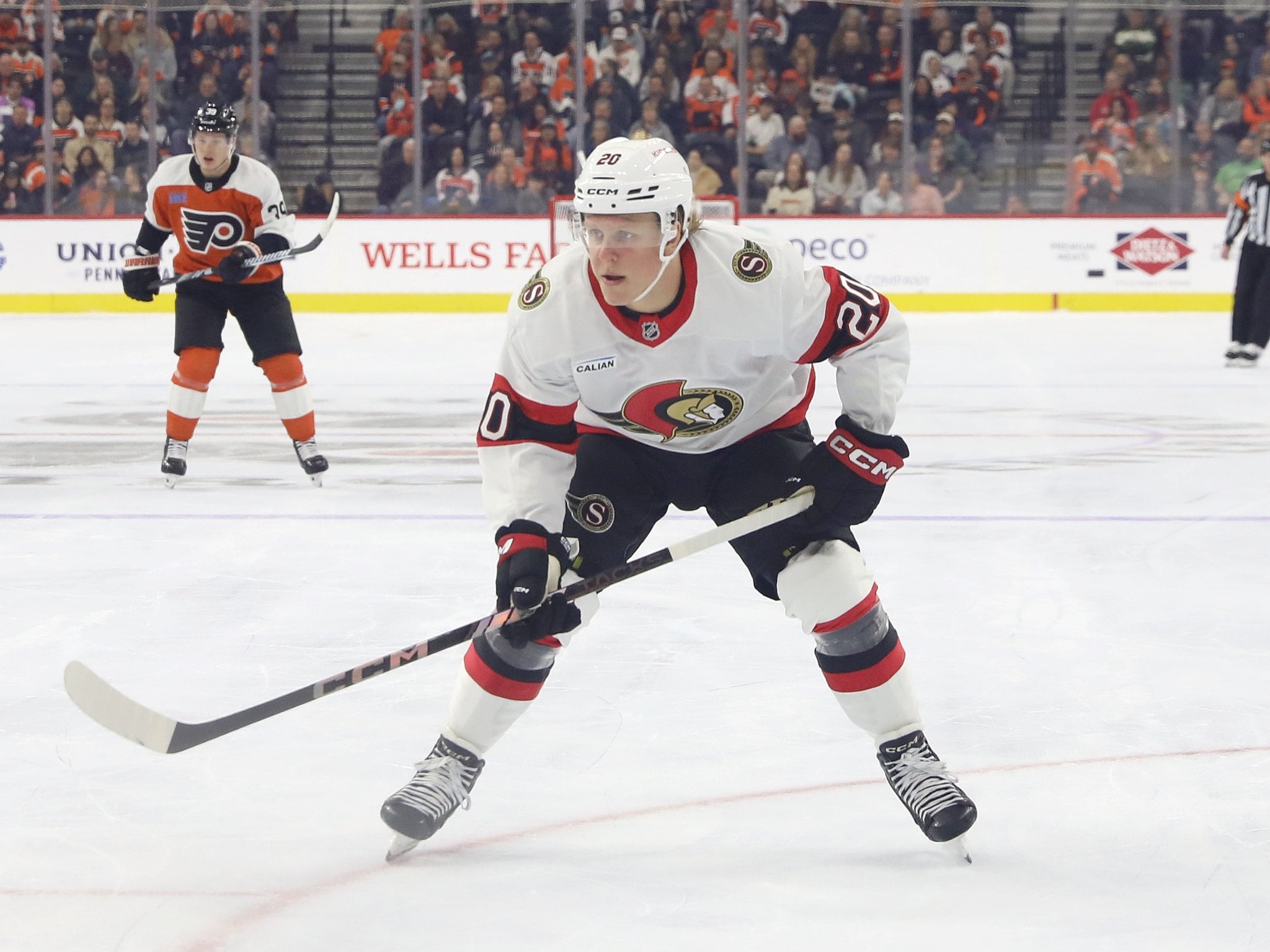
The Senators swept in the first round by Carolina represents a roster failure, and Fabian Zetterlund's uneven fifth NHL season is a microcosm of it. Acquired from San Jose at the 2025 deadline for a second-rounder and prospect Zack Ostapchuk to bolster forward depth, Zetterlund produced 17 goals and 33 points across 82 regular-season games—his second consecutive year missing the 24 goals and 44 points he posted in 2023-24. The issue isn't effort or physicality; it's fit. When lined with Brady Tkachuk and Tim Stutzle, the trio drove 64% shot-for and 62% scoring-chances-for at 5-on-5. Drop him to the bottom six with Foegele and Eller, and the line collapsed to 42% Corsi. That gap doesn't close with confidence or repetition—it signals a structural mismatch.
Zetterlund's game contains legitimate skill. His 155 hits ranked fourth on Ottawa, and his 2.04 giveaways per 60 led the team—he manages the puck with discipline and attacks the forecheck with physicality. His release is above-average for his position. The problem surfaces in expectation vs. execution. Top-six wingers are supposed to feed stars in tight areas and create secondary chances; he didn't consistently deliver that. In the bottom six, he lacked the two-way stability teams demand there. Playoffs exposed the vulnerability: his even-strength ice time plummeted to 9:33, second-lowest among Ottawa forwards, because Travis Green had nowhere to deploy him that worked. He couldn't defend, couldn't drive his own line, and couldn't anchor a secondary unit.
General manager Steve Staios faces a retention decision that most clubs avoid: keep a $4M+ contract-holder (salary structure TBD post-extension) whose production depends entirely on his center and which star winger he's paired with, or move him for immediate cap relief in a retool. The market for Zetterlund exists—European wingers with physicality and top-six experience are perpetually in demand—but he'll fetch less in a seller's market than the package that acquired him. Holding him forces Ottawa to build the next iteration of the top line around his usage, which constrains flexibility.
For the prop market, Zetterlund's fate matters primarily to Ottawa season-long totals and playoff equity. If he stays and Ottawa retains Tkachuk and Stutzle, his regular-season shot volume and point pace should stabilize closer to 220-240 SoG (he hit 232 this year across 82 games). The volatility lies in ice time: if Green uses him as a committed third-line winger next season, expect unders on his individual shot props in games where Ottawa faces top-six defensive wear. Conversely, if Staios deals him before camp and Ottawa brings in depth from free agency or trade, Zetterlund's props vanish from Ottawa slates entirely. The Senators' forward core is too fragile for luxuries. A 26-year-old who excels only alongside All-Stars isn't depth—he's a complimentary player with a star's price tag.
Watch the off-season carefully. If Zetterlund is still in a Senators uniform by October, he'll be slotted back into the top six by necessity. That positioning should sustain shot and point volume near his regular-season average. But if he moves before free agency, his line props become irrelevant, and bettors should follow the destination, not the narrative of "redemption with the right fit." The data already told us what the right fit is: two of the league's best forwards. Ottawa can't rely on that to fix a logjam.