Detroit Trades Cossa to Utah, Signals Goalie Depth Play Over Star Prospect
By Erik Schwartz ·
The Red Wings' sale of their 15th-overall prospect reveals a calculated bet that internal development—not top-tier prospect capital—matters more in a tandem-heavy era.
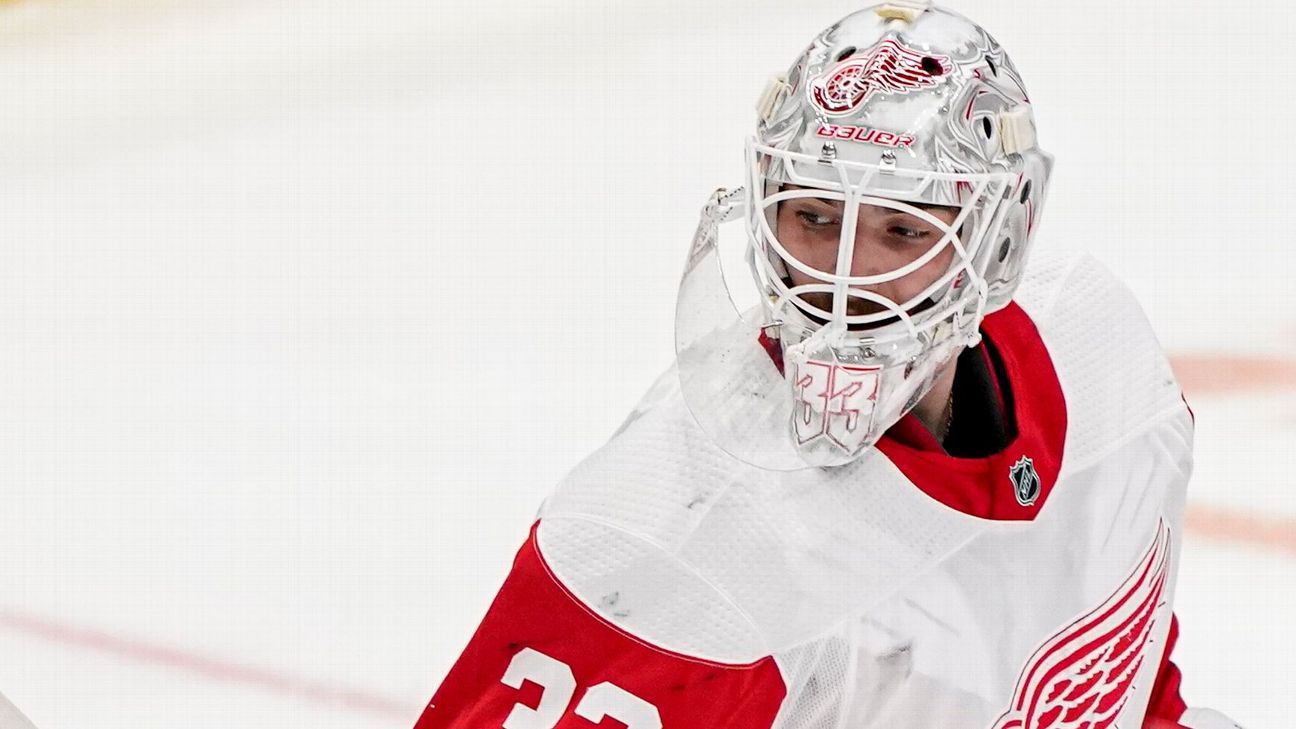
The Detroit Red Wings moved goaltender Sebastian Cossa to the Utah Mammoth on Friday for the 23rd overall pick in the 2026 draft, then immediately deployed that selection on Kamloops Blazers winger JP Hurlbert. On paper, Detroit shed a 23-year-old netminder who posted a 2.33 goals-against average and .915 save percentage across 38 AHL games last season—solid, measurable production. The real story is what the trade exposes: Detroit's front office has decided that prospect-level goaltending depth is worth less than a mid-round NHL asset when the organization has internal alternatives that grade higher.
Trey Augustine, Detroit's second-round pick from 2023, is the mechanism here. The 21-year-old Michigan State product finished his college career with a .929 save percentage—26 basis points better than Cossa's AHL clip—and has already crossed into the professional layer with two regular-season Griffins games under his belt. That's not a massive sample, but it's directional: the Red Wings view Augustine as the higher-ceiling prospect, the one worth protecting organizational capital around. Cossa wasn't blocked; he was revalued downward relative to internal competition. Teams don't trade 15th-overall picks for mid-round selections unless they've made a hard calculation about who projects to stick at the NHL level.
Utah benefits from a simpler calculus. The Mammoth leaned on Karel Vejmelka for 38 games last season (38-20-3, 2.75 GAA, .897 save percentage)—more starts than any goaltender in the league. That volume is not sustainable without injury risk or deterioration. Cossa gives the Mammoth a capable tandem option to bleed minutes and, critically, to give Vejmelka the rest that has become league standard in a post-2025 era where goaltenders across the NHL now share workloads. Vejmelka's .897 save percentage, while adequate for a playoff team, sits below the 50th percentile league-wide; adding a .915 backup compresses that risk.
For bettors, the immediate impact flows through Utah's season totals and game-level props. A fresher Vejmelka—one managing 30-35 starts instead of 38—typically generates a 20-30 basis-point save-percentage lift over a full season. Utah's wins total for 2026-27 was likely built on a Vejmelka workload assumption baked into the preseason line. If the market hasn't adjusted for a genuine tandem deployment, overs on Utah's win total could carry value, but only if you've verified that the opening line incorporated full-volume Vejmelka starts. More durable is watching Utah's goals-against rate: if Cossa sees 15-20 starts and his .915 mark holds, Utah's team GAA could improve by 0.08-0.12 per game depending on split usage. That's a leverage point when live betting Utah games later in the season, when injury exposure forces the Mammoth into heavier reliance on their backup.
Detroit's move is less about replacing Cossa and more about validating Augustine's trajectory. If Augustine emerges as a reliable NHL option in 2026-27, this trade ages cleanly—the 23rd pick becomes a minor cost for clearing organizational clarity. If Augustine flattens in the professional layer, Detroit will wear this as a miss on prospect evaluation, not on the trade itself. The betting angle here is patience: wait to see how Augustine's first full professional season unfolds before piling into Detroit goalie-adjacent plays. The Red Wings' confidence is already baked into how they're spending assets.