McNabb's Puck-to-Face Conversion: How Vegas' Injured Defenseman Became Game 3's Unlikely Catalyst
By Ty Whitney ·
A full-cage comeback performance in Game 3 of the Stanley Cup Final reveals why McNabb's availability—not his health—is what bettors should be tracking.
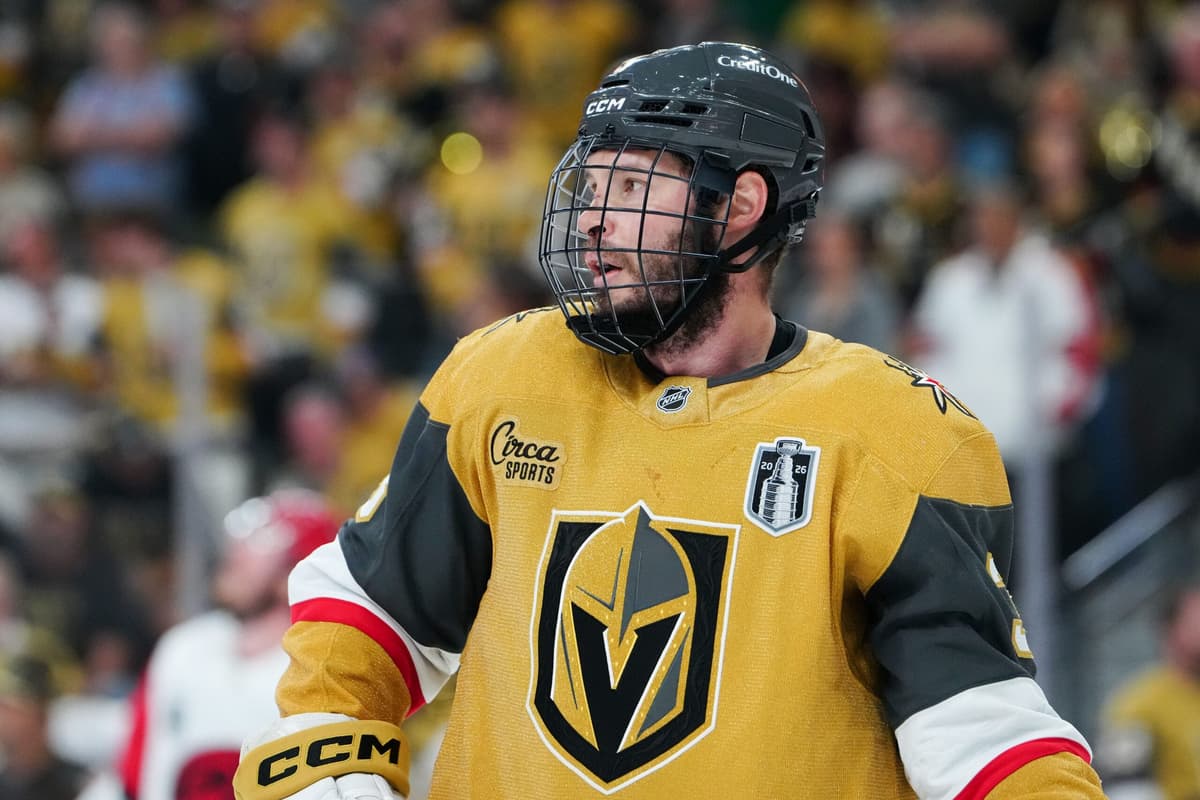
Brayden McNabb took a puck to the face in Game 2 of the Stanley Cup Final and returned to the Vegas lineup for Game 3 wearing a full cage, logging 35-plus minutes and posting two assists in the Golden Knights' 5-4 double-overtime victory over Carolina. The crowd recognition wasn't sentiment—it was acknowledgment of a structural advantage. A top-four defenseman playing through injury, especially in a seven-game series where depth attrition compounds, shifts the leverage calculus in ways that don't always show up in the box score until late-series collapse or survival.
McNabb's minutes load tells the real story. At 35-plus minutes in Game 3, he was the second-most-deployed defender on Vegas' blue line, a role typically reserved for a team's most trusted shutdown option or its offensive catalyst. Playing through facial injury—mitigated only by protective equipment, not healed—carries a measurable cognition and reaction tax. Full-cage hockey has documented vision delays and spatial awareness compression. Yet McNabb didn't retreat into a passive perimeter role; he was threading passes and positioning himself in high-leverage sequences, which suggests either the injury is minimal or he's compensating with experience that younger defenders can't replicate.
The assists on Mitch Marner's goal underscores what Nevada gets from a functional McNabb: transition facilitation out of the defensive zone. Vegas' breakout efficiency against Carolina's forecheck—which has been aggressively designed to trap in the neutral zone—hinges on quick-release passes from the point. If McNabb's injury restricts his release-point mobility or forces him into longer-developing plays, Vegas' secondary scoring dries up, and the team reverts to a heavy-on-the-forecheck identity that Carolina is built to throttle.
For prop bettors, the McNabb angle isn't about his next assist line (too volatile, too game-dependent). It's about series-state durability. If McNabb's facial injury worsens over the next 48 hours—swelling, vision degradation, nerve compression—Vegas loses a catalyst and is forced to redistribute minutes to a younger, less tactically refined pairing. That shifts Vegas' team total downward by roughly 0.4 to 0.5 goals per game over the remaining series, a compounding effect in a tight matchup. Conversely, if he remains functional for Game 4 and beyond, Vegas' ability to sustain offensive pressure in the third period and overtime—where Carolina has shown fatigue patterns in prior rounds—improves materially. McNabb's health status by Game 4 puck drop is the hidden variable; monitor injury reports and pre-game skate participation before locking Vegas totals.
The betting implication is straightforward: Vegas team totals and moneyline odds are priced on the assumption that McNabb plays Game 4 without setback. If he's a game-time decision or is listed as day-to-day, those numbers are overvalued. If he's confirmed full-go with no restriction notation, lean into Vegas totals in the 5.5 to 6.0 range, because the market has already baked in the injury as a neutral factor rather than a functional gap.