Capitals Strip Assets for Future Windows—Betting Markets Must Recalibrate Washington's Depth
By Ty Whitney ·
Washington has dismantled its depth chart ahead of the 2026 draft, trading Lapierre and Chisholm for future picks while holding just 21 contracted players and a rebuilt prospect pool—a roster reset with immediate implications for offensive consistency.
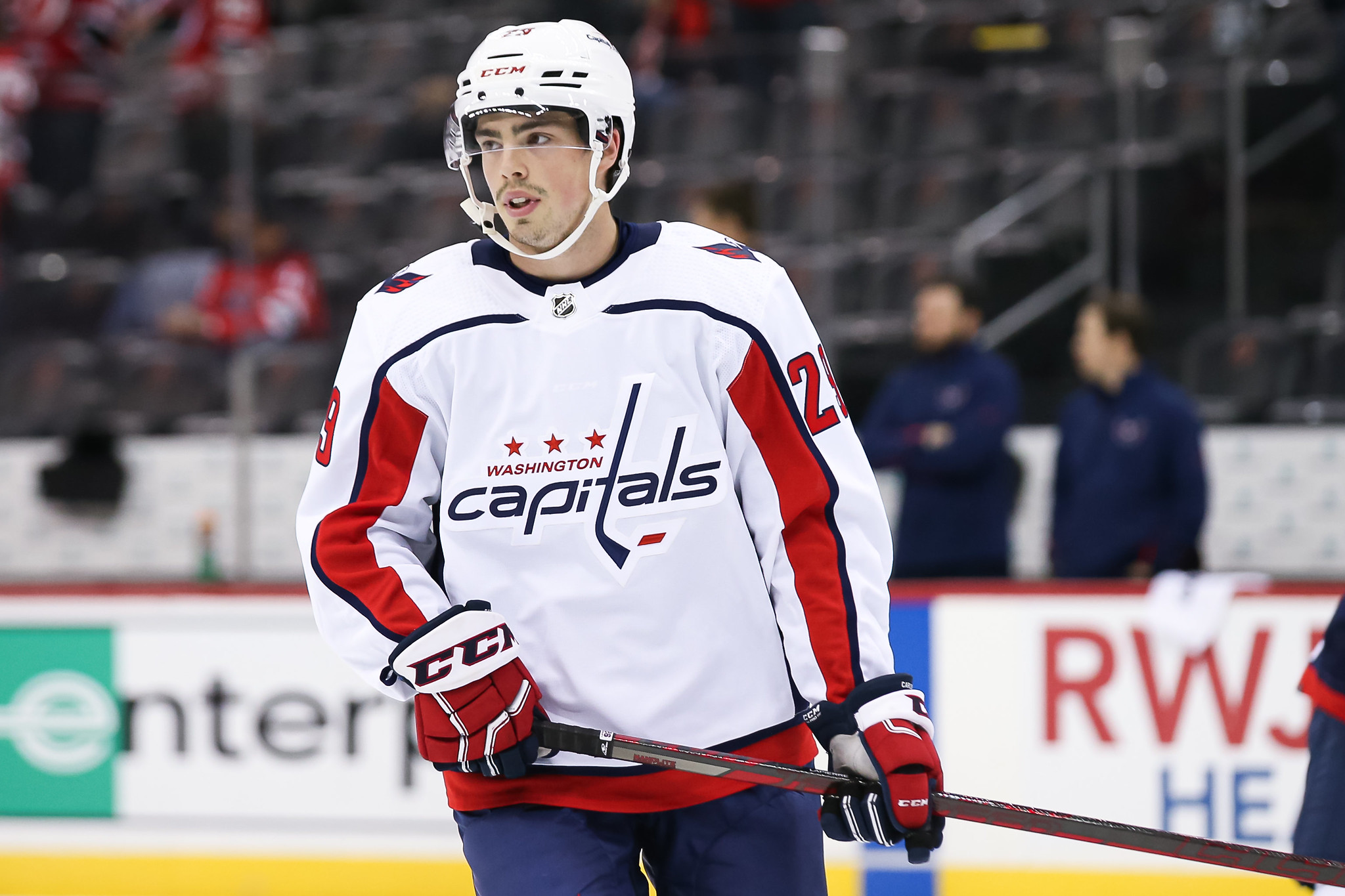
The Washington Capitals executed four trades in 48 hours before the 2026 draft weekend, offloading both Hendrix Lapierre (to Pittsburgh for mid-round picks) and Declan Chisholm (to New Jersey for a 2027 fourth-rounder) while earlier acquiring Jordan Kyrou and Alex Tuch through separate moves. The sequence signals a deliberate pivot: the organization is trading cheap depth for optionality, accepting short-term lineup thinness to preserve cap flexibility and accumulate draft capital in next summer's class. With 21 players already under contract for 2026-27 and $14.3 million in projected cap room (before accounting for Alex Ovechkin's potential return and the 10% offseason cushion), general manager Chris Patrick has effectively reset the roster composition.
Lapierre, a 24-year-old restricted free agent who averaged under nine minutes of ice time per night, represented underutilized salary. His four goals and 16 points in 74 games this season didn't justify the ice-time constraints Spencer Carbery's system imposed, making him a logical candidate for subtraction. Chisholm's one-year, $3.2 million contract and seven points in 26 games presented similarly marginal value—expendable depth masquerading as a roster piece. By converting both into future draft ammunition, Washington isn't losing on-ice production so much as it's exchanging proven mediocrity for upside in a loaded 2027 draft class. The Capitals now hold nine selections in that draft, including four picks in the first three rounds, positioning themselves as potential draft-weekend aggressor.
The roster construction risk becomes immediately visible: Washington enters the 2026-27 season thinner in the middle six, dependent on Kyrou and Tuch to backfill the production Lapierre and Chisholm will no longer deliver. If either of those acquisitions underperforms or sustains injury, the lineup lacks the proven secondary scorers to compensate. This creates a bifurcated offensive profile—top-tier talent through Ovechkin, Kyrou, and Tuch concentrated at the apex, with unproven or limited depth below. Teams with such hierarchical scoring structures tend to post volatile shooting percentages and goal totals, depending heavily on whether the elite trio stays healthy and whether supporting forwards can exploit secondary opportunities at high efficiency rates.
For betting purposes, this roster architecture creates a narrow edge on Washington's season-long team totals and game-by-game goal props. The Capitals will be vulnerable to shooting variance: when Kyrou, Tuch, and Ovechkin are clicking and generating high-danger chances, they'll convert at elevated rates and inflate team totals. But when the supporting cast doesn't execute or those three face defensive attention, the lack of reliable secondary scoring becomes exposed and teams allow more shots while scoring fewer goals. Books will likely price Washington's team total assuming moderate depth contribution; the actual depth may deliver worse-than-market efficiency in the first 20 games while roster cohesion settles. The edge is on fading Capitals overs on team totals in September and October when uncertainty is highest and the depth-dependent variance hasn't yet been priced into adjusted-play numbers. Once we have sample size on Kyrou and Tuch's integration and see which role players emerge as reliable third-line threats, that edge disappears and the line recalibrates.
Meanwhile, Capitals under 3.5 shots on goal for any individual forward not in the Ovechkin/Kyrou/Tuch tier becomes a viable fade for early-season matchups against weak defenses. Limited depth usually correlates with shortened offensive possessions and role-player shot suppression, even in favorable matchups. The lineup's top-heavy construction means fewer opportunities are distributed to fourth-liners and third-pairing defensemen, compressing their volume floors and making under-type props dangerous for books chasing early bets on Washington depth before they've adjusted for the actual composition.