Vancouver's Draft Blueprint Signals Defensive Overhaul—and Nikishin Pursuit Confirms It
By PropBetEdge Editorial Team ·
The Canucks drafted for size and speed, then immediately pivoted toward acquiring an elite young defenseman; the team's offseason direction is now unmistakable.
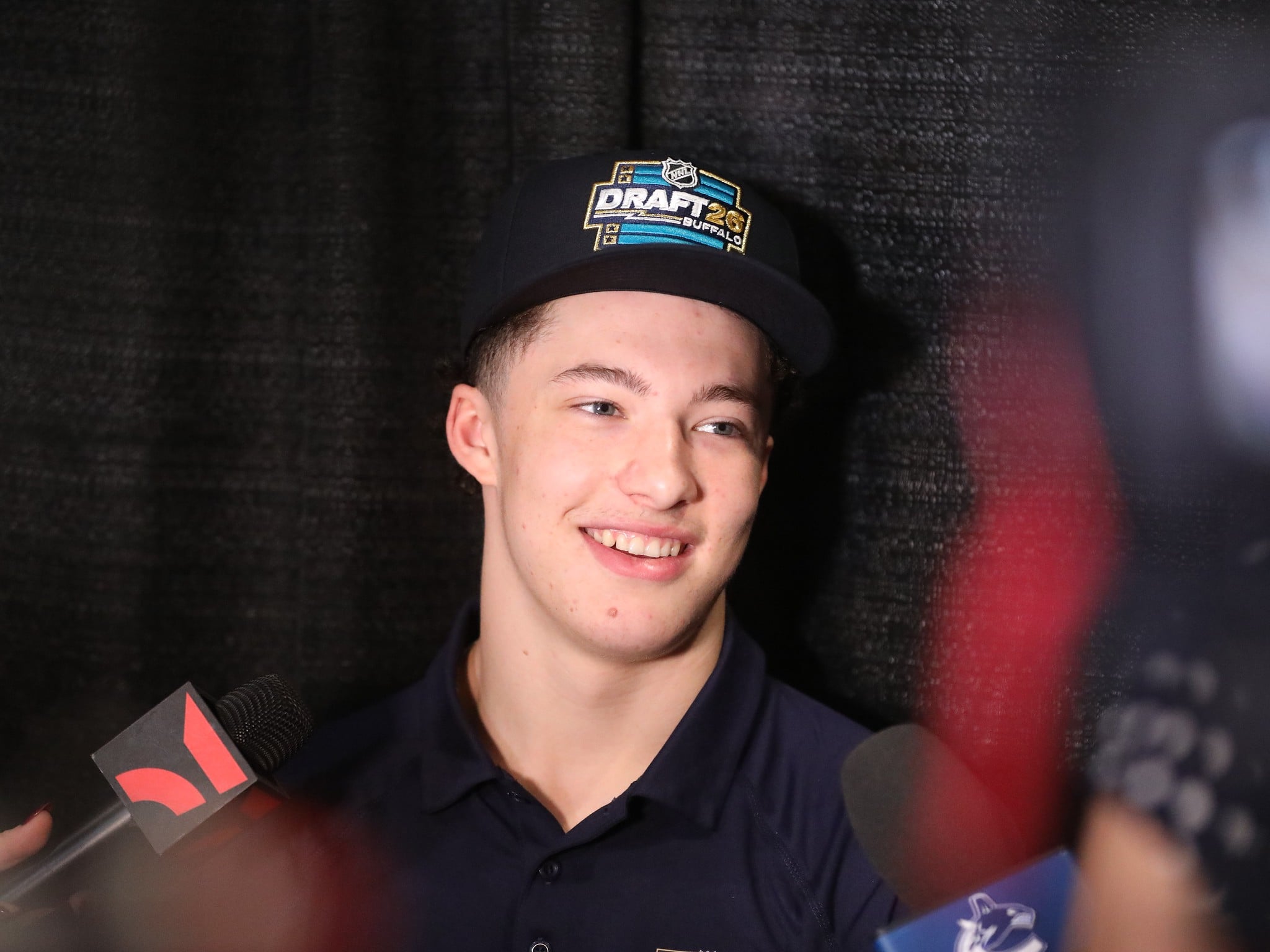
Vancouver's 2026 draft class left no ambiguity about management's intent. Director of amateur scouting Todd Harvey publicly committed to a rebuild architecture centered on "bigger, faster, harder"—and the selections proved it. Five of nine picks measured at least 6-foot-3; five weighed 200 pounds or more. Yet the Canucks didn't sacrifice offensive upside for that frame. Early-round forwards Caleb Malhotra and Adam Novotný paired skill with physicality, while second-day centre Brooks Rogowski added 6-foot-7 of developmental depth. The message was architectural: Vancouver is constructing a prospect pipeline built to compete in a heavy, speed-oriented modern NHL.
That philosophy didn't end at the draft floor. Within hours of the final selections, the organization surfaced as a serious bidder for Carolina defenseman Alexander Nikishin—a 24-year-old blueliner whose profile matches Vancouver's stated blueprint precisely. Nikishin stands 6-foot-3, weighs 218 pounds, and arrives with legitimate pedigree: three seasons as the KHL's highest-scoring defenseman before his NHL arrival. He recorded 11 goals and 33 points in 81 games for the Hurricanes last season, a credible rookie output that underperformed his offensive track record. The fact that Vancouver and at least five other teams are reportedly in pursuit signals that Nikishin's trade price remains accessible—Carolina didn't offer an impenetrable ask.
The Nikishin interest reveals the Canucks' operational calculus. They're not waiting for prospects to develop in a vacuum. Instead, they're layering in proven offensive production from the blue line, a tactical shift that carries immediate implications for team structure. If Vancouver acquires Nikishin, the defensive unit gains a right-side shot-generator capable of 35+ points annually—a foundation piece that accelerates the competitive window. Combined with their draft haul, the organization would be signaling that the prospect phase is accelerating into asset-accumulation mode.
From a betting lens, this dual-track offseason approach affects team total scoring expectations and defensive workload. Nikishin's presence would alter shot volume and assist distribution: a defenseman averaging 11 goals over 81 games doesn't merely contribute points—he changes offensive zone positioning, increases point-shot frequency, and typically elevates line-mate assist rates. Vancouver's road power-play points would rise proportionally. If the team lands Nikishin before the 2026-27 season opener (expected training camp is weeks away), expect team totals to shift upward by 0.5 to 1.0 goals per game compared to pre-acquisition market numbers. The market hasn't yet priced a fully-formed defensive core into Canucks team total overs; a Nikishin signing would force line managers to recalibrate.
The broader architecture matters too. When a team publicly commits to size and speed, then immediately pursues a 6-foot-3 offensive defenseman, that's not noise—it's a front office telling you what their construction priorities are. Early-season unders on Vancouver team totals carry risk if Nikishin wears a Canucks jersey by October; overs, by contrast, gain credibility because the offensive foundation is intentionally being widened. The draft signals intent; the Nikishin pursuit confirms it. Teams that telegraph their build this clearly are typically playing for volume, not defensive grinding.