Slavin's Defensive Collapse Signals Deeper Hurricanes Vulnerability Than Game 1 Scoreline
By Erik Schwartz ·
Carolina's star defenseman was on the ice for four goals in a 6-2 loss to Montreal, exposing a first-period execution gap that extends beyond rust.
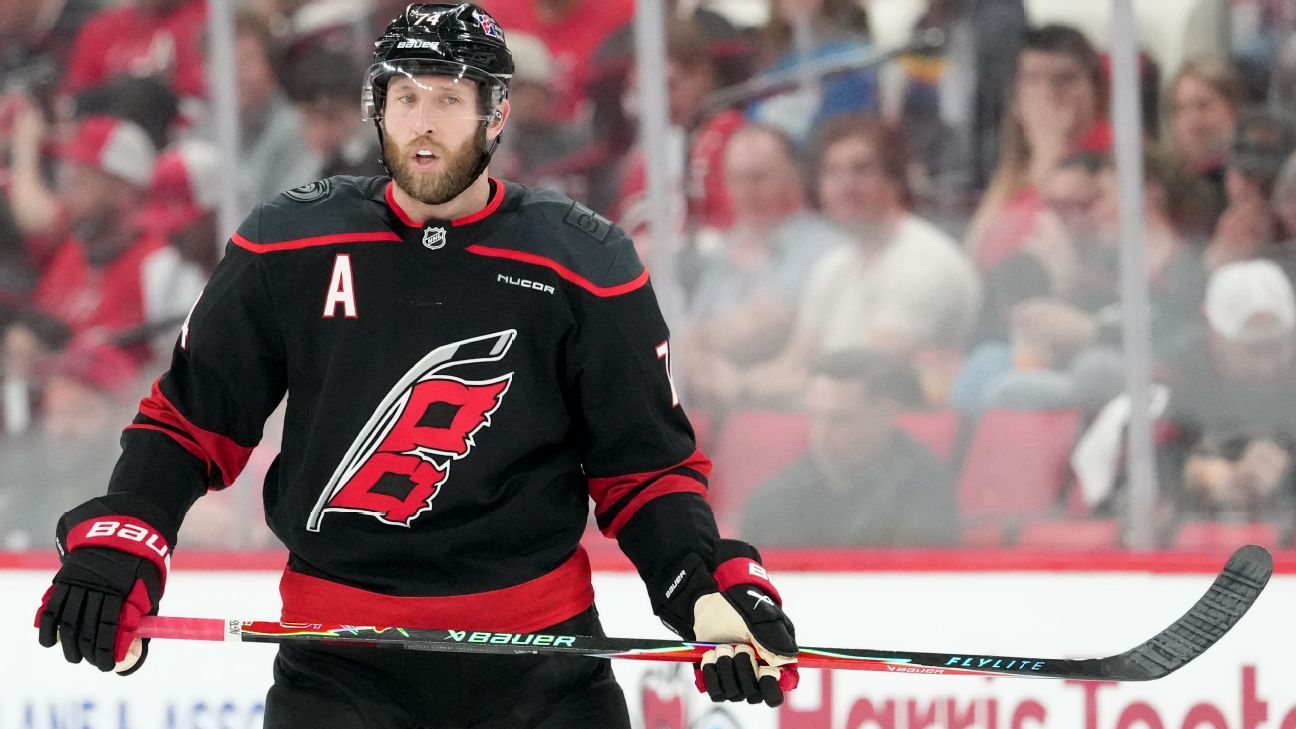
Jaccob Slavin, widely regarded as the NHL's premier defensive defenseman, recorded a minus-4 rating in Game 1 of the Eastern Conference finals—the worst single-game mark in his 95 playoff appearances. Carolina's 6-2 home loss to Montreal wasn't a matter of bad luck or playoff jitters. It was a structural breakdown, and Slavin's presence on the ice for four Montreal goals revealed the Hurricanes' vulnerability to tempo and aggressive puck pursuit.
The first period exposed the seams immediately. Seth Jarvis scored 33 seconds in, but Cole Caufield answered 27 seconds later after Carolina's forwards collapsed toward the puck, leaving him unmarked in front of Frederik Andersen. Phillip Danault's breakaway goal came on the heels of a deflection off Slavin that spring-loaded Montreal's counterattack—not a misread by the defenseman alone, but a symptom of the Hurricanes' reactive positioning. An 11-day layoff between playoff rounds, the longest in the modern era, didn't excuse the pace problem; Rod Brind'Amour and his players acknowledged that their first-period structure simply wasn't match-ready.
What's notable is that Andersen made 16 saves on a night when Montreal fired 26 shots, meaning the Hurricanes' goalie wasn't overextended by volume. Carolina allowed quality looks at consistent rates—Zack Bolduc alone in front, Jake Evans with an open net, Alexandre Texier left unguarded for a one-timer. The defensive assignment lapses weren't isolated to Slavin, but his repeated presence on the ice during Montreal's surge underscores a deeper problem: when the Canadiens pressed high and moved laterally with speed, Carolina's defense became reactive rather than anticipatory.
For prop bettors, this is a critical pattern to track. Slavin's minus-4 is an extreme outlier in his playoff history, but it wasn't driven by 20+ Montreal shots or an Andersen implosion. It reflects decision-making and positioning—specifically, the Hurricanes' vulnerability to teams that attack with horizontal speed and force low-zone pressure. Montreal's depth forwards (Danault, Texier, Evans) generated chances not from sustained pressure but from quick, directional plays that caught Carolina rotating late. If the Canadiens continue this high-tempo approach in Game 2, expect Hurricanes defensemen, including Slavin, to spend more ice time in plus/minus predicaments. Conversely, if Carolina tightens its first-pass assignment discipline and resists overcommitting to the puck, Andersen's save percentage should stabilize and plus/minus variance should narrow. Slavin's minus-4 serves as a ceiling marker for how badly this group can misfire under tempo; betting on his individual performance props or Carolina's team defense metrics in Game 2 requires calibrating for either a sharp correction (more likely) or a repeat collapse (lower probability but possible if Montreal's system doesn't change).