Andersen's save percentage collapse in Finals demands closer analytical scrutiny than coach's faith allows
By PropBetEdge Editorial Team ·
Carolina's goalie has surrendered 12 goals in six playoff games after a dominant opening two rounds, but his coach is banking on fatigue and shot quality rather than a skill regression.
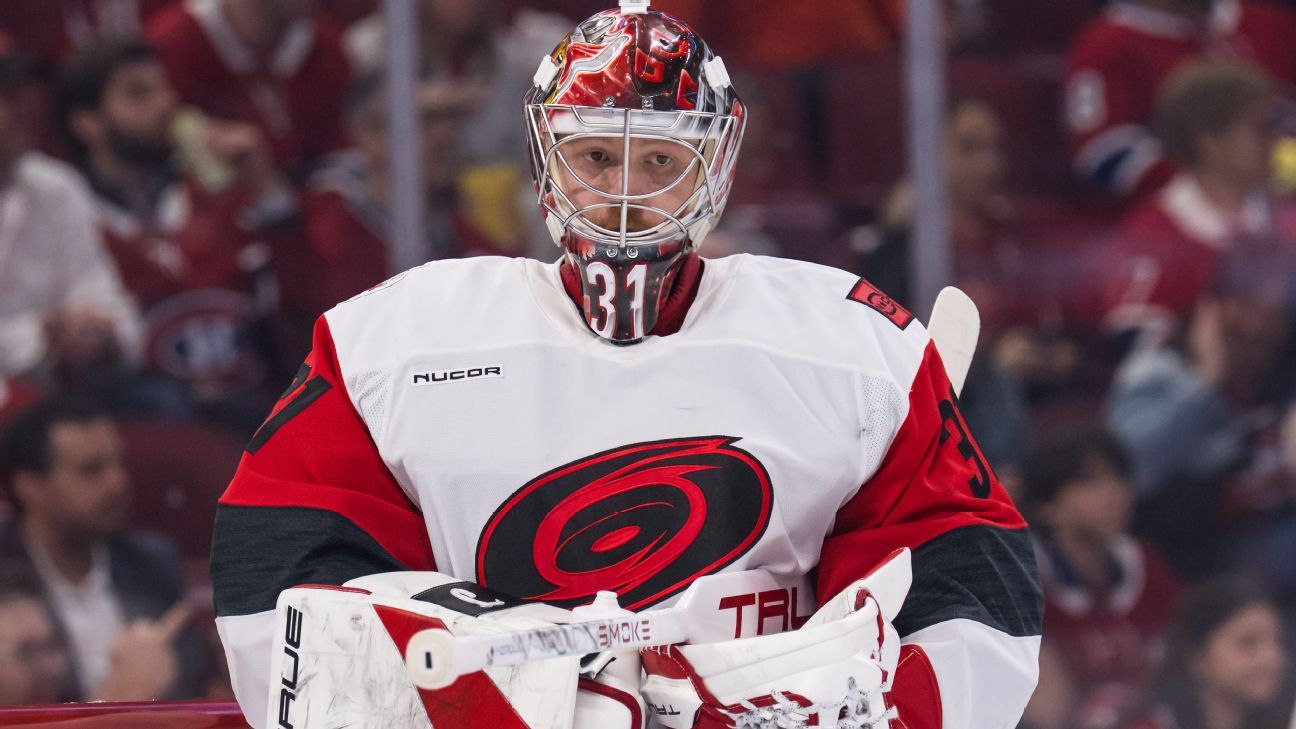
Frederik Andersen allowed five goals on 23 shots in Carolina's Game 1 Stanley Cup Final loss to Vegas on Tuesday, extending a statistical free fall that began in the Eastern Conference Finals. Over the past six games, the 36-year-old has posted a .867 save percentage and 2.33 goals-against average—a stark departure from his .950 save percentage and 1.12 GAA across the first two playoff rounds. Coach Rod Brind'Amour has publicly endorsed Andersen regardless, crediting the Hurricanes' defense rather than any goalie decline. "We don't give up a lot," Brind'Amour said. "There's still quality chances. There's just not a lot of fluff." That framing misses a critical detail: Evolving Hockey data shows Andersen has posted negative goals saved above expected in four of those six games—a metric that isolates individual goalie performance from shot quality and volume.
Andersen's narrative heading into these playoffs featured legitimate advantages. He hasn't been worked to exhaustion; the Hurricanes' early sweeps of Ottawa and Philadelphia meant fewer total starts than a typical playoff opponent might face. Brind'Amour invoked fatigue as a potential factor, not a certainty: "We've been fortunate that he hasn't had to play a ton of games there." That's tactically honest—36-year-old goaltenders don't recover elasticity the way 26-year-olds do. Andersen's track record with Carolina's previous playoff runs includes injury stretches and ineffectiveness that led to benching, so the organization has seen his floor. This is different. This is deterioration mid-series against elite scoring talent, not a mid-game pull.
Vegas' Carter Hart faced similar scrutiny after giving up four goals on 29 shots in Game 1, yet his underlying metrics actually favored him relative to Andersen. John Tortorella's postgame deflection—"He made some key saves at key times"—carried the same defensive coloration as Brind'Amour's shot-quality argument. Both coaches are protecting their net-minders publicly, which is standard operational procedure. The market, however, has already begun pricing in Andersen's volatility. Game 2 pricing reflects uncertainty in Carolina's ability to suppress scoring when their goalie's positioning and rebound control have demonstrably deteriorated.
For bettors, the mechanism is straightforward: Andersen's xGoals-against data shows he's giving up more dangerous looks than his save percentage in the first two rounds would suggest his post-season baseline allows. That's not fatigue noise—that's a shift in either positioning consistency or the types of chances Vegas is generating against Carolina's structure. If Vegas continues to hunt the same slot angles and perimeter rushes that produced five goals on 23 shots, Andersen's game-to-game volatility will remain elevated. The Hurricanes are not expected to make a goalie change before Game 2, meaning the same performer carries forward into a high-leverage situation where his underlying metrics are deeply concerning.
The betting angle hinges on whether you believe Brind'Amour's shot-quality thesis or Evolving Hockey's xGoals framework. Vegas' scoring volume (4 goals on 29 shots) actually sits below their expected output, suggesting the Golden Knights underperformed their own offensive generation. If that efficiency improves while Andersen continues to post sub-.900 save percentages against quality chances, Carolina's goal-line defense becomes genuinely fragile. Team totals and over/under pricing already incorporate some nervousness about Andersen's recent form, but the gap between public perception ("he's tired" or "shots were quality") and analytical reality ("he's saving fewer high-danger looks") is where the edge exists.