Andersen's Eight-Game Sample Masks a Larger Reality: Why Dobes Presents Value in Round 3
By Erik Schwartz ·
Frederik Andersen's .950 save percentage in the playoffs is a mirage built on limited exposure; Jakub Dobes has faced triple the volume and remains the more reliable backstop when variance normalizes.
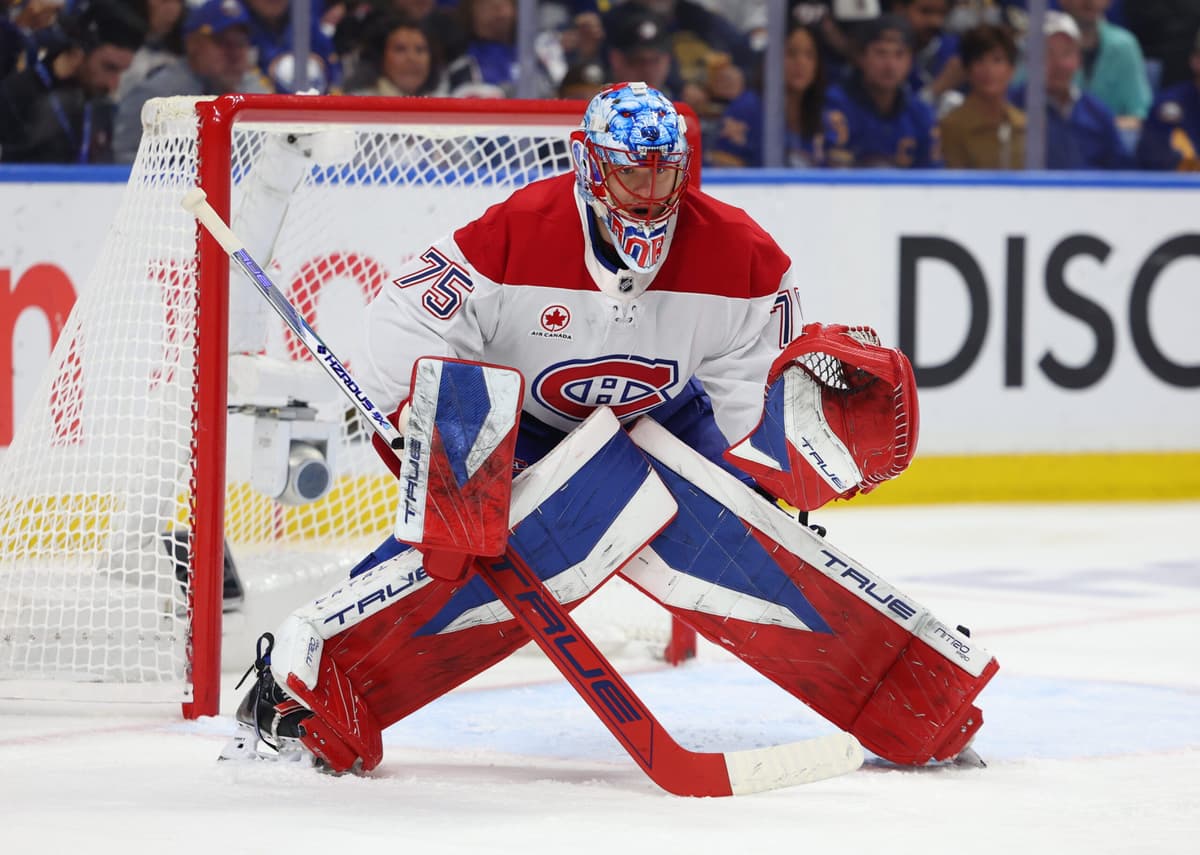
The East Final goaltending debate feels settled on paper: Frederik Andersen has posted a .950 save percentage across eight playoff games, a number that would rank among the best postseason performances in decades. Jakub Dobes, by contrast, sits at .901 over 14 playoff appearances. The visual gap is stark enough that most analysis stops there. But sample size and context matter more than single-digit playoff game counts, and they tell a different story about which crease carries real stability heading into Round 3.
Andersen's eight-game heater is genuine—he has not surrendered to variance over that stretch. The problem is that eight games is functionally one playoff series, and a single hot series proves almost nothing about a goaltender's long-term reliability, especially for a 36-year-old who entered the playoffs with a .874 save percentage over 35 regular-season games. His 5v5 GSAx of 10.87 suggests Carolina's defense has been excellent in his starts, but it also masks how much of his performance owes to team play rather than independent goaltending excellence. Dobes, meanwhile, has authored a .901 mark over 14 games—roughly 1.75 times the sample—with a 5v5 GSAx of 9.39. The key difference: Dobes achieved that consistency despite Montreal's defense being measurably weaker than Carolina's.
The mechanics of this matchup favor Dobes in ways the surface stats obscure. Andersen benefits from a Hurricanes team that controls play and limits high-danger chances; his opponents have fewer quality looks, so even modest goaltending appears elite. Dobes, conversely, has faced higher volumes of dangerous scoring chances—the negative 0.73 GSAx in his 25-game regular-season sample reveals he plays behind a less-structured defensive system—yet his playoff performance (9.39 GSAx over 14 games) represents a significant improvement under pressure. That improvement suggests he elevates when stakes rise, a trait that doesn't show up in year-to-date numbers but becomes visible in playoff ramps. Andersen's eight-game streak, by contrast, could reverse within a single series. Carolina has struggled in Conference Finals historically; if the Hurricanes' defensive structure breaks down against Montreal's forecheck, Andersen will face the kind of volume he hasn't encountered in his playoff run, and his true talent line—closer to .900 than .950—will reassert itself.
For prop bettors, the implications are concrete. If Andersen is priced as an elite playoff goaltender based on his eight-game sample, that's overcorrection. His save percentage line, if offered at 0.915 or higher for the series, carries fade value; the market has extrapolated a small sample into a sustained performance level that his career data and regular-season form don't support. Dobes, if available at 0.900 or lower for the series, offers countervailing value. His ability to post a .910 mark over 14 games while facing more volume and playing behind looser defense suggests his true talent is north of what an .901 playoff average implies. The Canadiens' path to the Cup runs through goaltending outperformance—if Dobes reaches .905+ while Andersen regresses toward .905-, Montreal's defense can steal a series.
The market will likely price Andersen's eight-game streak as signal, not variance. That's the edge.