Blackhawks Add Depth on Opening Day: Boucher and Mylymok Sign Two-Way Deals
By Erik Schwartz ·
Chicago's free-agency opening move signals a continued investment in physical play and organizational depth, but neither signing moves the needle on win-now contention.
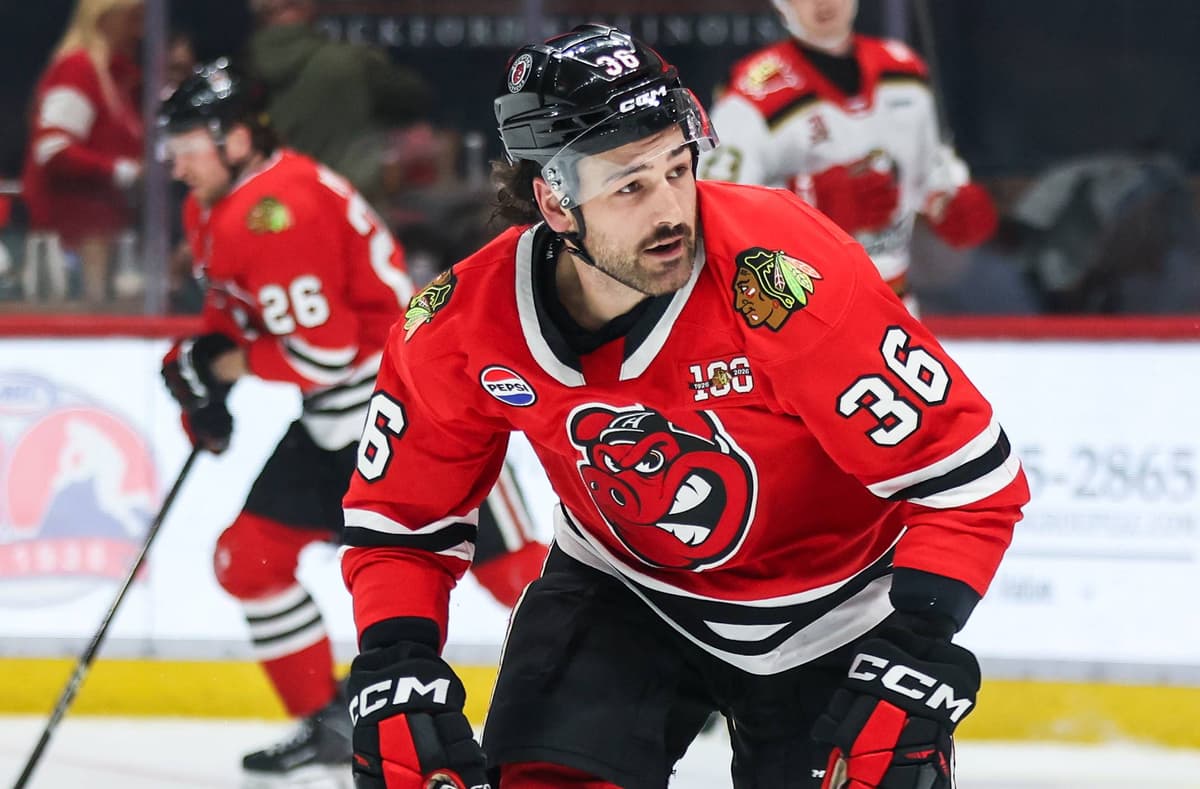
The Chicago Blackhawks opened the NHL free-agency period by signing forwards Dillon Boucher and Connor Mylymok to one-year, two-way contracts, each carrying an $850,000 cap hit. Both players spent the 2025-26 season with the Rockford IceHogs, Chicago's AHL affiliate, where they logged heavy minutes in a losing season that finished last in the Central Division and missed the Calder Cup Playoffs.
Mylymok, in his second full professional season, compiled 10 points in 52 games while racking up 204 penalty minutes—third-most in the AHL and anchored by five fighting majors. The Niagara University product has cycle-tested his game across three professional tiers: 14 goals and 26 points in 51 ECHL games with Rapid City and Calgary's ECHL affiliate, then 3 goals and 10 points across 60 AHL contests. Boucher, a Dalhousie product making his professional debut after two-plus seasons in the ECHL with Wichita, appeared in 53 AHL games as a rookie, producing 3 goals and 8 points while accumulating 114 penalty minutes. Both players profile as organizational depth and physical presence rather than impact scorers.
From a roster-construction standpoint, the signings reveal Chicago's continued emphasis on organizational depth and penalty-minute accumulation—a notable priority for a franchise rebuilding around Corey Kane's younger core. Neither Boucher nor Mylymok projects as an NHL regular based on their scoring production, and both are likely to spend significant time shuttling between Rockford and Chicago. The two-way structure means they'll operate at AHL salary floors during any Rockford assignment, preserving NHL cap flexibility as the offseason progresses.
The betting implications are minimal at the macro level. Chicago's team total will be set based on projected lineup composition and recent performance trends, not on marginal depth signings in July. However, the signing does reinforce a structural truth: the Blackhawks are building a young, physical roster with considerable organizational depth. If either player earns substantial NHL ice time—a scenario dependent on injuries or unexpected performance—their penalty-minute propensity becomes a secondary consideration in game-specific leverage situations. Currently, neither player carries enough expected ice time to warrant individual prop attention. Monitor their early preseason performance; if either emerges as a fourth-line regular, their hits and blocked-shot volume could become relevant in specific game environments where Chicago leans heavily on physical depth play.