MacKinnon's Injury Status Reframes a Vegas Sweep: Colorado's Offense Faces Elimination Without Its Catalyst
By Ty Whitney ·
Nathan MacKinnon's right-knee injury after Game 3 transforms Tuesday night from a series clincher into a dependency question—and the betting market hasn't fully repriced Colorado's scoring ceiling without him.
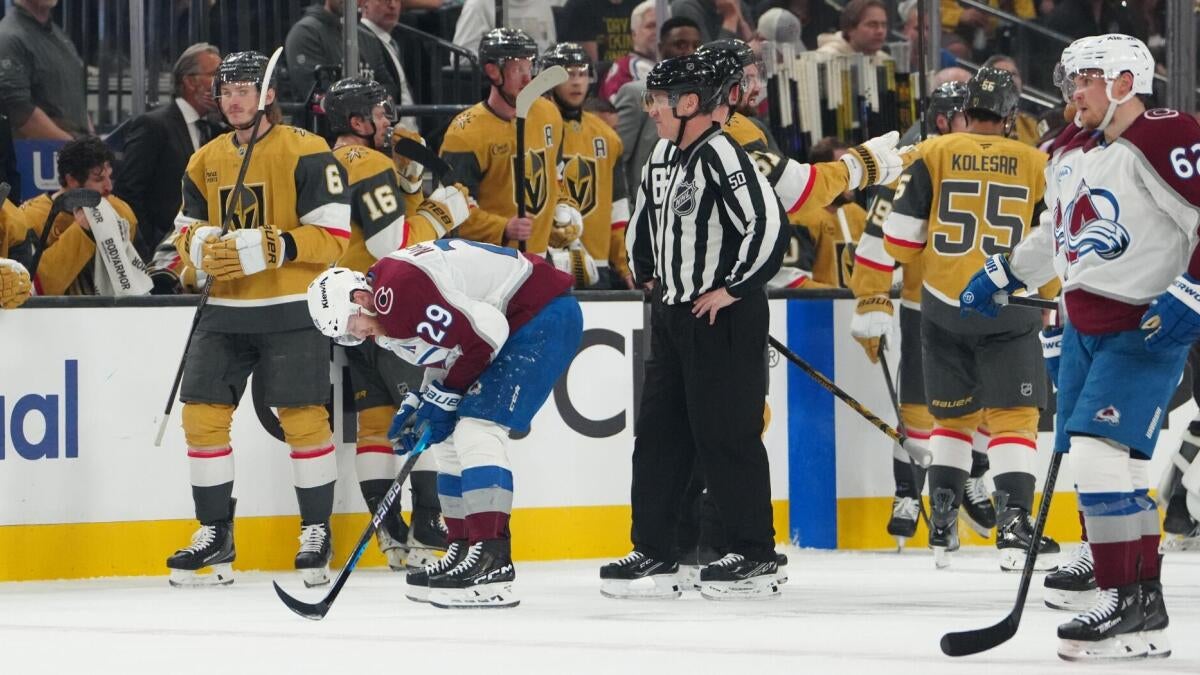
Colorado's West Final collapse accelerated Sunday with a 5-3 loss that put the Presidents' Trophy winners one game from a sweep at the hands of John Tortorella's Vegas squad. The Avalanche have managed just six goals through three games—a stark drop from their first-round output—and that offensive drought has now been complicated by MacKinnon's apparent knee injury suffered while blocking a shot in the third period. He finished with only four shifts after the injury, visibly favoring his right leg, and his status for Game 4 remains uncertain.
MacKinnon is the fulcrum of Colorado's attack. He led the NHL with 53 regular-season goals and carries seven playoff goals and 15 points into this series, trailing only in-team scoring behind the team total. His 14 career points in elimination games rank third in franchise history—he's the player Vegas must account for when desperation forces the Avalanche to attack. The injury timing compounds Colorado's problem: they've been outmanufactured, not just outplayed. Cale Makar returned from his own injury for Game 3 and delivered 27:14 of ice time with three shots and six blocked shots but zero points. Scott Wedgewood surrendered five goals on 22 shots, unable to hold a 3-0 second-period advantage that Colorado had parlayed into a 49-game winning streak over the past two seasons when holding three-goal leads. Vegas, meanwhile, has now recorded five playoff comeback victories and entered the series having trailed 1,966 minutes during the regular season—second-most in the league. This team doesn't panic behind. Mark Stone's return Sunday (goal, assist on the power play 19 seconds into the second period) gave the Knights a captain-level stabilizer at exactly the moment Colorado's depth began fracturing.
The betting market has treated Vegas' 3-0 lead with appropriate weight: teams leading 3-0 before the Stanley Cup Final are 49-0 historically, 13-0 when starting on the road. But the MacKinnon injury status creates a mechanical divergence between Vegas' win probability (already priced as a near-lock) and Colorado's scoring probability. If MacKinnon is unavailable or significantly limited Tuesday, his anytime-goal odds (currently -125, implying a 55% win probability) should compress sharply—yet that specific prop may not have repriced quickly enough if the injury designation came late in the night or wasn't flagged as a long-term question until Tuesday's morning skate.
The operational lever here is Colorado's power-play dependency. Without MacKinnon at full strength running the half-wall in the Avalanche's primary man-advantage look, the penalty-unit architecture weakens. Vegas killed 85% of power-play attempts in the regular season and has allowed only one power-play goal in seven playoff games through the second round. If MacKinnon is hobbled or absent, Colorado's 0-for-12 power play in this series becomes less a small-sample variance problem and more a structural limitation. Their five-on-five goal generation has already cratered. That's where the unders on Colorado team totals (currently 1.5-2.0 depending on the book) gain edge: the mechanism isn't that Colorado is tired or demoralized—it's that their primary shot-creation catalyst may be physically compromised, and Vegas' goaltending tandem (Wedgewood/Blackwood, Jennings Trophy winners in the regular season) has already shown it can handle elimination pressure.
The real angle is conditional: if MacKinnon's status is confirmed as questionable or limited, immediately target Colorado team-total unders and MacKinnon anytime-goal unders (or lay the -125 if you're at a book offering action on that side). The market has priced Vegas' series win correctly but hasn't fully repriced the mechanism of that win shifting from goaltending dominance to offensive neutralization. One-game angles fade quickly when a star gets injured late—the opening numbers may hold Vegas moneyline unchanged while individual prop markets overshoot in both directions. That's where the split opens.