Karlsson's Absence Exposed Vegas' Depth Limit in Cup Final Loss
By Ty Whitney ·
The Golden Knights' championship run ended not in a single collapse but in a slow depletion of roster depth—and the injury that accelerated it offers a clear blueprint for how to neutralize Vegas' offense.
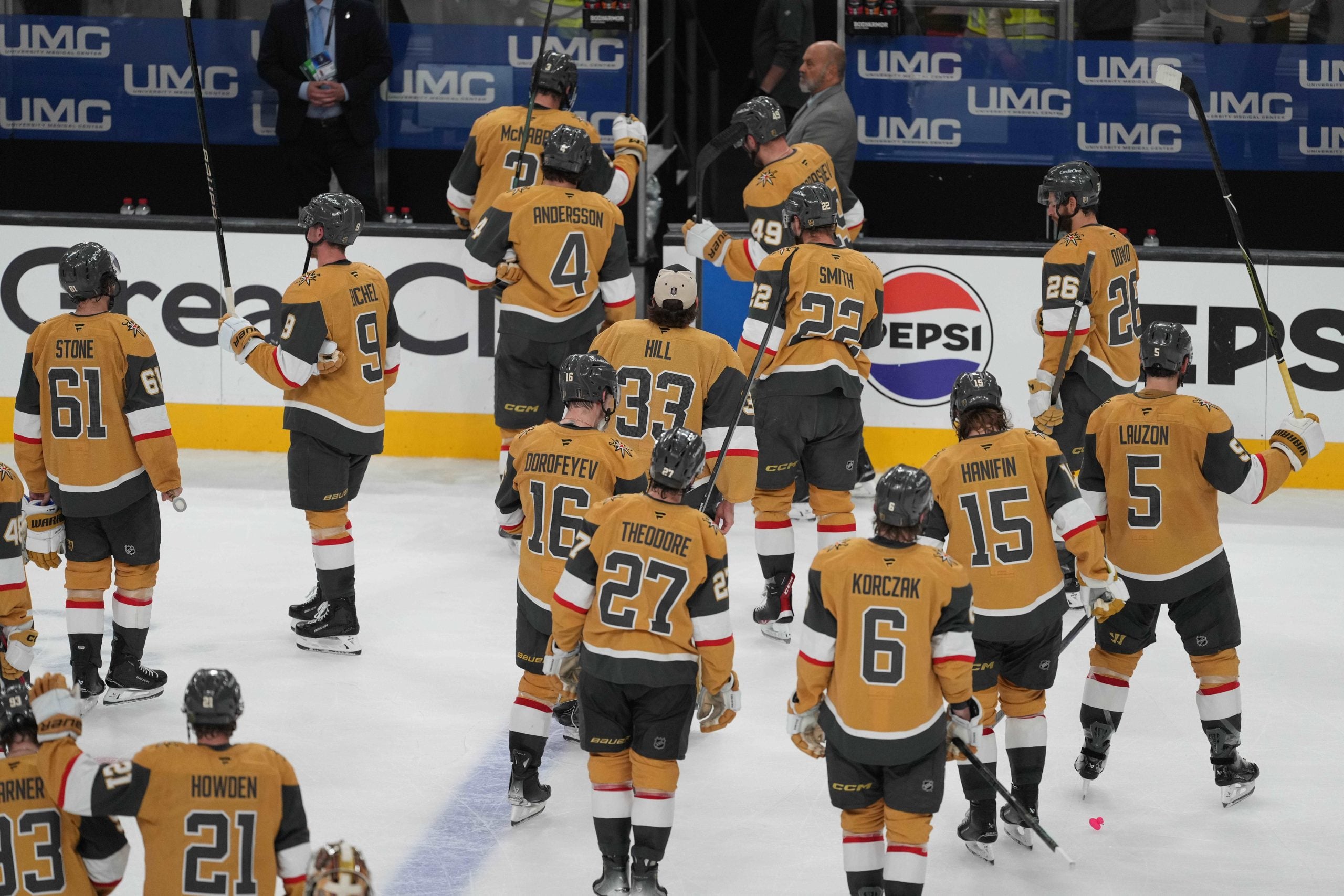
The Vegas Golden Knights lost Game 6 of the Stanley Cup Final 3-0 to the Carolina Hurricanes on Sunday, surrendering the series 4-2 and closing out a season that began with legitimate championship texture but ended in offensive suffocation. Carter Hart made 20 saves on 22 shots; the Hurricanes' Taylor Hall, Jackson Blake, and Nikolaj Ehlers scored into a void. Vegas' offense managed only 22 shots and zero goals—the fifth shutout Vegas endured all season, but the first in the postseason until this series-clinching moment.
What appears at first glance as a Finals collapse was actually a cascade fault line that began earlier in the series. Vegas' 5-4 double-overtime victory in Game 3—a win that required the Hurricanes to blow a 4-0 lead before Vegas won 25:38 into the second extra period—extracted a tax the team couldn't repay. The Hurricanes controlled much of the first overtime; Vegas survived on grit and luck, not dominance. From Game 4 onward, Carolina played with momentum and structure while Vegas ran through increasingly thin offensive combinations. In Game 4, down 2-0 early, Vegas clawed back to tie 3-3 before losing 5-3. Game 5 saw Pavel Dorofeyev score first for Vegas, but the Hurricanes answered five minutes later and never trailed again. By Game 6, Vegas arrived at the arena needing to score first against a team holding a 3-2 series lead and all the psychological leverage. The Hurricanes scored early and Vegas, now desperate, played without precision.
The critical variable wasn't Game 6 itself—it was the absence of William Karlsson, Vegas' second-line center, whose injury gutted the team's depth structure at exactly the moment the Finals required it most. When Karlsson entered the lineup healthy in Round 2, he'd formed an immediate and explosive chemistry with Brett Howden and Mitch Marner, transforming what had been a vulnerable Vegas depth chart into a three-line scoring threat. In Games 4 and 5, the top four forwards (Dorofeyev, Karlsson, Theodore, and Eichel) combined for eight points; Dorofeyev and Karlsson alone produced three goals. Without Karlsson, Howden—a natural center miscast as a winger—centered a line with Ivan Barbashev and Marner that never found footing. The Hurricanes' defensive system is built to suffocate opposing depth; they thrive against teams forced to rely on top-heavy scoring. Remove one blue-chip forward and the entire ecosystem collapses.
For bettors, this sequence carries a specific implication: Vegas' offensive ceiling in future playoff runs will remain artificially depressed until roster construction addresses depth scoring at the center position. Karlsson proved to be not just a productive player but an organizational lynchpin—his absence didn't cost Vegas one game, it cost them the Finals because it eliminated the margin for error that a championship team needs against a defensively elite opponent like Carolina. Any future matchup involving Vegas as a favorites or over/under plays will need to account for whether Karlsson is available and healthy. His presence turns Vegas into a multi-line threat; his absence turns them into a single-elimination offense waiting for the opponent to execute. The Hurricanes found that blueprint and exploited it ruthlessly.
Looking ahead to next season, Vegas will face hard decisions about roster construction. Howden proved capable in a complementary role but was underpowered when forced into a top-nine centerpiece. That organizational reality will shape how Vegas' odds move in the offseason market and how their total goals, team offensive props, and series lines are priced. The 2025-26 Finals didn't reveal a lack of talent in Vegas—it revealed a structural vulnerability that depth can't mask when it's depleted.