Bucs Receiver Room Fragments Without Evans; Hurst's Ceiling Matters for Tampa's Air Attacks
By PropBetEdge Editorial Team ·
Ted Hurst arrives as a physical outlier, but the Buccaneers' passing-game architecture shifts so dramatically that early-season receiving props demand repositioning against past Evans-era benchmarks.
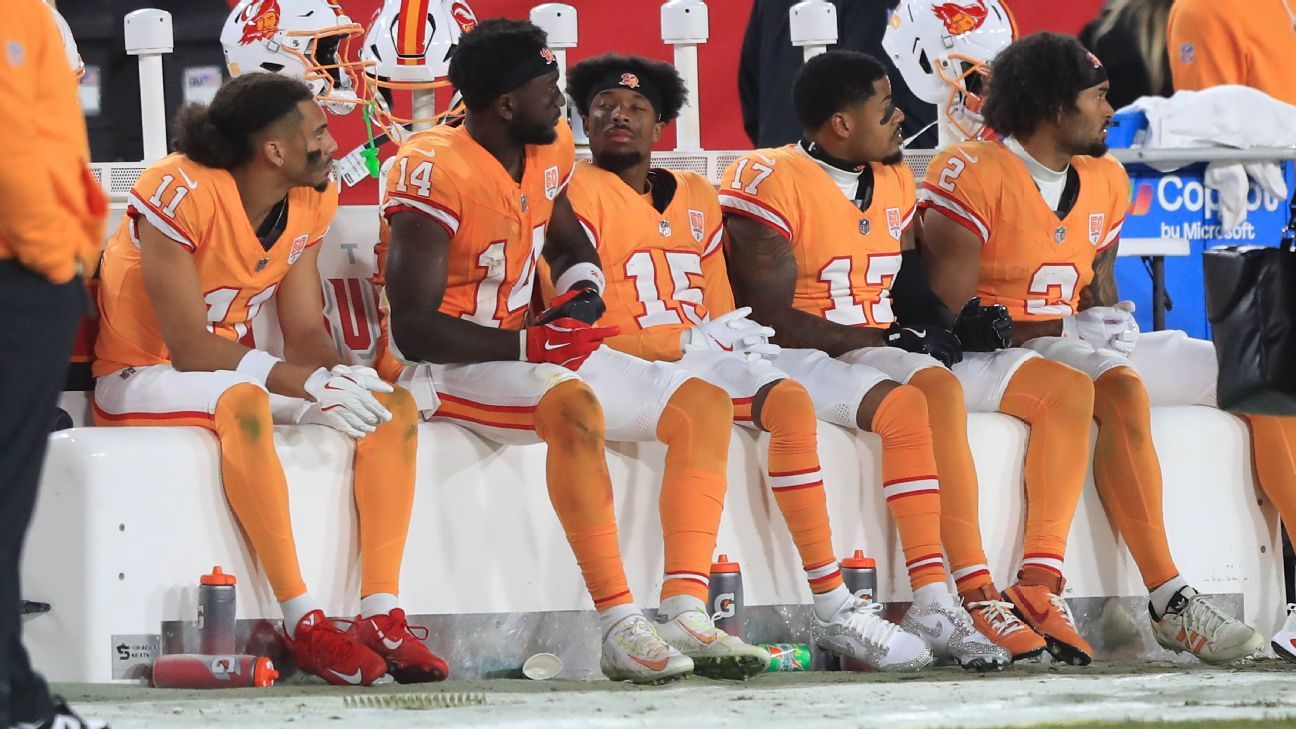
Mike Evans is gone, and the Tampa Bay Buccaneers' passing game is no longer built around a single gravitational force. New offensive coordinator Zac Robinson has inherited a receiving corps fractured by role—Emeka Egbuka moving to the "Z" spot off the line, Chris Godwin Jr. anchored in the slot, Jalen McMillan still nursing physicality concerns, and Tez Johnson limited by his 5-foot-10 frame. Into this repositioning lands Ted Hurst, a third-round pick whose 6-4, 206-pound frame and 4.42 forty-yard-dash time represent the rare combination of size, speed, and catch-radius that the Bucs lacked once Evans departed. Robinson has been explicit: Hurst is the closest thing the offense now has to a true "X" receiver—the boundary role Evans occupied for over a decade.
Evans accounted for nearly 29% of Tampa's air-attack scoring since 2014, a gravitational pull that no single successor will replicate. Robinson knows this. What matters instead is how the Buccaneers compress that production across multiple alignments. Godwin finished last season with 50 catches in just seven games before a dislocated ankle sidelined him; his efficiency in the slot suggests Robinson will lean on motion and free releases rather than line-of-scrimmage battles. Egbuka, thrust into significant snaps last season when Evans and Godwin both were out, has already demonstrated the versatility to shift between outside and slot. McMillan, still adding strength, operates best in motion and from cleaner release points. Hurst enters with a skill profile Robinson explicitly likes—instinctual, smart, great hands—but also carries the classic rookie-to-target-share lag. The Bucs will not hand him 120+ targets immediately.
For bettors, this matters acutely. Season-long receiving totals for Tampa's top three wideouts will not simply scale down from Evans-era baselines; they will redistribute. Godwin's slot role makes him the safest early target for steady catch volume—his seven-game 50-catch pace last year translates to 114 over a full season, a floor the Buccaneers are likely built around. Egbuka's role as a "Z" specialist suggests he'll inhabit the intermediate route tree at higher frequency than the deep vertical work Evans ran. Hurst's path to consistent targets is steepest because Robinson is bringing him along intentionally, not forcing him into an impossible Evans-replacement narrative. Early-season unders on Egbuka and McMillan props could carry value as the market overweights past target-competition models. By mid-season, once snap counts stabilize and the new route hierarchy settles, that edge will evaporate.
The passing volume question itself is crucial. Tampa's offense was designed to move Evans in space and let him operate on the perimeter; that offense no longer exists. Robinson's system emphasizes interchangeability and motion, which typically requires more attempts to generate the same scoring output—a structural headwind for team passing totals and individual receiving props that assume late-season efficiency. Quarterbacks (Baker Mayfield, if healthy, or a backup) will need to operate a more complex read tree with receivers flowing across formation. If Mayfield carries injury concerns into the season, those passing volume props tighten further. The Bucs are not going to lose explosiveness entirely—Hurst's athleticism and Godwin's production cap suggest they will remain a mid-tier passing offense—but the path to top-10 passing efficiency is narrower than it was when Evans could win leverage on sheer physical dominance.
For week-to-week prop construction, the immediate play is patience. Early-season Bucs receiving lines—Egbuka, McMillan, Godwin, Hurst—will not yet reflect the true target-share distribution. Robinson said Hurst requires "a long way to go," and rookie receiving props that assume full deployment are overbought. Conversely, Godwin's slot-specialist role is established, and if his ankle heals cleanly, his catch totals could run higher than the market prices, especially if oddsmakers anchor on his games-played discount. That's the durable edge: the offense is reshaped, but Godwin's role within it is not experimental. Everyone else—including Hurst—carries development variance that will price out quickly once snap counts clarify.