Vikings Front Office Clarity: Teasley Has the Pen, But O'Connell and Brzezinski Hold Real Leverage
By PropBetEdge Editorial Team ·
Minnesota's new GM structure sounds clean on paper—but organizational decision-making in Minnesota has never worked that way, and roster construction uncertainty could ripple through player usage and game-script predictability.
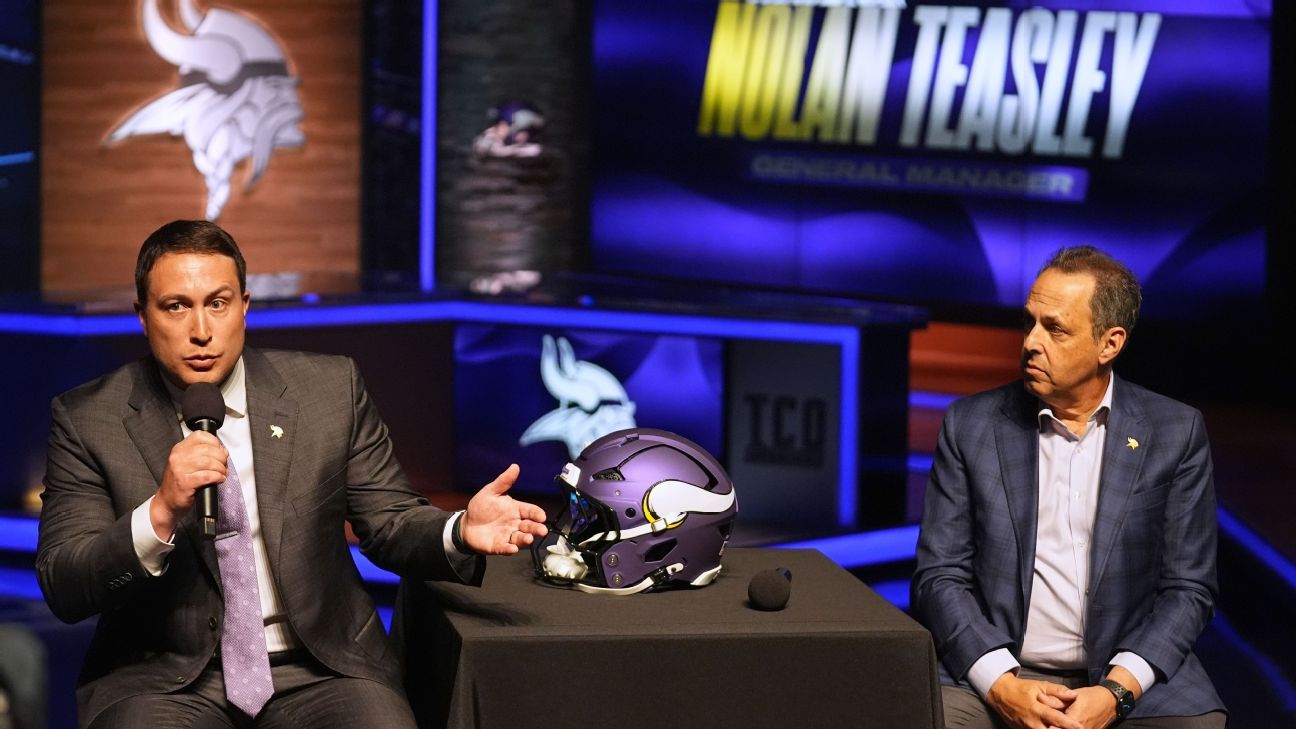
The Minnesota Vikings introduced Nolan Teasley as general manager on Wednesday, and owner Mark Wilf made a straightforward pronouncement: Teasley has final say on the 53-man roster. Both Teasley and coach Kevin O'Connell report directly to ownership. Rob Brzezinski, the longtime contract negotiator and interim GM for four months this spring, now answers to Teasley. Clean lines. Clear accountability. In theory.
The problem isn't what Wilf said—it's what he left implicit. Wilf acknowledged that Teasley will "lean heavily" on O'Connell and Brzezinski, and that multiple leaders must "collaborate" and "work together." That language reveals the actual operating system: consensus-building under the threat of ownership override. In an organization where the Wilfs have cycled through regime changes and power redistributions for over two decades, the structural clarity is really a pressure valve. It buys time. Teasley gets the roster title; O'Connell retains his seat at the table and his ear with the coach-adjacent players; Brzezinski keeps his institutional memory and cap leverage. No one fully loses, which means no one is fully empowered either.
For bettors, this matters because ambiguous authority structures produce inconsistent decision-making—particularly in-game and in-week. When a head coach and GM have proven friction or unclear boundaries, you see oscillation in game-script adherence, personnel deployment in crucial moments, and risk tolerance on fourth-down and two-minute decisions. Teasley's hiring came after four months of Brzezinski's interim tenure, which itself followed the Kwity Paye departure and other front-office turnover. The Vikings are now managing three leaders with overlapping spheres instead of one. That governance tax shows up in execution variance. A team confident in its chain of command runs crisp two-minute drills and deploys personnel with surgical intent. A team still negotiating its power structure does not.
O'Connell's track record suggests he'll push back on roster construction that doesn't match his offensive architecture. The Vikings' passing volume and red-zone efficiency will hinge partly on whether Teasley and O'Connell align on wide receiver investment and offensive line continuity—decisions Teasley nominally makes but practically negotiates. If that negotiation extends into camp and the season, you should expect elevated variance in Kevin-centric props like pass-attempt distribution and target allocation. Similarly, if Brzezinski's cap expertise leads to roster corners Teasley didn't prefer, the team's late-season flexibility and injury-replacement quality will suffer, which shows up in team-total unders in December.
The prop takeaway is straightforward: avoid high-conviction bets on Vikings player efficiency, target share, and snap-count stability until Week 2 or 3, when the on-field hierarchy settles. The announced org chart masks operational friction, and that friction tends to resolve via production variance in the first month. Wait for the smoke to clear before anchoring on Vikings offensive props.