Ben Johnson's Bears Receivers: Why Loveland Is the Safest Leverage, Burden the Volatility Play
By PropBetEdge Editorial Team ·
Chicago's three-headed receiving corps carries wildly different risk profiles heading into 2026, and draft positioning reveals where the real edge lies.
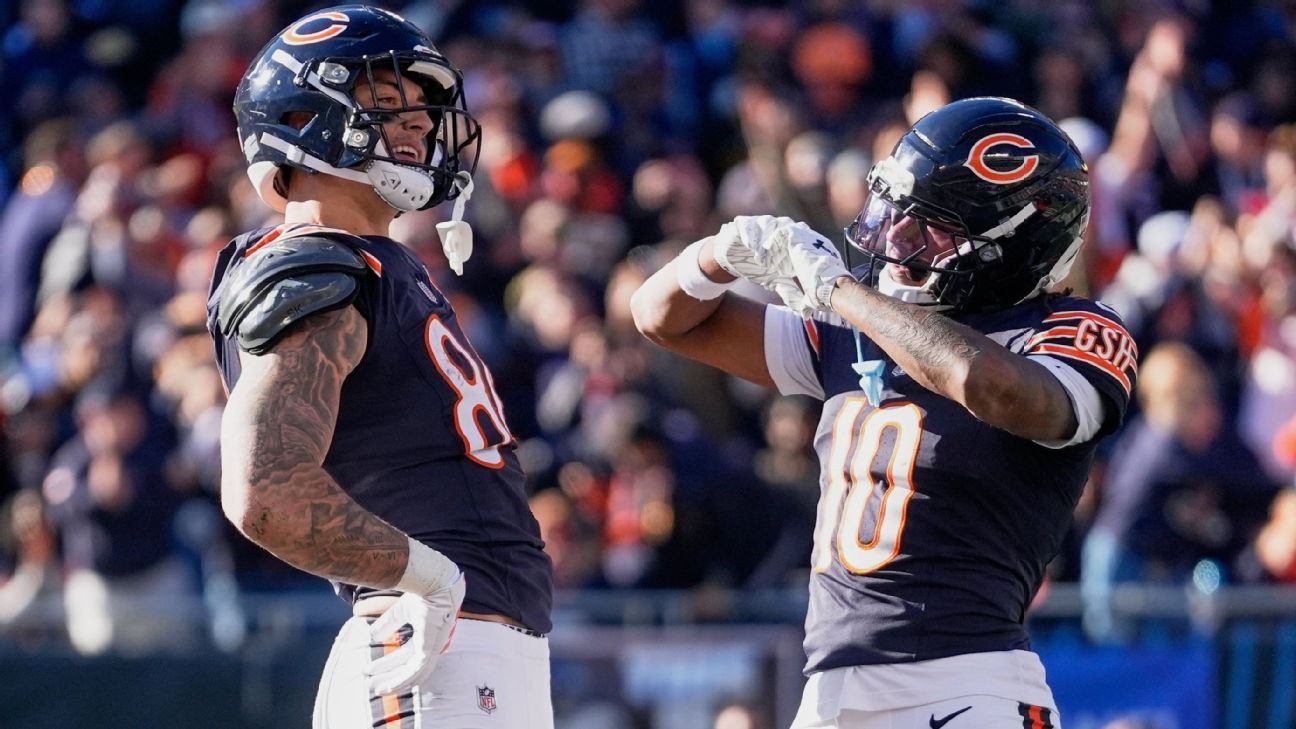
Ben Johnson's arrival in Chicago has reordered the Bears' offensive pecking order, and nowhere is that clearer than in how the team's pass catchers are being drafted this offseason. Colston Loveland, Rome Odunze, and Luther Burden III are clustered in early-to-mid rounds, but their individual trajectories—and their fantasy ceilings—diverge sharply. The framework for evaluating them isn't complicated: draft capital, usage trends, and scheme fit. What matters is how those variables compound.
Loveland's case is the strongest. The No. 10 overall pick in 2025 was eased into his rookie season but accelerated hard down the stretch, averaging 12 targets and 20 fantasy points per game over his final four contests. He finished the year (including playoffs) with 105 targets—more than any other Chicago pass catcher—on a roster that featured two former top-five receivers. That's not a fluke; it's a statement about where Johnson wants to run his offense. Tight ends in Johnson's system (see: Brock Bowers, the Lions' incumbent) operate as primary progression reads and red-zone anchors. Loveland has the size, athleticism, and now the usage trend to justify being ranked as a top-five tight end for 2026.
Burden presents the inverse problem. The 2025 second-round pick flashed elite efficiency as a rookie—77% catch rate, 10.8 yards per target, 2.9 yards per route run—but on a light 61-target sample. He vanished in the playoffs (6 receptions, 66 yards across two games on 14 targets) and now faces a simplified passing tree with DJ Moore and Olamide Zaccheaus gone. In Johnson's offense, that doesn't mean more volume; it means fewer mouths fighting for touches. The risk isn't that Burden can't produce—his mechanics and polish are genuinely high. The risk is that his baseline in a three-elite-target system might be 80–90 targets instead of 110, which compresses his ceiling from WR1 to WR2. At his current ADP (WR27, 56th overall), he's priced as a high-confidence breakout. That's a volatility bet, not a value bet.
Odunze, the third leg of this trio, is the player most likely to benefit from simplification. A 2024 first-round pick, he logged over 900 receiving yards as a rookie and profiles as a slot operator and YAC threat—the exact archetype Johnson has historically favored. Unlike Burden, Odunze's role in the offense hasn't been cannibalized by competing mouths. He should see a usage bump, not a plateau. From a prop-betting lens, this matters because target and reception totals are being set based on 2025 roster composition. The Bears' pass-catching unit is materially different now. Loveland's over on receiving yards (a season-long prop likely around 900–950 yards) has sharper odds than his individual-game receiving props, because his weekly variance is low—he'll see 8–12 targets in most outings. Burden's receiving yards total should be avoided until his playoff performance is priced in; the line is probably set for a 95-target season when a 75-target regression is more probable.
The deeper read: Johnson's system rewards consistency and role clarity. Loveland has both. Burden has neither—not yet. Odunze sits in the middle, which makes him the true value play for 2026 fantasy leagues and the prop angle worth monitoring into opening week.