Brissett's Contract Standoff Tests Cardinals' QB Resolve
By Ty Whitney ·
Jacoby Brissett ends his offseason holdout this week, but Arizona's commitment to him as starter remains unresolved—and his personal statistics suggest the 1-11 record undersells his performance.
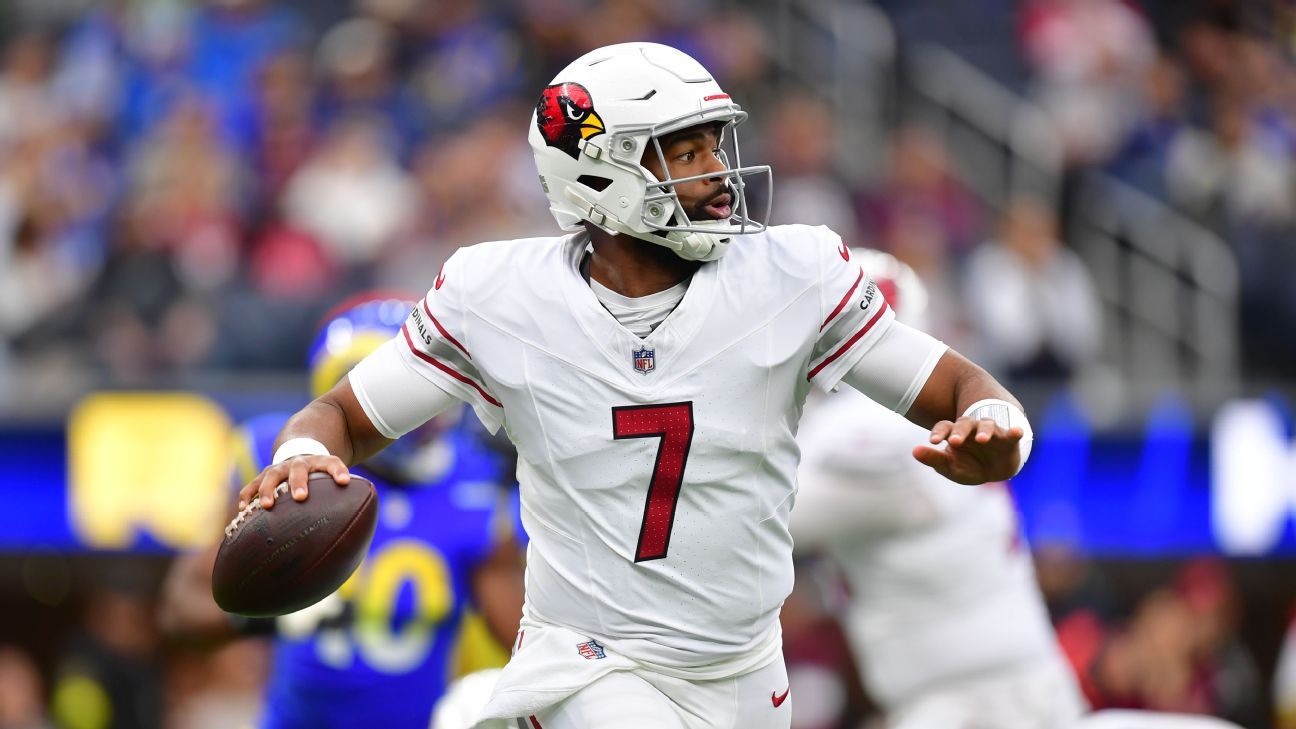
Jacoby Brissett reports to the Arizona Cardinals' mandatory minicamp this week, ending an offseason holdout in which he sought reworked contract terms with increased guaranteed money. The 33-year-old completed his 2025 stint as Arizona's starter with a 1-11 record after taking over from injured Kyler Murray in Week 6, but his pending resolution with the team carries implications far beyond the headline win-loss tally. Whether Brissett practices remains an open question; his arrival at the facility—meetings, weight room, game planning—doesn't automatically mean full participation during drills.
The surface argument against Brissett rests on that 1-11 mark. Critics point to it as disqualifying evidence that he doesn't merit fresh contract dollars. But the statistical architecture of the Cardinals' collapse during their nine-game losing streak (Weeks 10-18) reveals a different picture. Arizona's defense ranked last in the NFL in points allowed (35.2 per game) during that span, and finished dead last in defensive efficiency, opposing QBR, and opponent TD-to-attempt ratio. The unit surrendered 378 yards per game—31st in the league—while ranking 30th or worse in EPA, run yards per game, third-down conversion rate, and opponent time of possession. Defensive coordinator Nick Rallis later acknowledged the unit "played bad ball," pinpointing execution and scheme as compounding factors. Brissett himself operated behind a rushing attack that ranked dead last in total carries and run yards after contact (32nd), and 31st in total rushing yards. That means he was asked to execute a vertical passing game into a defense-first style, while his own ground game offered minimal constraint.
Brissett's completion percentage, yards per attempt, and touchdown-to-interception ratio during the losing streak held up reasonably for a backup thrown into extended starting duty against game-planned opponents. He did not single-handedly tank those games; the mathematical weight of Arizona's failure rested elsewhere. The contract negotiation hinges on whether the organization views him as a bridge option for 2026 or a reclamation project. If the Cardinals intend to keep him on the roster, his individual efficiency metrics—however obscured by team deficiency—become a negotiating lever.
From a prop-betting standpoint, clarity on Brissett's role will shift his seasonal passing-volume ceiling. If Arizona signs him to a restructure and commits to him as the starter, his passing-attempt totals and yardage props move higher relative to preseason projections. The market has likely already priced in a lower floor (backup/platoon scenario) given the 1-11 record and age profile. A definitive contract resolution signals how Arizona's front office actually values him—not what talk-radio detractors argue. If the Cardinals issue a rework, expect books to nudge up his per-game passing-volume lines; a release or trade erases his prop sheet entirely. His individual statistics from the 2025 losing streak are durable—they won't regress if he plays meaningful snaps in 2026. The edge, then, lies in catching the line-move that follows a contract announcement. Early season Brissett passing-yardage unders that assume minimal volume carry vulnerability if Arizona commits to him.