Mac Jones Staying Put in San Francisco: What a Backup's Breakout Year Means for 49ers QB Depth
By Erik Schwartz ·
Mac Jones will play out his final contract year in San Francisco after the 49ers rejected trade offers that fell short of a first-round price tag, cementing a depth chart that gives Kyle Shanahan a luxury most teams don't have.
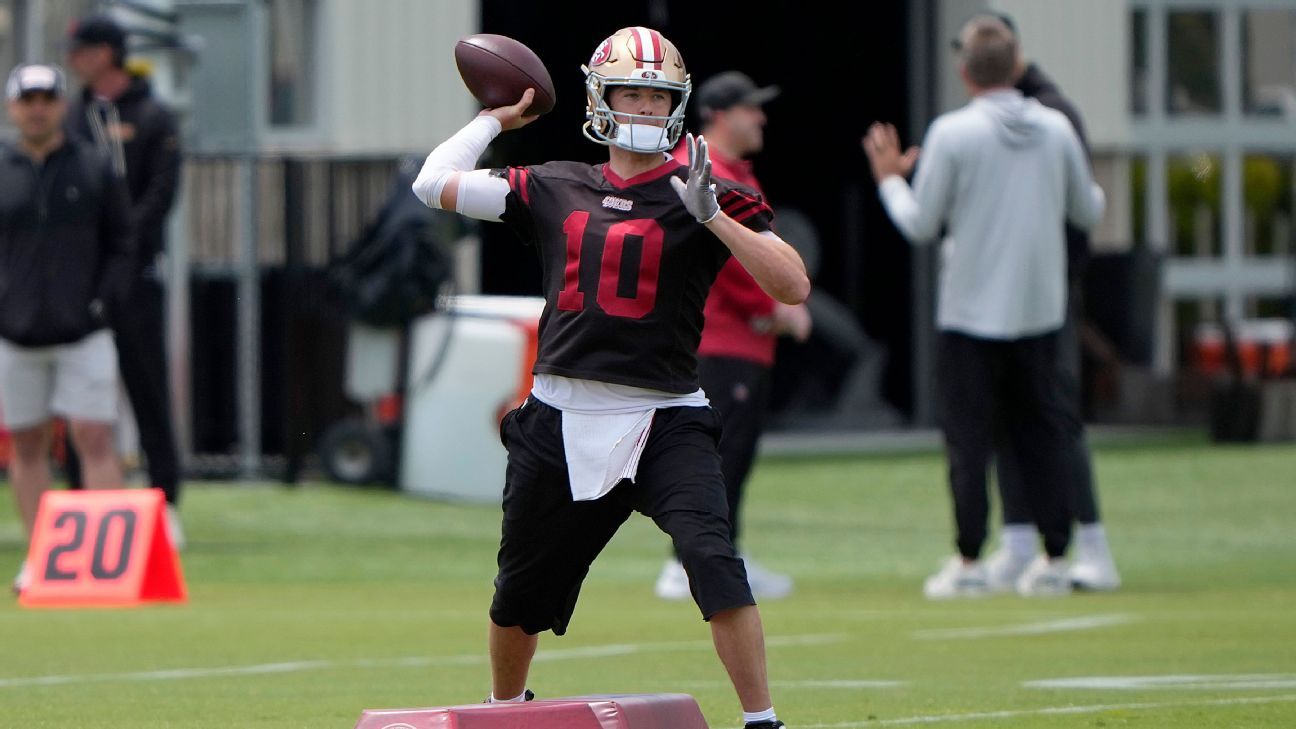
Mac Jones is staying in San Francisco. After eight starts filling in for Brock Purdy during the 2025 season—a stretch that produced a 5-3 record and kept the 49ers competitive in the NFC West—the quarterback became a trade-deadline curiosity. Teams in need of starting quarterback help circled; the 49ers held firm. No offer reached the threshold Kyle Shanahan had set: a first-round pick, minimum. Now, with the offseason program concluded and contract details finalized, Jones will play out the $3.55 million final year of his two-year deal, available for $2.25 million in additional incentives before hitting unrestricted free agency in 2027.
What actually happened over the past four months is worth parsing. Jones wasn't shopped; he was made available. There's a distinction. The 49ers positioned themselves as sellers only if the price exceeded what they valued him at internally—not as a commodity. Shanahan's own postseason comment was revealing: "It really surprised me that no one came and offered something." That surprise tells you two things. First, the market didn't perceive Jones as the kind of backup-turned-asset worth mortgaging draft capital for. Second, the 49ers' asking price was steep enough to deter even desperate teams. Between those two facts sits the real story: backup quarterback depth at the NFL's highest level is genuinely rare, and San Francisco knows it.
The mechanics of Jones's eight-game run matter here. He averaged 251 passing yards per game and maintained a 60.1% completion percentage in a Shanahan system built for short-to-intermediate precision and run-game setup. He threw 8 touchdowns against 5 interceptions—a 1.6:1 ratio that, while not elite, is functional in an offense that rarely asks its quarterback to carry games. When Purdy returns healthy (he's the starter, full stop), the 49ers get back to their preferred model: efficient quarterback play enabled by playcalling. Jones becomes insurance. And if Purdy suffers another injury, the team has a quarterback with film against NFL defenses and eight weeks of playoff-caliber execution already on his résumé.
From a betting perspective, this shapes how bettors should view 49ers passing volumes and game scripts. Jones isn't going anywhere, which means the market can price the 49ers' backup depth with confidence. If Purdy stays healthy—which the market assumes at odds-making time— 49ers passing totals and touchdown props will reflect Shanahan's conservative, run-first philosophy. Purdy's passing yards tend to range 240-280 per game in non-blowout scenarios; his team total typically sits in the 23-26 point range. But if Purdy goes down again, bettors facing Jones as a starter should expect similar efficiency metrics, maybe slightly lower ceiling on explosive plays but higher floor on game management. The contract adjustment—that $300,000 roster bonus tied to incentives he partially earned last season—signals the 49ers view Jones as a long-term depth piece, not a bridge. Backup quarterback value usually evaporates once another team thinks it can get a free look. The 49ers are telling the market: don't expect a gift.
The absence of a trade is itself a prop signal. Teams that deal their capable backup are betting on health and cap flexibility; teams that keep them are betting that the insurance is worth more than the draft pick. San Francisco kept Jones. That's a macro statement about how they're modeling Purdy's durability going forward.