Gibbs' Bell-Cow Coronation Arrives With Efficiency Risk
By PropBetEdge Editorial Team ·
Detroit's elite rusher faces his first real test: whether explosive efficiency survives a workload jump that could push him past 300 carries.
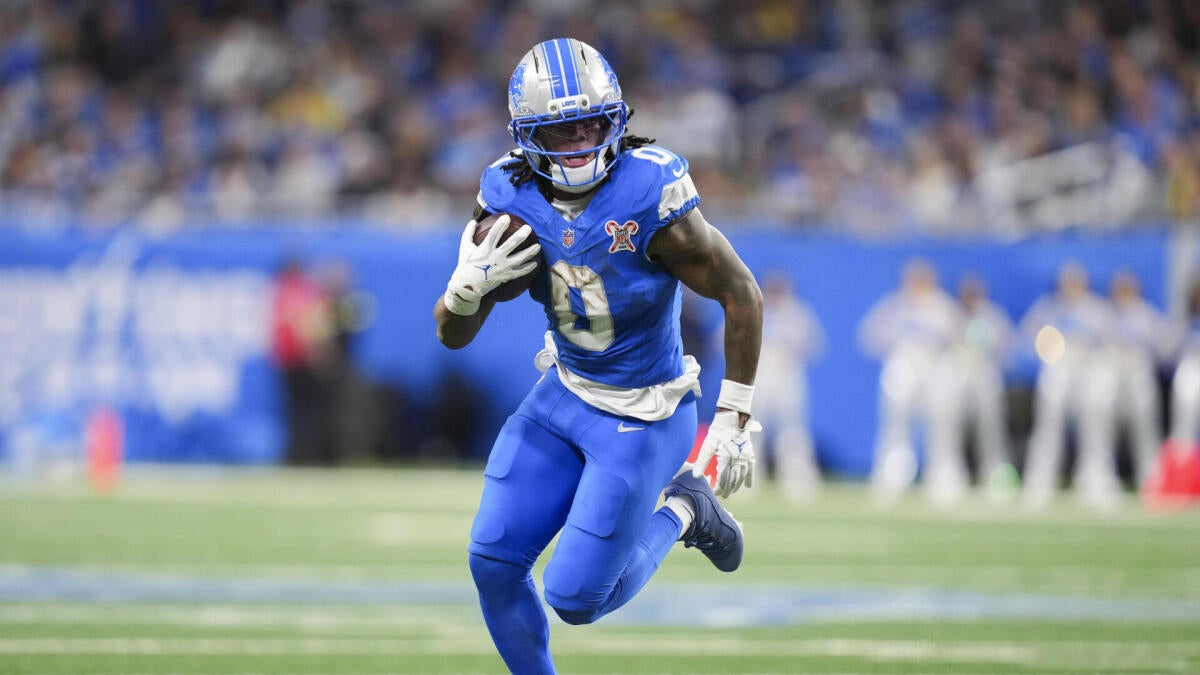
Jahmyr Gibbs is about to find out whether he's actually elite or just efficient. Dan Campbell's recent pronouncement—that Gibbs will be Detroit's "bell cow" going forward—marks the formal end of the running back rotation that has defined his first three years in the league. Through those seasons, Gibbs has compiled some of the sharpest volume-independent metrics in football: second in yards per carry (5.3), second in explosive rushing rate, sixth in tackle-breaking frequency among 50-back cohorts with 250+ carries. He's done it all on 234 career carries, a workload that has steadily climbed from his rookie snap share (57%) through Year 3 (67%), but which still leaves room for significant volume increases ahead.
The mechanics of Gibbs' elevation are straightforward. David Montgomery's exit from Detroit opens the backfield. Campbell's acknowledgment that Gibbs "became more of that last year" references his Year 3 snap share jump and, crucially, his passing-game expansion: 94 targets in 2025 compared to 71 as a rookie. The Lions offense has invested capital in getting Gibbs touches—not just carries, but routes run and touches in space where his 8.0 career yards-per-reception average can be deployed. That target spike without a corresponding carry increase suggests the team sees a player who can absorb more volume across both phases. Extrapolating his Year 2-3 averages to a 300-carry workload yields roughly 1,603 rushing yards and 18 rushing touchdowns; at 100 targets (a reasonable projection given McCaffrey's 129 last year and Gibbs' existing 94), he'd add 79 catches and 632 receiving yards, approaching 2,300 total yards.
But here's the friction point: Gibbs' efficiency already showed wear under the Year 3 volume expansion. His yards per carry dropped from 5.6 and 5.2 in Years 1-2 to 5.0 in Year 3. That's still elite territory—but it's the first downward tick in an otherwise flawless trajectory. When teams scale up touches from 12-13 per game to 17-18, defenses adjust. Boxes get slightly fuller. Safeties cheat down. The explosive-play frequency that makes Gibbs special compresses. McCaffrey himself saw that dynamic last year: elite per-carry numbers but lower touchdown rate and some red-zone work dilution compared to his 2023 season. The prop market will likely price Gibbs' Year 4 season total on the optimistic side of that extrapolation—betting that elite backs can simply absorb higher volume without efficiency loss.
For betting purposes, the edge lies in recognizing that Gibbs' per-carry number will almost certainly fall from 5.0 or better. The question is not whether it declines, but by how much. If you project him at 300+ carries at 4.8 yards per carry (still a top-5 rate), you're looking at roughly 1,440 rushing yards—50-80 yards below what the market is currently pricing into season-long rushing-yard totals set with optimistic efficiency assumptions. Season-long rushing-yard totals for elite 300-carry backs typically land in the 1,500-1,650 range; Gibbs' receiving volume adds another 600-700 yards, but the carry-efficiency loss is real. Early-season unders on his rushing-yard total, especially if the line opens above 1,550, will reward a player base that hasn't yet factored in the volume-efficiency tradeoff that affects every running back in football history who scales from sub-250 to 300+ carries.