Watson Returns to Browns Competition After 20 Months Out—Market Still Pricing for Disappointment
By Erik Schwartz ·
Seven months removed from a second Achilles surgery, Deshaun Watson addressed reporters for the first time, signaling full health and competitive intent in a QB1 battle against Shedeur Sanders.
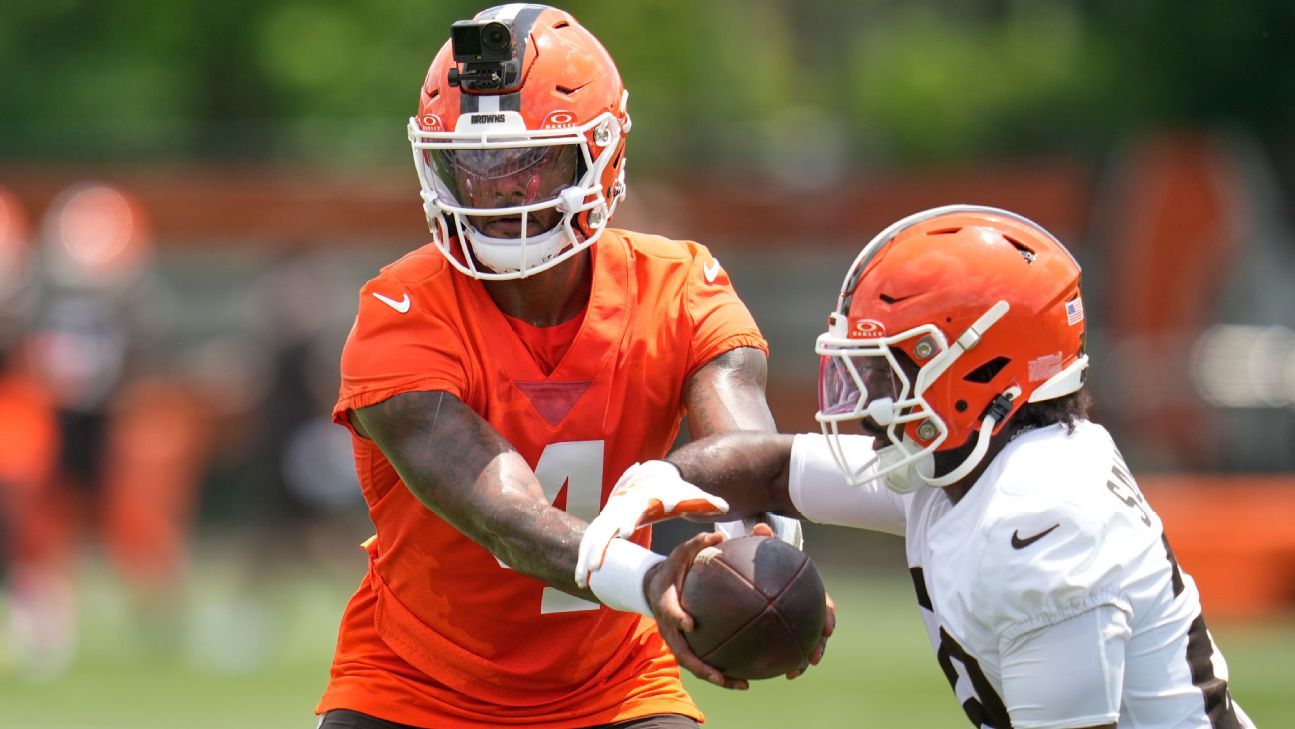
Deshaun Watson stood in front of Cleveland reporters Wednesday for the first time since rupturing his right Achilles tendon on October 20, 2024—nearly eight months of silence now broken. The Browns' $230 million quarterback, speaking after the second day of mandatory minicamp, delivered the standard recovery messaging: he's healthy, he's focused, he's ready to compete. What matters more than the words is the timeline. A second surgery in January 2025 kept Watson out of the entire 2025 season. By June 2026, he's had a full offseason to build capacity and work within the system alongside Shedeur Sanders, the team's second-year alternative at the position. This is Watson's first real opportunity to establish continuity since arriving in Cleveland in March 2022.
The math of Watson's injury history reads like a cautionary tale. He's played 19 games in four-plus years as a Brown—a 11-game suspension to start, then a shoulder surgery in November 2023, then the dual Achilles ruptures. His QBR in those 19 games sits at 33.1, which would rank last among qualified passers. Owner Jimmy Haslam called the trade a "big swing-and-miss" in March 2025, a public indictment that Watson downplayed on Wednesday. But the phrase matters because it reflects organizational doubt baked into the structure. Watson is in the final year of his guaranteed deal, which means this offseason represents both maximum leverage for the team (they can move on after 2026) and maximum urgency for him. He has one full, healthy season to prove the trade wasn't a sunk cost.
The competitive element is real: Sanders was a first-round pick (seventh overall in 2025) and has an offseason to learn the Browns' offense. But Watson, even in decline, has thrown for over 4,200 yards in three of his Houston seasons and has a Pro Bowl pedigree. The market hasn't yet calibrated to a Watson who is genuinely healthy for the first time in three years. Before the Achilles tear, Watson threw for 19 TDs and 8 INTs in 2024 (through Week 7), trending toward a full 16-game season in that ballpark. Extrapolated out, a Watson operating at 60-70% of his peak Houston form could still hit 3,400+ passing yards and 20+ TDs in a full 2026 season.
For bettors, this creates an asymmetry between preseason expectations and plausible outcomes. If Watson wins the QB1 job—and competitive minicamp comments suggest he's positioned to—his passing prop lines will carry embedded doubt pricing based on 20 months of injury headlines. A 3,800+ passing yard season from Watson would be viewed as a recovery narrative and surprise outperformance. The market may be pricing for another injury or Sanders emergence. Watson's actual path to 3,600-3,900 passing yards is straightforward: stay on the field and operate at 70% of his Houston efficiency. That's not miraculous. It's the baseline for a healthy starting QB with weapons. The edge isn't predicting Watson becomes elite again. It's recognizing that "disappointing but available" (which is what 3,700 yards and a 55% completion rate looks like) could be priced as a positive surprise.
The prop angle is persistent, not a one-game spike. It's built on multi-season career efficiency (Watson's Houston standards vs. his 19-game Cleveland nadir), a genuine health clearance (dual surgeries, full offseason), and organizational confirmation (minicamp reps suggest he's the starter). The downside is execution risk—Watson could re-injure, Sanders could win the job outright, or Watson could deteriorate faster than his age (30) suggests. But the market's current pricing reflects a 2024-2025 version of Watson, not a 2026 Watson coming off his first real recovery window.