NFL
Murray's Week 3 Return Reshapes Vikings QB Architecture—and the Spread
Carson Wentz kept Minnesota undefeated at 2-0, but the arrival of the starter upends the offensive formula that won ugly against Chicago.
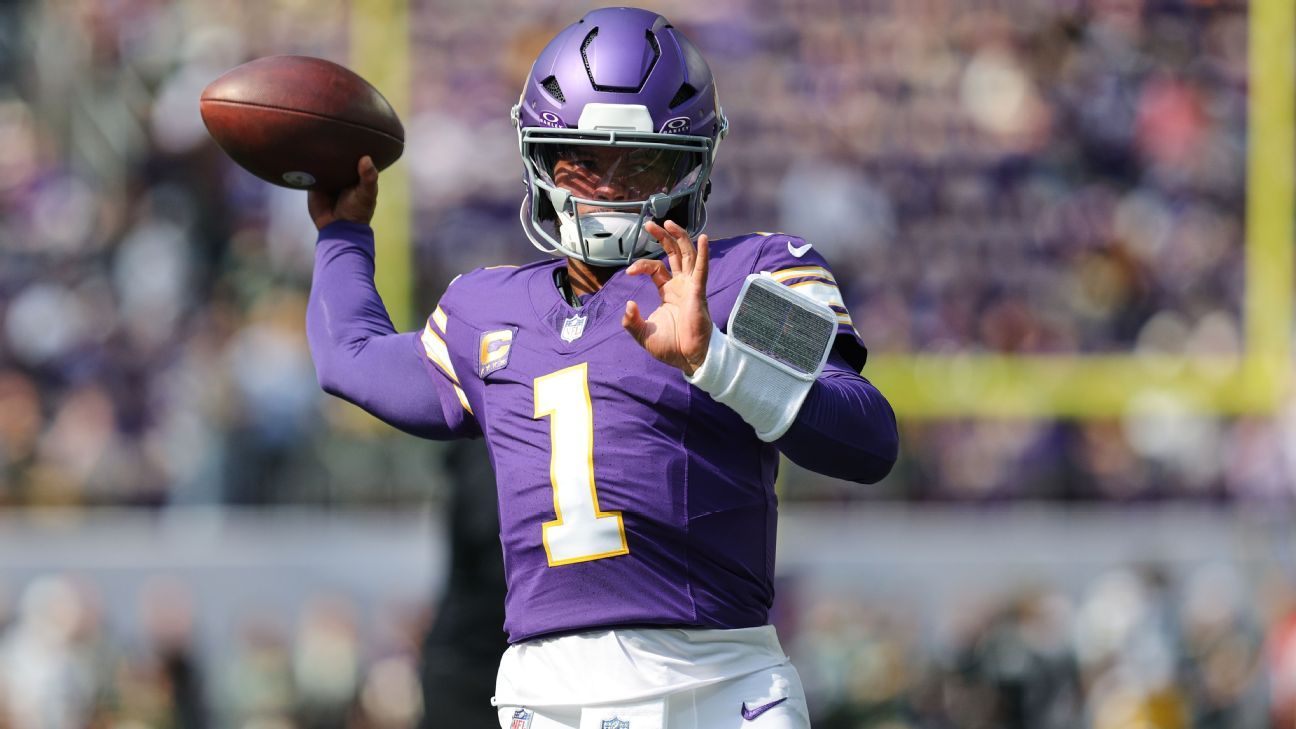
Kyler Murray will clear concussion protocol early this week and rejoin the Minnesota Vikings for their Week 3 matchup against Tampa Bay on September 27, coach Kevin O'Connell confirmed Sunday after the Vikings' 9-3 win over Chicago. Murray suffered a concussion on the 11th play of his debut with Minnesota last week but was cleared to practice on a limited basis throughout the week, signaling a minor injury that did not require extended sidelining. The Vikings entered the season expecting Murray to be their starter; instead, backup Carson Wentz has steered them to 2-0 while Murray recovered, and now the pendulum swings back to the original plan.
Wentz's two-game cameo reveals something crucial about what Minnesota's offense can and cannot do. Against a Bears defense that ranked 23rd in pass DVOA entering Week 2, Wentz completed 23 of 39 passes for 276 yards and three touchdowns with no turnovers—a functional floor, not a ceiling. His two critical third-quarter completions against Chicago (a 15-yard slant to Jordan Addison, a 19-yard floater to T.J. Hockenson) drained 5 minutes, 8 seconds off the clock in a one-score game, prioritizing clock management and ball security over explosive play. That is not the Murray offense. Murray's game is built on scramble-drill improvisation, vertical spacing, and play-extension—the very things that get flagged in a rigid, clock-management gameplan. Wentz's strength is precision in structure; Murray's is chaos control in the gaps.
The Buccaneers' pass defense, which allows 7.8 yards per attempt (12th in the NFL entering Week 2), will see a different burden when Murray takes the field. Tampa's weakness is not scheme-resistant—it's depth. Losing Leonard Fournette to injury earlier this year left the Buccaneers thinner in short-area coverage, and Murray's ability to create off-platform and extend plays beyond the pocket directly exploits that. Additionally, Murray's completion percentage (63.2% career) is lower than Wentz's this season (59%), but his yards per attempt (7.9) and touchdown rate (5.2%) are significantly higher. The Vikings' passing volume should increase Week 3; the question is whether that volume translates to efficiency or forces a pace that works against their run-heavy, clock-conscious scheme.
For bettors, Murray's return introduces volatility to a Vikings offense that had settled into a grind-it-out identity. The Week 3 spread will likely tighten as the market recognizes Murray as a superior arm talent, but that conflates quarterback talent with offensive efficiency. Wentz won ugly because the Vikings' defense and special teams (Will Reichard's 39-yard field goal was decisive) carried the load. A Murray return doesn't automatically boost scoring; it changes the variance profile. Expect the total at Minnesota-Tampa Bay to move downward as the week progresses, because the market will initially overprice Murray's individual arm talent and underweight the fact that O'Connell's gameplan—clock management, third-down conversion efficiency, field-goal-drive closing—was working. The edge sits on unders early in the week before the market corrects to the reality that the Vikings are still a low-volume, ball-control offense.
Murray's passing-yards total will likely be set in the 240–260 range, an overreaction to his debut and the volume shift from Wentz. The mechanism here is scheme, not skill. O'Connell does not run a vertical, air-it-out system; he runs a system that values third-down conversion and clock economy. Against a Tampa defense that allows 7.8 yards per attempt, Murray's per-play efficiency should be solid, but total volume will remain capped. His interception rate (career 1.9%) is also significantly lower than Wentz's body of work (2.3%), reducing tail risk on under-style props.