Skoronski Extension Signals Titans' Shift: Why Guard Stability Matters for Offensive Line Props
By Erik Schwartz ·
Tennessee's willingness to lock down its left guard early marks a franchise first and reshapes how to read the team's pass protection ceiling for 2026.
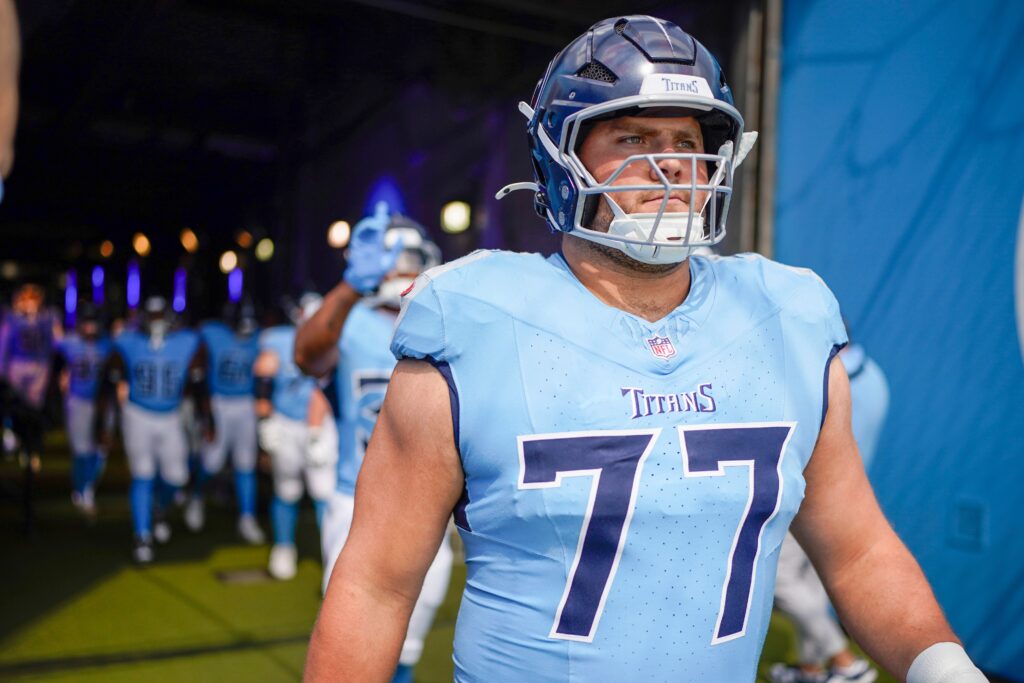
The Titans are in active extension talks with left guard Peter Skoronski, their 2023 first-round pick, with GM Mike Borgonzi characterizing negotiations as positive. The move comes after Tennessee exercised Skoronski's fifth-year option ($19.07MM), keeping him under contract through 2027. This is not routine housekeeping—it represents the first time in the franchise's modern era that Tennessee has pursued an early extension on a first-rounder during the fifth-year option window.
Skoronski has earned the investment through sustained elite play. He missed only three games across his first four seasons, including all 17 contests in both 2024 and 2025. Pro Football Focus ranked him fifth among guards last season with the second-best pass blocking grade. ESPN's pass block win rate metric placed him seventh league-wide. The 2023 first-round pick from Northwestern has completed a rare successful journey: college left tackle transitioning seamlessly to interior line play in the NFL—a conversion that fells most prospects. Tennessee's offensive line architecture, already battered by the Cushenberry release and the eventual exhaustion of Dan Moore Jr.'s deal, hinges on continuity at guard. An extension signals the front office views Skoronski as foundational rather than replaceable.
The Titans' market timing matters. Tyler Smith's $24MM per year contract set the guard ceiling pre-Linderbaum. But the Raiders' outlier $27MM annual deal for center Tyler Linderbaum reshuffled compensation expectations across the interior line. If Tennessee moves on Skoronski now, they lock in a guard price before the market inflates further—a valuation tell that the organization has ranked him among its franchise cornerstones. Three other 2023 first-rounders (Smith-Njigba, Will Anderson Jr., Jalen Carter) secured extensions earlier, but the Titans' historical reluctance to move early on first-round talent makes this inflection point worth noting.
For prop purposes, Skoronski's durability and pass blocking pedigree directly influence quarterback pressure metrics and overall offensive efficiency. Will Levis has labored behind inconsistent protection; a locked-in, elite left guard eliminates one variable and should reduce Levis's sack rate and hurry frequency. Over 17 games in 2025, Levis absorbed 32 sacks and 58 total pressures. Skoronski's presence at peak efficiency suggests the Titans' pass protection baseline—barring catastrophic injury elsewhere—should improve measurably. Bettors tracking Levis passing yards and touchdown props should factor in that left side of the line as now solidified. If Skoronski signs a multi-year deal in the coming weeks, the Titans' offense gains a ceiling boost for 2026 that the betting market has not yet priced in. Extension talks at this stage carry real intent; Borgonzi's use of the word "positive" is not fluff in extension discourse.