Saints OTA Shuffle: Shough's Path Clears While Kamara's Role Hangs in Cap Limbo
By Erik Schwartz ·
Tyler Shough enters his second offseason with momentum, but New Orleans' willingness to add Travis Etienne suggests the front office is hedging its bets on Alvin Kamara's future—a signal that carries real implications for passing volume and red-zone efficiency.
The Saints open OTAs on Thursday with a materially different roster than the one that limped into 2025 spring practice. Cameron Jordan and Taysom Hill are gone. Demario Davis has moved on. The defense has been reshaped around younger pieces. But the story that matters for betting purposes isn't the turnover—it's the calculus around Alvin Kamara and what his uncertain status tells us about how New Orleans plans to attack defenses this season.
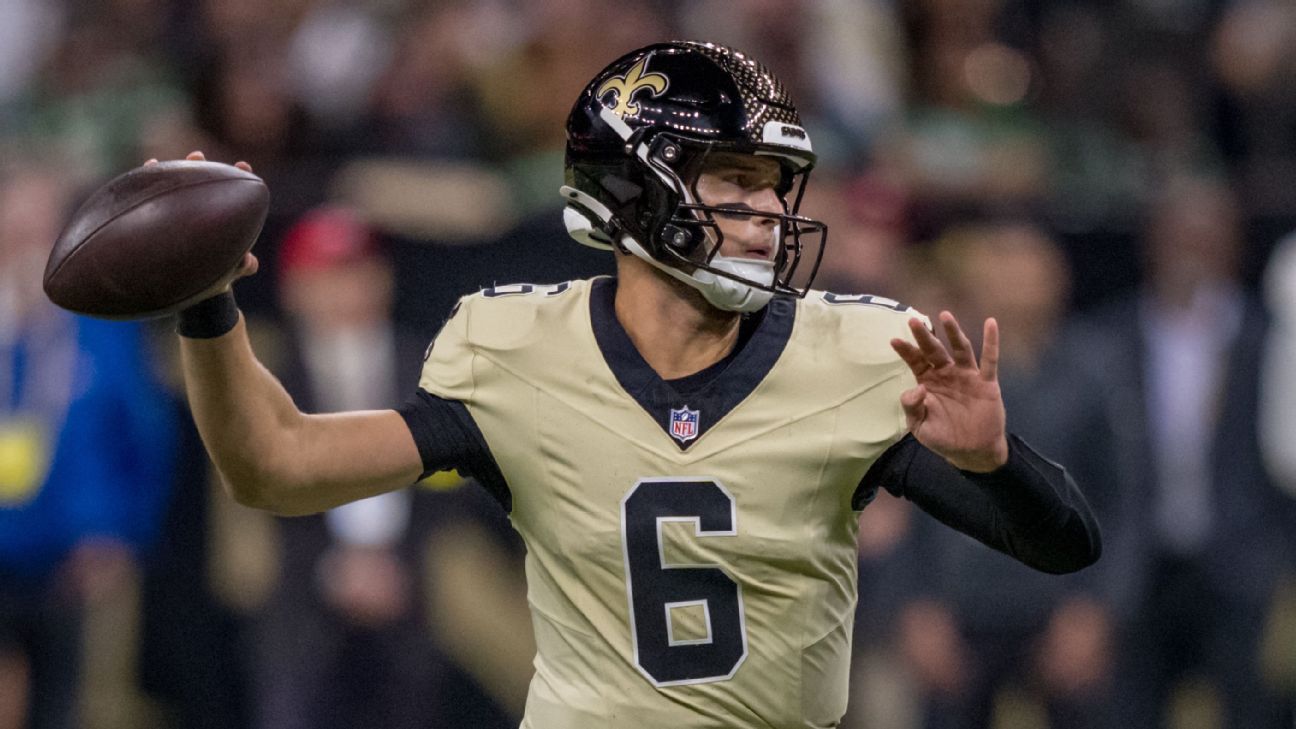
Tyler Shough, the rookie who steered the Saints to four wins in their final five games, enters 2026 with genuine momentum. That late-season surge gave the franchise something it didn't have a year ago: a quarterback option past Derek Carr's retirement and a runway to evaluate whether Shough can function as more than a caretaker. Kellen Moore's second season typically produces cleaner play-calling. The pieces are there for Shough to take a legitimate step forward in efficiency and decision-making. But the front office's move to sign Travis Etienne Jr. in March—a power runner acquired from Jacksonville—is the tell.
When a franchise brings in a second productive running back while their starter's contract situation remains unresolved, one of two things is happening: either they're preparing for Kamara to take a smaller role, or they're building organizational cover to move off him entirely. General manager Mickey Loomis has publicly tied Kamara's status to "resource management" and salary cap flexibility without confirming whether the player was asked to restructure. The Saints still have runway to make this call, but the timeline is tightening. OTAs serve as an informal deadline—Loomis himself admitted as much—and the team's willingness to add another 1,000-yard runner suggests they've already gamed out a world in which Kamara carries less volume.
For prop bettors, this creates a clean split. If Kamara remains a Saint at starter's touches, his receiving yard total should anchor higher because Shough's limited experience means the offense will lean on safety-valve dumps and short-area completions to the backfield. That's how rookie-driven passing attacks preserve efficiency. If Kamara is moved or takes a pay cut that reduces his role, the Saints flip toward a more vertical approach and Shough's passing yards tick upward—but his interception rate could widen because the backup plan (checkdown volume) shrinks. Watch Etienne's snap count and route participation in the first two weeks of camp. If he approaches 50% of running back work, Kamara's receiving prop total should be faded; if he hovers below 30%, Kamara's floor remains intact.
Shough's own passing volume presents a secondary angle that doesn't hinge on Kamara's status at all. The Saints ranked 30th in passing attempts per game last season (34.1) and 24th in passing yards per game (216.8). That's not because Moore is run-happy—it's because they were playing from behind in most games. With four straight wins to close the season, confidence in Shough and a stabilized defense, New Orleans may finally have the luxury of controlling game script. Expect more play-action, more downfield shots, fewer desperation passes. His passing yards total should be adjusted lower from where it would sit on raw volume alone. The market will chase his late-season efficiency, but the ceiling for volume gains is capped by improved team health and competitiveness.