Tank Dell's Restructured Deal Signals Measured Confidence in Houston's Receiving Core
By Ty Whitney ·
Dell's reworked contract and injured reserve designation reveal the Texans are hedging against his availability while banking on his ceiling when healthy.
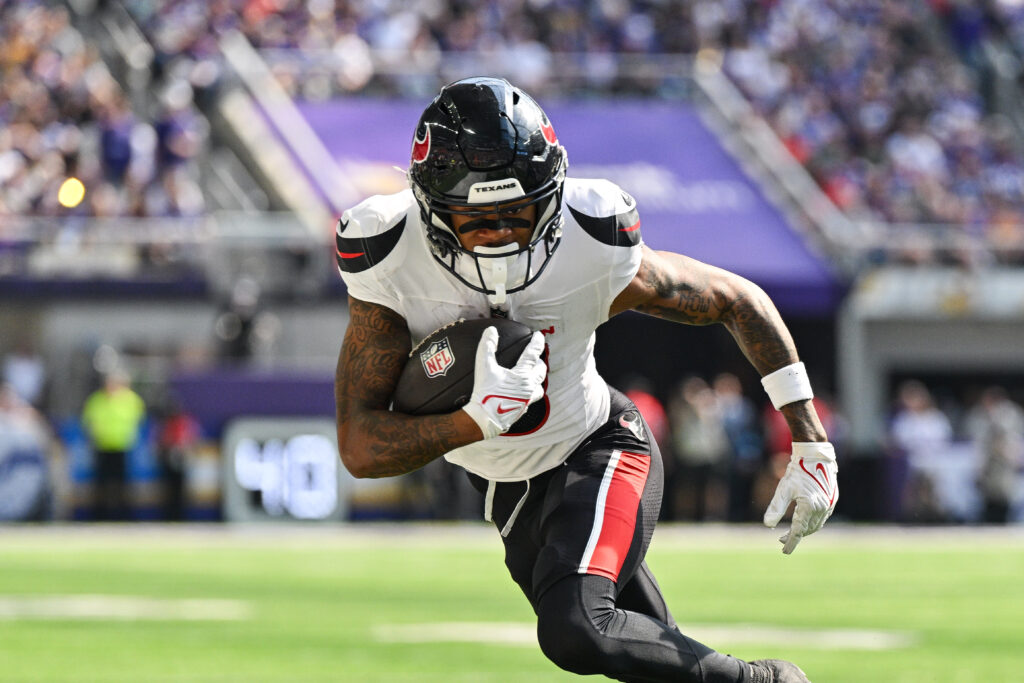
Tank Dell restructured his deal with the Texans on Friday, converting his expiring rookie contract into a one-year pact worth $1.7MM with $1MM guaranteed, generating nearly $2MM in cap relief for Houston. The move comes as Dell works his way back from a severe leg injury suffered late in the 2024 season, a setback that sidelined him entirely through 2025. He's been designated for injured reserve-return, meaning the Texans expect him to contribute at some point this season but not immediately.
GM Nick Caserio's comments paint a nuanced picture: Dell has progressed materially since training camp but remains below full strength, and the team is as focused on his mental readiness as his physical recovery. That calibrated optimism—not full confidence—drove the restructure. The contract resets Dell's salary commitment to minimal levels while preserving his role flexibility. If he stays sidelined or never reaches form, Houston absorbs minimal dead money. If he returns and produces, they've got him on a bargain deal that becomes a free agency chip or a foundation for a longer-term extension.
The context matters for Houston's passing offense. Jayden Higgins tore his ACL, gutting their second receiving option, and the Texans responded by trading for Kayshon Boutte. Nico Collins remains the primary target, with Jaylin Noel and Xavier Hutchinson as tertiary options. Dell's pre-injury profile—98 catches and 10 touchdowns in 25 games alongside C.J. Stroud—established him as a legitimate third-down and red-zone weapon. When he clears injured reserve, the Texans gain both pass-game depth and ceiling relief for Stroud's workload.
For prop bettors, Dell's return timeline creates a bifurcated market. Early season Stroud passing yards and Texans passing touchdowns lines are priced without Dell; once he returns—likely midseason given Caserio's hesitation—Houston's pass volume and scoring efficiency could shift noticeably. The Texans aren't rushing him back, which reduces variance on weekly props involving active week-to-week unknowns, but it also means any explosive first performance upon his return may be marked by a market that hasn't fully repriced his touch share. His absence early season actually makes his eventual return a value inflection point rather than a day-to-day flip. Bettors patient enough to wait for the official designation lift will have clearer sight lines on his snap share and route participation than those chasing him into the lineup.
Dell's contract structure—low salary, high guaranteed percentage—is also a tell about internal valuation. The Texans are willing to eat guaranteed money because they believe the upside of his recovery outweighs the downside of a setback. That's organizational conviction, not narrative hope, and it should inform how much skepticism to apply to his eventual impact.