Stover's Hernia Recovery Opens a Fullback Door for Houston's Tight End Shuffle
By PropBetEdge Editorial Team ·
The Texans' third-year tight end is cleared for spring work, but his path to consistent targets remains congested—and his emerging fullback role may be the real volume story.
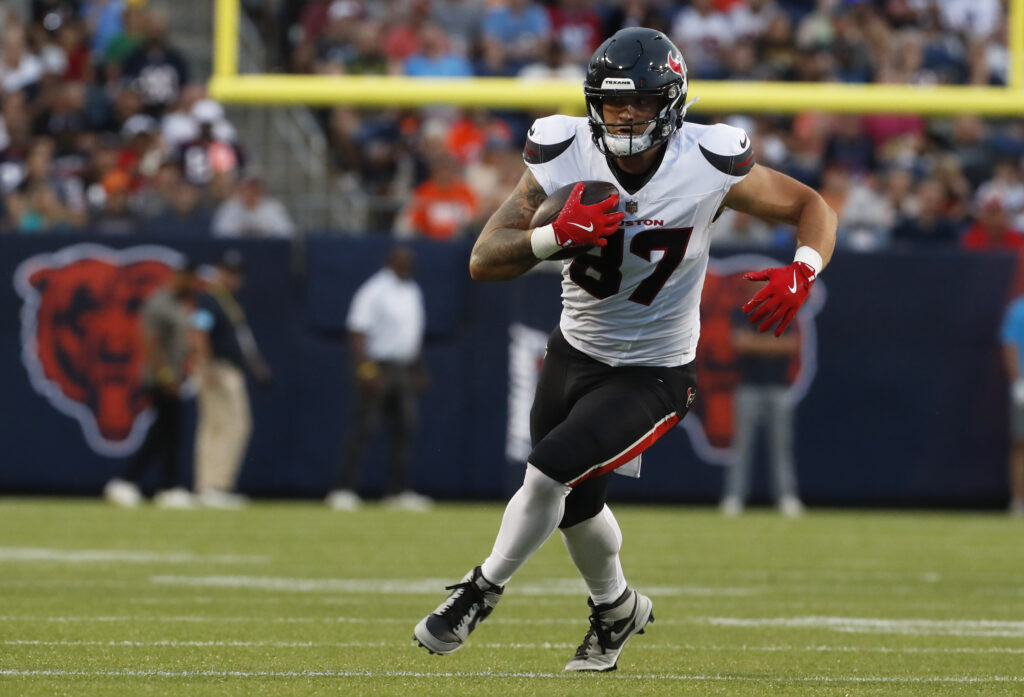
Cade Stover is healthy again. The Texans tight end underwent hernia surgery during the offseason and has already cleared medical checkpoints to participate fully in spring conditioning and practice reps. That timeline—surgery, recovery, and return to work—tracks well for a player the team drafted in 2024 with the expectation that he'd evolve into a reliable pass-catcher and run-blocker. But Stover's path to meaningful production in 2026 is anything but linear.
The congestion at tight end in Houston is real. Dalton Schultz returns as the veteran anchor. The team signed Foster Moreau in free agency. Marlin Klein, a second-round pick, is already on the roster. Brevin Jordan—who missed all of 2025 with a torn patellar tendon—is making his own recovery and signed a contract extension in December, signaling the team's long-term commitment to him. In his first two seasons, Stover logged a 40% snap share and has drawn only 38 career targets. That target volume floor is unlikely to expand much when Schultz and Jordan are healthy and competing for red-zone and pass-game reps.
What's changed is Stover's positional versatility. Per Aaron Wilson's reporting, Stover has been taking snaps at fullback during spring practices. This is not a marginal development. A fullback role—even part-time—creates an entirely different snap-count pathway. Fullbacks in modern Houston offenses (and most NFL offenses) are less about receiving targets and more about staying on the field across formations: lead-blocking in power running schemes, pulling in gaps, and extending drive continuity when the team wants to control the line of scrimmage. If Stover earns 30-40% of his snaps as a fullback, his total offensive snaps could jump from 40% to 50% or higher, even if his pass-catching role doesn't materially increase.
For bettors, the distinction matters because target-based props—receiving yards, receptions, anytime TD—track differently from snap-count-based props. A fullback snap counts the same as a tight end snap on the field, but it rarely generates the same fantasy value. If Stover opens 2026 with a receiving yards total of 350-400 yards (a reasonable line for a third-year tight end), that line was priced assuming pass-game reps. If instead he sees 15-20 targets (on pace for roughly 200-250 yards) because he's moving into a fullback role, that over is a fade. The market will likely price him as a traditional tight end because that's his designation; the fullback experiment, if it sticks, creates a discrete cap on target ceiling that the initial line may not reflect.
Brevin Jordan's return timeline is also critical context. Jordan's patellar tendon injury is notoriously slow to heal; even with an encouraging extension signed in December, full explosiveness and route-tree depth may not return until late summer or the start of the season. If Jordan is limited through training camp, Stover's pass-game reps spike by default. But if Jordan is truly recovered and competing at full health, Stover's receiving volume compresses further. The safest bet until September is that Stover's receiving props—yards and receptions—carry downside risk relative to where the market opens him. The fullback pivot is his best path to consistent snaps, not more opportunities in the passing game.