Texans Stall on Stroud Extension as QB Market Inflates
By PropBetEdge Editorial Team ·
Houston's reluctance to lock in its franchise QB ahead of training camp signals either patience or brinkmanship—and it matters for how the organization approaches the 2026 season.
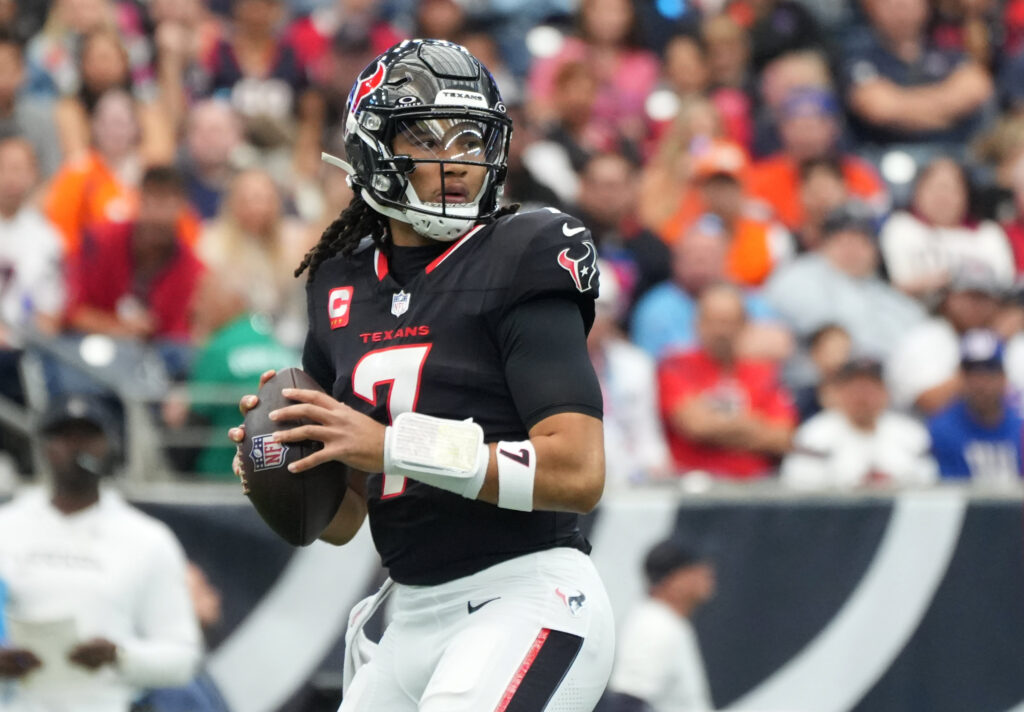
The Texans and C.J. Stroud remain at an impasse on a contract extension, according to GM Nick Caserio, who offered only vague assurances about progress during training camp. The two sides have been in a holding pattern since the offseason, with no material movement on terms. Stroud is back in the building and participating, but the extension remains unsigned—a notable gap for a franchise QB entering his third year.
The stall is worth parsing. Stroud has delivered: he threw for 4,108 yards last season with a 23:8 TD-to-INT ratio, ranking him squarely in the upper tier of young passers. He's proven durable, productive, and a legitimate centerpiece. Yet Houston is choosing not to move aggressively now. That constraint could reflect one of two positions: either Caserio believes the cap math improves with delay (unlikely in a QB market that only inflates), or the organization is using extension timing as leverage—a signal that Stroud must prove durability over a full season before Houston commits to top-five QB money. The second reading is more plausible and more uncomfortable.
From a roster construction standpoint, the delay matters. A locked-in extension typically reshapes how a team allocates capital in the receiving room and offensive line—resources that compound. Without it, Houston preserves optionality, which can read as either prudent or as a chilling lack of faith. For bettors, the extended ambiguity introduces a marginal friction on Texans passing volume forecasts. If internal uncertainty leaks into locker-room chemistry or if Stroud feels the need to prove something to justify his ask, it could nudge his decision-making toward higher-variance plays—slightly elevated interception risk, fewer dink-and-dunk sequences, more downfield shots. That's a small lever, not a pivot.
The prop-level implication lands on Stroud's interception line, if books are offering one for the 2026 season. His career baseline sits at roughly 8-9 picks per 16 games. If the extension delay bleeds into early-season play-calling—Stroud pressing, coaches dialing up more aggressive downfield concepts to justify his contract value—we could see a modest lift in INT volume (10-11 range) without a parallel lift in TD volume. The mechanism isn't dramatic, but it's real: contract uncertainty in the QB room historically correlates with tighter decision-making on safe throws and more calculated risk-taking when tape matters. Stroud's talent buffers against meaningful regression, but the environment has tilted slightly toward INT upside.
Monitor extension news through August. If no deal surfaces by Week 1, the implied tension becomes part of the gameplan analysis for Houston's opening stretch. Early-season passing lines may not yet reflect the marginal increase in interception probability that organizational uncertainty introduces.