Mendoza's Starting Timeline Isn't Settled—And That Uncertainty Matters for Vegas Passing Props
By Ty Whitney ·
A public disagreement between Doug Pederson and Tom Brady over when the Raiders should deploy their rookie QB creates real-time variance in passing-volume forecasts.
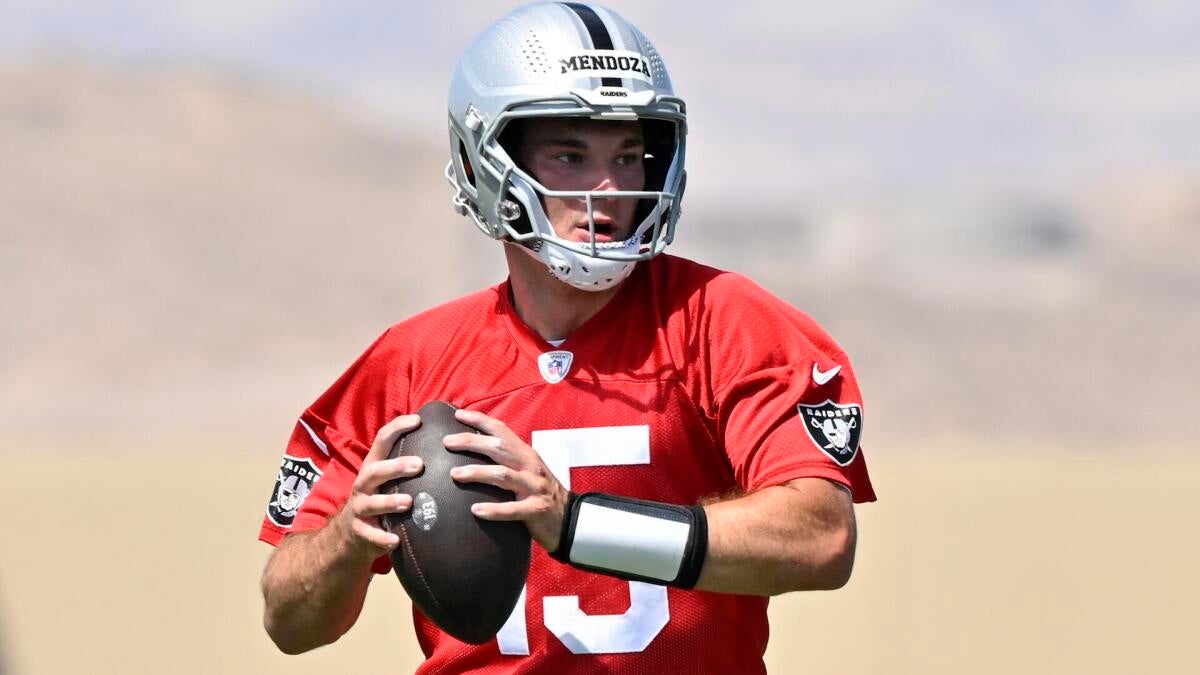
The Las Vegas Raiders' quarterback decision for the 2026 season sits in limbo, and that fog is meaningful for bettors. The team drafted Fernando Mendoza with the No. 1 overall pick on the strength of his Heisman Trophy season and undefeated Indiana campaign, then signed veteran Kirk Cousins to mentor him. But Doug Pederson, the former Philadelphia Eagles head coach who won Super Bowl LII, publicly argued that Mendoza should start Week 1—not because the Raiders lack conviction in him, but because benching elite prospect talent prolongs adjustment pain into mid-season when stakes matter more.
Pederson's logic rests on his Carson Wentz precedent: In 2016, he drafted Wentz at No. 2 overall, initially planned to sit him behind Sam Bradford, then shipped Bradford to Minnesota before the regular season and handed Wentz the job immediately. Wentz went 7-9 as a rookie, but used that full-season runway to build mechanical and decision-making foundation. By year two, he started 11-2 before an ACL injury derailed what looked like an MVP trajectory. Pederson told Sean McDermott the same thing in 2018 about Josh Allen: if you're truly sold on the prospect, deploy him Week 1. The alternative—Tom Brady's institutional view—opposes rookie starters on principle. Brady, now a minority owner with the Raiders, has argued that premature deployment is a "tragedy" forced by oversimplified offensive schemes. His worldview values the Mahomes-Smith, Rodgers-Favre, and Brady-Bledsoe models: a year or two of backing up allows a prospect to absorb pace, read leverage, and build resilience away from starter pressure.
What matters for betting purposes is that this isn't a resolved question inside the Raiders organization. If Mendoza starts Week 1, his passing volume, completion percentage, and turnover rates will track toward rookie baseline—historically inefficient, high variance, vulnerable to negative game scripts. If Cousins holds the job through October and Mendoza enters mid-season off the bench, the volume ceiling shifts down but the range tightens. Kirk Cousins' established profile becomes the primary passing catheter, with Mendoza's involvement purely situational. The market has already opened passing lines assuming Cousins starts, but those lines will reprice sharply if word breaks that Mendoza is Week 1's starter. That repricing window is narrow and likely closes by mid-August.
For prop bettors, the edge lies in early-season Cousins passing props if Mendoza's appointment holds through September. Cousins' 2025 season saw him average 271 passing yards per game with a 65.2% completion rate—workmanlike, low-ceiling stuff—but in systems emphasizing play-action and run-first frameworks (Klint Kubiak's scheme fits that mold), his yards-per-attempt efficiency actually improved. If Mendoza sits and the Raiders lean on power run game with Ashton Jeanty in the backfield, Cousins' passing-attempts total compresses, making unders on his yardage and touchdown props attractive. The flip: if Mendoza starts immediately, Cousins' passing touches evaporate, making his props near-unplayable until injury forces his hand. The decision hasn't been made public, but in a Week 1 environment—roughly 3.5 weeks from current date—sportsbooks will force clarity. Early money should recognize that Cousins' touch volume is contingent on a head-coach decision that remains unresolved.