Broderick Jones Returns From Spinal Fusion: Steelers Offensive Line Depth Reshuffles
By PropBetEdge Editorial Team ·
The Steelers' first-round tackle receives medical clearance eight months after a season-ending neck injury, but his ramp-up timeline reshapes Pittsburgh's pass protection equation heading into the regular season.
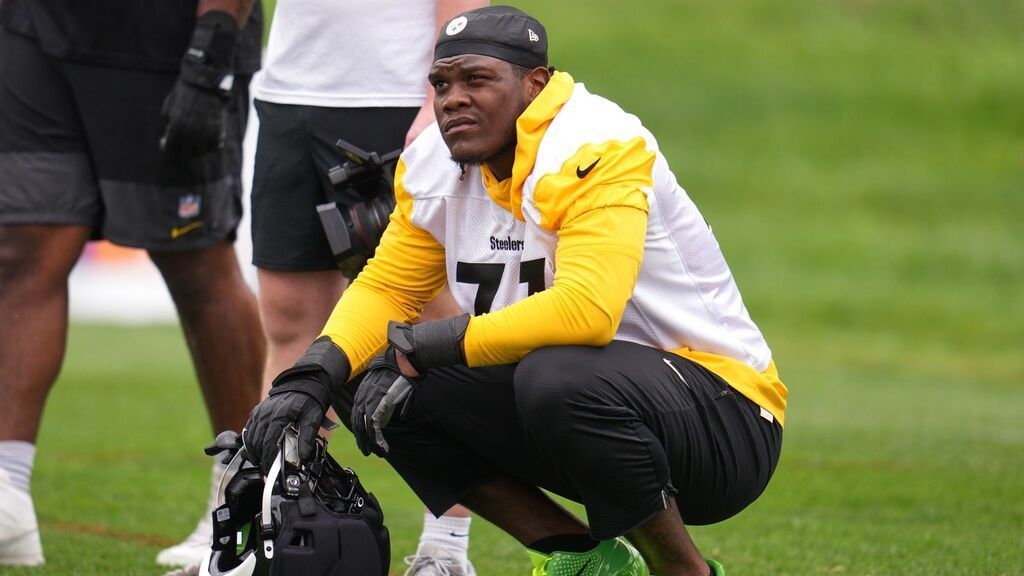
Broderick Jones took the field at St. Vincent College on Thursday for his first training camp practice since suffering a spinal fusion in Week 12 of last season. The Steelers' 2023 first-round pick sustained the injury during a collision with Chicago Bears linebacker Dominque Robinson, an incident that briefly threatened his playing future. After eight months of rehabilitation—including more than three months without any physical activity—Jones has received full medical clearance and is actively practicing, though on a managed ramp.
The injury itself was jarring in its severity. Jones felt fine immediately after the Chicago game, unaware that imaging would reveal structural damage serious enough to require surgery. The recovery process tested his resolve: extended periods of inactivity, gradual return to strength training, and the psychological toll of uncertain career trajectory. Asante Samuel Jr., who underwent his own spinal fusion during the 2025 offseason and later joined Pittsburgh, became a crucial mentor, meeting with Jones multiple times to share recovery insights. That peer guidance—paired with support from DK Metcalf, who sustained a similar injury in high school—became as important as the medical protocol itself.
Coach Mike McCarthy has signaled confidence in Jones' starter-level ability, but practice reps tell the real story. Through two camp sessions, Jones has cycled through second-team work at both left and right tackle, a measured approach any offensive line coach would employ post-surgery. The bigger structural shift: Troy Fautanu, the Steelers' 2024 first-round pick, moved from right to left tackle during Jones' absence and has taken snaps with the starting unit. That positional reorganization creates a bottleneck for Jones' return to a starting role. McCarthy won't—and shouldn't—yank Fautanu mid-camp, which means Jones will spend the preseason competing for snaps and proving durability in live situations. Pittsburgh's pass protection grade depends heavily on both front-side tackles operating at full capacity; unproven chemistry off a long recovery is a liability in Week 1.
From a betting lens, this matters for Steelers QB line movement and season-long pass protection efficiency. If Jones isn't fully integrated into starting snaps by game one, Pittsburgh's per-play sack rate could spike early. The market will likely account for general offensive line volatility, but it may underprice the specific risk of a formerly injured tackle carrying residual strength deficits or mechanical compensations into September. Jones himself acknowledged he's at 300 pounds, roughly 10-15 pounds below his playing weight, and still refining technique after months away. That gap doesn't vanish in a two-week preseason. Watch his snap percentages and the team's fourth-quarter performance in pass protection: if the Steelers lean on backup tackles when games tighten, sack totals trend up relative to expectation.
The positive signal is durability confirmation—Jones is cleared, his surgery was successful, and his mental state is sound. That alone removes downside tail risk from season-long prop bets. The neutral-to-slight-negative signal is timing: Jones will return as a contributor, not an immediate starter, and his effectiveness in live game reps remains untested. The Steelers' pass protection baseline should be penciled slightly higher than it would be if Jones were healthy and uninterrupted, but not at pre-injury levels. Wait for preseason snaps and early regular-season utilization data before moving on Pittsburgh QB durability or sack totals.