Raiders' Guard Shuffle Signals Offensive Line Risk Entering 2026
By Erik Schwartz ·
Spencer Burford's arrival and Jackson Powers-Johnson's injury recovery leave Las Vegas searching for stability on the interior—a setup that could ripple into quarterback protection metrics.
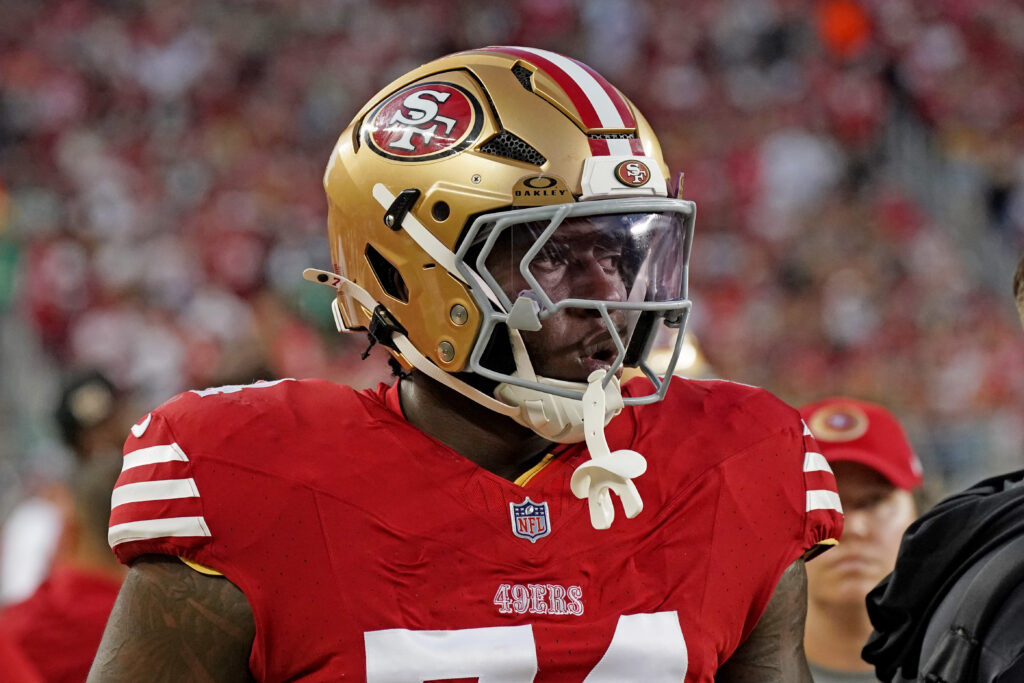
The Raiders' mandatory minicamp wrapped this week with clarity on three-fifths of their offensive line but persistent uncertainty at both guard spots. Kolton Miller and Delmar Glaze anchor the tackles; Tyler Linderbaum's nine-figure investment locks center. But left guard remains contested, with Spencer Burford—a free-agent acquisition from San Francisco—now favored over returning options Atonio Mafi, Jordan Meredith, and Will Putnam. The right guard battle between Jackson Powers-Johnson and third-round pick Caleb Rogers carries higher volatility, especially with Powers-Johnson coming off an ankle injury that shuttered his 2025 season at seven starts.
Burford's tape doesn't scream confidence. In 2026—his only full season at left guard for the 49ers—he surrendered pressure on 9.4% of pass blocking snaps and posted a 95.0 pass blocking efficiency ranking dead-last among 87 guards with 250-plus snaps. The Raiders are paying him $3.3MM, a mid-level guard salary that reflects the market's skepticism. His arrival in Las Vegas over the winter wasn't framed as a star grab; it was bracket-filling, and the team's willingness to let spring practices determine the starter signals they view the position as vulnerable rather than solved. On the right side, Powers-Johnson's ankle recovery timeline matters less than his trajectory: a 63.8 PFF grade and 96.9 pass blocking efficiency in 2025 placed him solidly middle-of-the-pack, not starter-plus. Rogers, who started the final six games last year, delivered a 59.6 grade and 95.9 PBE—marginally worse—but impressed enough at minicamp to be in contention. That's the tell: neither option is bulletproof.
For quarterback protection purposes, this interior instability compounds. Linderbaum's presence at center stabilizes the middle, and his connection with Miller on the left side is established. But Burford's pressure-surrender rate and the lack of a clear, proven starter at right guard mean Las Vegas enters training camp—and eventually the season—with two spots where gap integrity and pickup responsibility remain unresolved. The Raiders will have competitive reps throughout July and August, but the margin for error is thin. A rookie or a journeyman guard struggling in Week 1 isn't a scandal; it's a predictable vulnerability baked into the roster.
From a passing prop standpoint, this uncertainty matters more than preseason headlines suggest. Quarterback Brendan Sorsby, the presumed starter, will face variable pocket quality depending on which guard combination breaks the tape. If Burford and Rogers stick, Sorsby absorbs an interior line where both guards ranked in the bottom half of efficiency metrics last season. Historical data on guards with sub-96 PBE efficiency shows quarterbacks experience 3-6% elevated pressure rates in the following season when paired with similar-tier neighbors. Sorsby's passing attempts, completion percentage, and interception rates will all tilt toward the pressure-influenced side of the range if interior continuity doesn't solidify. Early projections building in average NFL interior protection are overweighting Linderbaum's quality and underweighting the gap-filling inexperience on either side of him.
Betting-wise, the angle isn't on Sorsby's volume—the Raiders will game-plan for his strengths regardless of OL health—but on efficiency metrics where pocket pressure shows cleanest. Passing yards overs built on neutral pocket assumptions carry elevated risk. Interception projections anchored to 2025 baseline rates (before interior weakness was formalized) should lean slightly higher. These aren't slam angles; they're positional tilts that survive only if Burford or Rogers underperform tape and game action doesn't prompt midseason adjustments. Monitor the first four preseason drives closely: if either guard generates consistent interior penetration or missed assignments, the protection risk hardens into a real seasonal factor.