The Real X-Factors: Why Harrison, Verse, and Hunter Matter for Your 2026 NFL Bets
By PropBetEdge Editorial Team ·
Three breakout talents carry disproportionate leverage on their teams' fates—and the market hasn't fully priced in what happens when they underperform or exceed expectations.
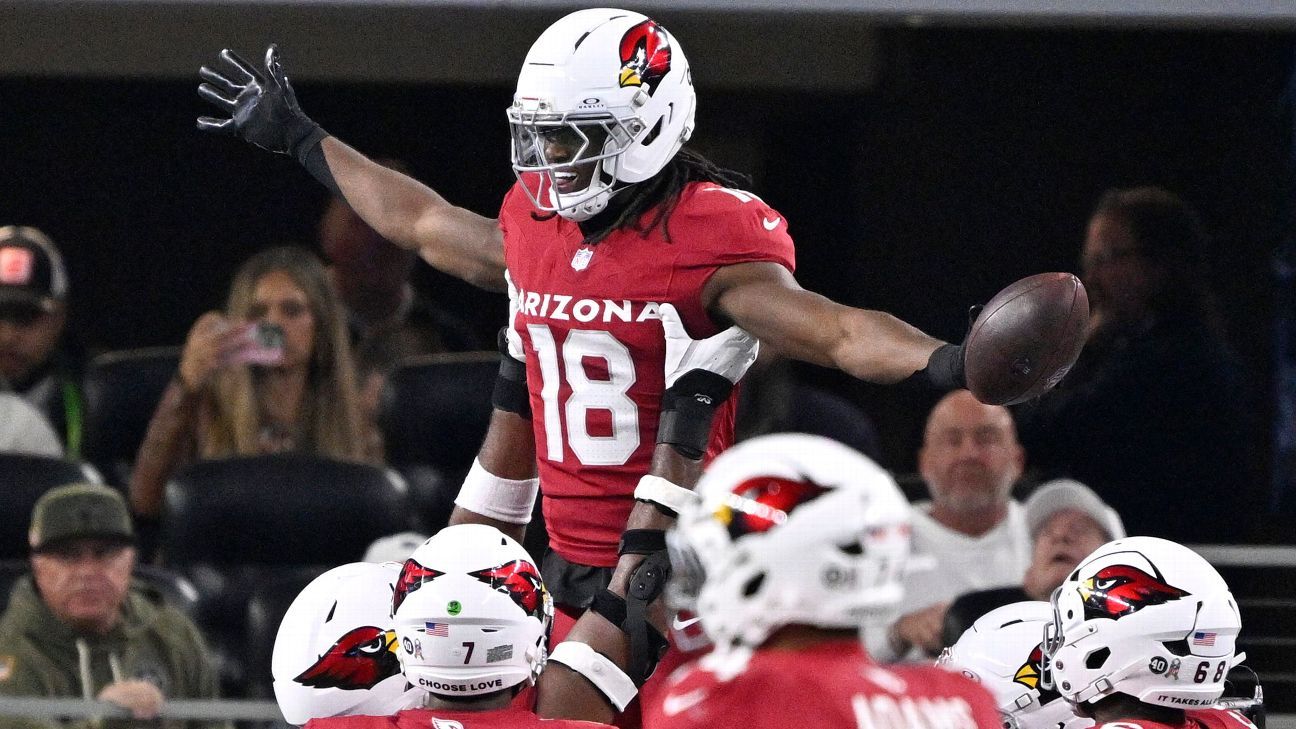
ESPN's Ben Solak identified a crucial betting framework this offseason: certain players function as organizational fulcrums, meaning their individual performance variance creates outsized ripple effects on team efficiency, pace, and playcalling. Marvin Harrison Jr., Jared Verse, and Travis Hunter occupy that tier—not because they're stars (though they are), but because their roles compress decision-making into singular point-of-failure scenarios.
Harrison's arrival in Arizona forces the Cardinals offense into a vertical, spacing-dependent system. His route tree, catch radius, and ability to create separation on intermediate breaks essentially unlock the Kyler Murray passing attack; without consistent targets downfield, Arizona either stalls in the middle distance or forces tight-window throws into coverage. This isn't abstract talent. It's structural leverage. If Harrison operates at 85% efficiency (drops, concentration lapses, or coverage adjustments against top secondaries), the Cardinals team total contracts. If he hits 95%+, Murray's TD rate and completion percentage both spike because the offense breathes. Verse, a pass-rush catalyst for the Chargers, compounds that dynamic on defense: edge pressure directly correlates to secondary performance and coverage downfield. Travis Hunter's two-way role at corner and pass-rusher for the Broncos means his availability and snap percentage literally determine whether the secondary operates with a floor or a ceiling.
The market has begun to price these players into individual prop lines—Harrison receiving yards, Verse sack totals, Hunter tackles—but has not fully absorbed how their variance bleeds into team totals and spread probability. A nagging hamstring limiting Hunter to 65% snap count doesn't move his personal tackles line by 0.5; it shifts Broncos defensive efficiency down 2–3 ranks, which cascades into moneyline and team-total unders that opened at mispriced probabilities. Similarly, if Harrison draws single coverage more than season-rate expectations (a function of defensive scheme adjustments, not his own skill), his targets and yards inflate in week 4–5, long after opening week bets have already locked. The edge exists in the lag—the 1–2 week delay before books remodel team totals around individual performance reality.
For bettors, the practical angle is two-pronged. First, monitor snap-count data and coverage looks in week 1–2 games; these are your real-time signals for whether breakout X-factors are operating at peak leverage or constrained. Second, when individual prop lines move faster than team totals, that's a smell test. If Harrison receiving yards climb to 95+ while Cardinals team total stays flat at 23.5, that's a misalignment worth attacking on the team side. The causal chain runs: individual performance → team efficiency → spread/total probability. Books price the middle step last.
This season's betting landscape rewards scouts who identify when organizational role becomes organizational destiny. Harrison, Verse, and Hunter are the telegraphs. Their early-season execution (or dysfunction) will determine which books are slow to recalibrate team projections and which sharps are ready to exploit that friction.