Trade Speculation Won't Move the Needle on Coleman, Kmet, or Richardson Props—Yet
By PropBetEdge Editorial Team ·
ESPN's offseason trade simulation surfaces four veteran names, but the market intelligence tells a different story about who's actually movable and why.
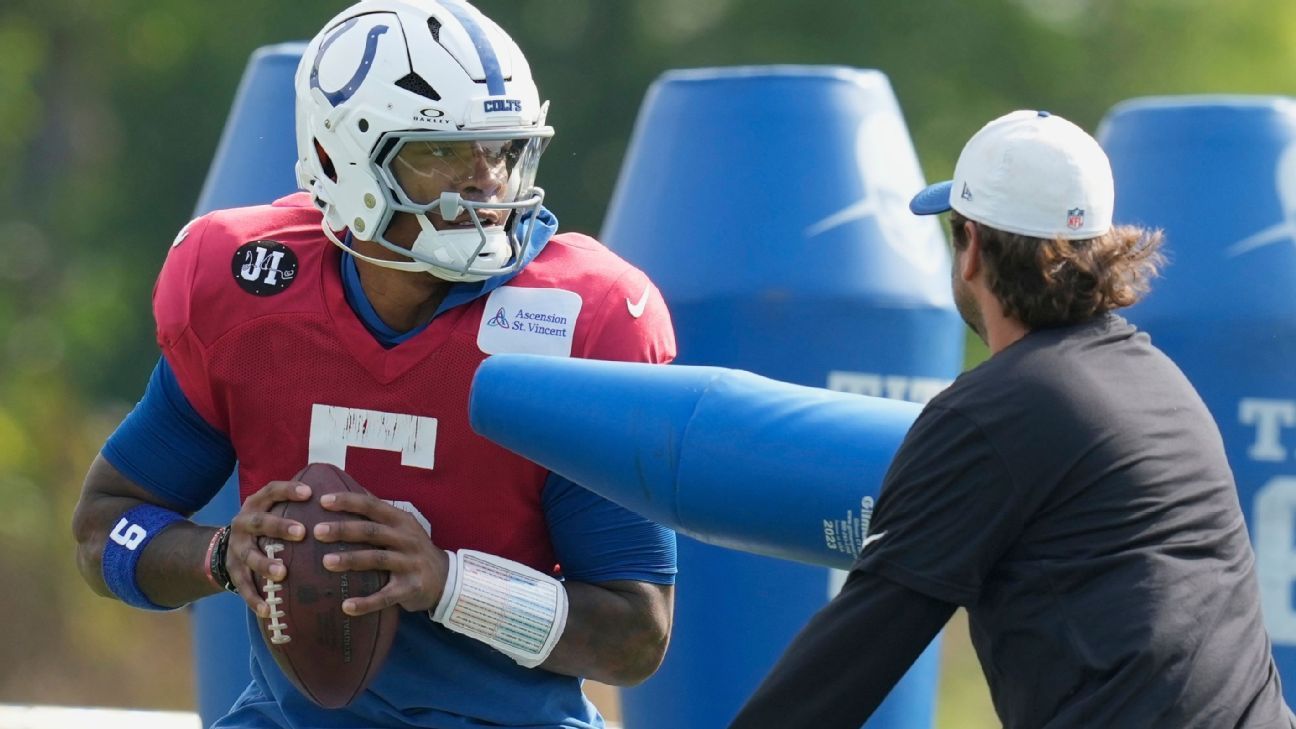
ESPN's offseason trade desk ran through a hypothetical market for four NFL veterans—Keon Coleman, Cole Kmet, Anthony Richardson, and Kayvon Thibodeaux—asking analysts to construct realistic swap offers and having NFL Nation reporters play GM. The exercise is analytically sound, but it glosses over a critical distinction: speculation about trade feasibility doesn't move actual prop pricing until a deal framework surfaces or a front office signal hardens into reportable fact.
Start with Coleman. Bills owner Terry Pegula's recent comments about the receiver's draft history created the typical summer churn—whispers about his future, questions about fit, the usual noise. But general manager Brandon Beane has already closed that door twice over: first, by clarifying that he made the pick (not the fired coaching staff), and second, by explicitly stating the team has rebuffed inquiries and intends to keep Coleman. A 38-catch, 404-yard rookie season is underwhelming, not disastrous. The Bills have already invested first-round capital and salary. Trading him now would be an admission of error, and front offices resist those moves unless a genuine upgrade surfaces. The market knows this. Coleman's receiving-yard and target-share props for 2026 are priced on the assumption he remains in Buffalo, and that pricing is sound until Beane actually signals differently—which he hasn't.
Kmet and Richardson present a different flavor of the same problem: the difference between "could be traded in theory" and "will be traded if the price is right." Kmet is a productive Bears tight end coming off a solid 2025; trading him requires either an overpay or the emergence of a superior option at the position league-wide. Richardson's 2026 will be his third season with Indianapolis, and the Colts have invested heavily in surrounding him with weapons. Neither player generates the kind of market heat that forces an owner's hand mid-offseason. Thibodeaux, on the Giants, is a star edge rusher playing out a rookie deal—moving him would require a haul the acquiring team can't afford while staying competitive. Trade simulation exercises are useful for understanding asset valuation, but they're not forecasting tools.
For prop bettors, the lesson is straightforward: treat offseason trade speculation as narrative texture, not material information. Coleman's receiving props, Kmet's target and TD projections, and Richardson's passing yards won't shift until one of three things happens: (1) a credible reporter with front-office access breaks a deal framework, (2) a team formally acknowledges interest in shopping the player, or (3) the player publicly demands a move. Speculation divorced from those signals is just conversation. The books have already priced in standard uncertainty for these players' 2026 roles. A hypothetical trade offer published in May doesn't change that math.
The durability of current prop pricing on Coleman (receiving yards and receptions), Kmet (targets, receptions, receiving TDs), and Richardson (passing yards, TDs, completions) rests on the assumption that each remains with their current team. Until front offices move from closed-door negotiations to actual framework reporting, those lines deserve to stay where they are.