Seattle's Price Tag: Why the Seahawks' Draft Investment Signals Immediate RB Workload Clarity
By PropBetEdge Editorial Team ·
The Seahawks used a first-round pick on Jadarian Price to fill Kenneth Walker's vacated role, removing ambiguity from a backfield now anchored by a top-32 talent.
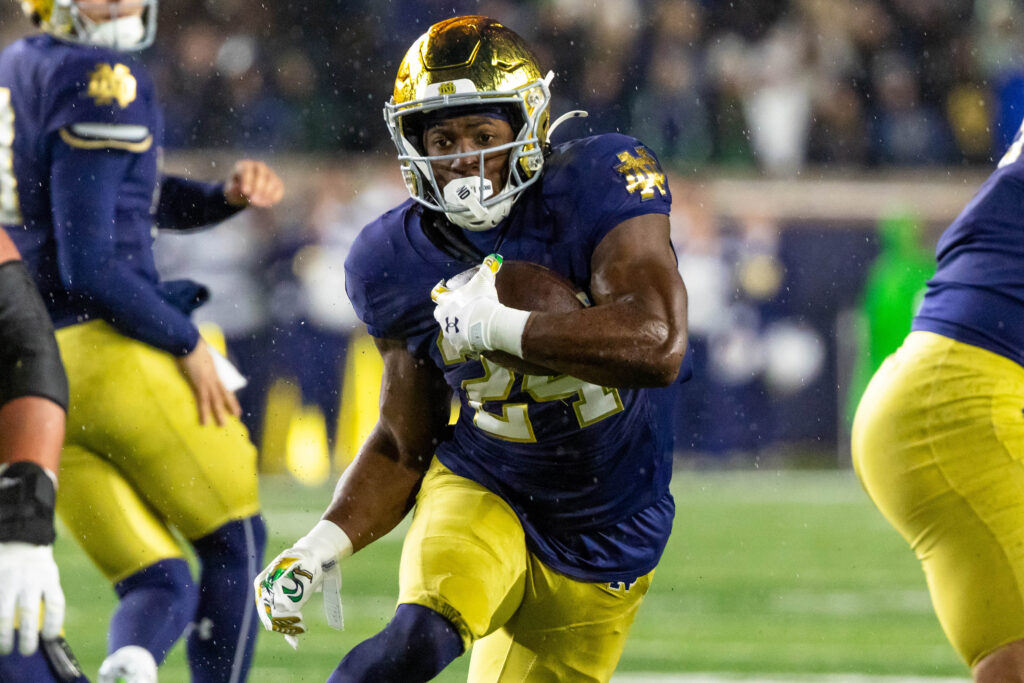
The Seahawks took Notre Dame running back Jadarian Price with the No. 32 overall pick in April's draft, a selection that raised eyebrows at the time but now reads as a direct answer to a specific problem: Kenneth Walker moved to Kansas City, and Zach Charbonnet faces a multi-month recovery from a torn ACL. Seattle's offense needed a backfield centerpiece ready for Week 1, and the organization clearly felt Price was the prospect worth that investment.
Price arrives into an opportunity that doesn't require him to win a committee vote. Charbonnet's injury timeline pushes him into the regular season—not borderline; well into it—which means the Seahawks' running back snaps and red-zone touches default to a single primary option for the first stretch of the year. That primary option is now a first-round talent, not a journeyman filler or a raw undrafted back. The team paid for it explicitly, which tells you Seattle's front office views Price not as a depth piece but as a feature back from day one.
This clarity matters for offensive construction. When a team invests a first-rounder at a position, schemes and game plans tilt toward maximizing that player's volume. Price should expect heavy usage: early-down carries, pass-game involvement, and goal-line touches. The Seahawks didn't burn a first to let him split snaps 50-50. Even once Charbonnet returns, Price's draft capital gives him leverage in competition for touches—teams don't elevate prospects that high just to bench them the moment an injured player heals.
For prop bettors, Price's rushing and receiving volume floors are effectively set by draft positioning. A first-rounder at running back in a backfield absence scenario typically carries 14-18 carries per game in his first full season, with 3-5 target-per-game upside in the passing game. The Seattle offense, under offensive coordinator John Macdonald, has leaned run-heavy in recent seasons, which compounds the opportunity. Price's anytime touchdown odds and rushing-yard totals should price in high-leverage usage from the opening week, not speculative volume. The market may lag on understanding that draft capital removes volatility—Price isn't competing for role definition; he's inheriting it.
One additional mechanism: quarterback Geno Smith's injury history (shoulder issues) creates defensive gameplan incentives toward run-heavy early-season offense until confidence in his arm ownership solidifies. That tailwind extends Price's early-season workload beyond just filling a vacuum. The backfield role is his to keep, not earn, which is a rare advantage for a rookie at a position typically stacked with uncertainty.