NFL
Olave's Extension Reflects Market Reality: Health Discount Locks Saints Into WR1 Without Top-Tier Costs
Chris Olave's new deal proves injury history still moves the needle in receiver negotiations, but it also locks New Orleans into sustained passing volume at a discount.
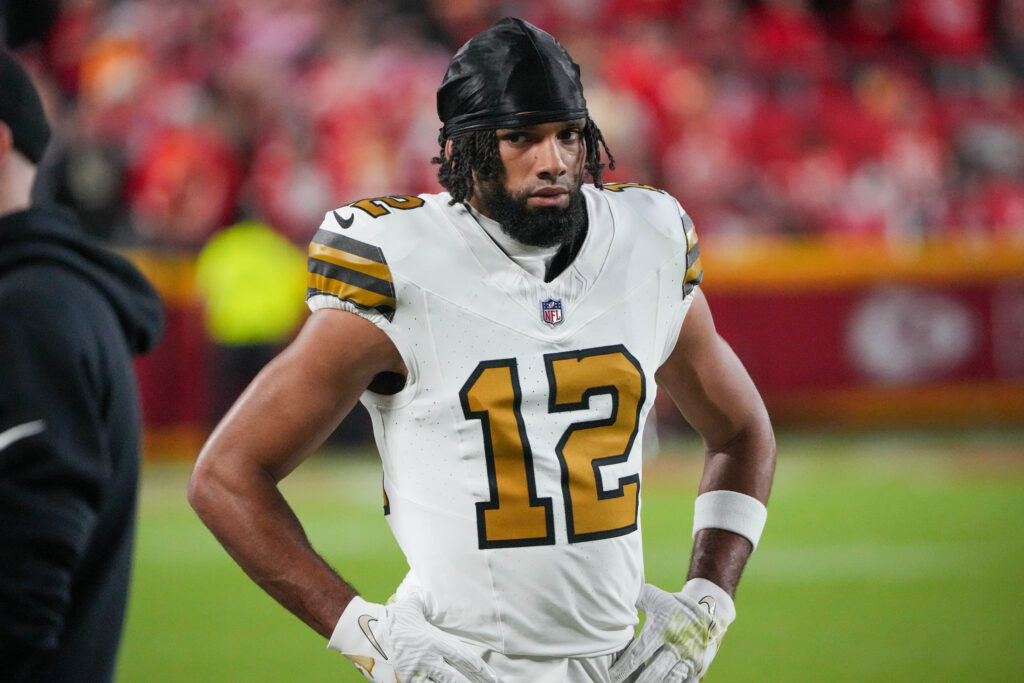
Chris Olave and the Saints agreed to a contract extension on August 2 that positioned the receiver outside the top 10 in average annual value and full guarantees among NFL wideouts—a notable gap for a player of his usage and production tier. Olave acknowledged that his prior health concerns shaped the negotiation; both sides met in the middle rather than the receiver commanding top-market rates. The discount, while real, comes with strategic consequence: New Orleans committed long-term capital to a receiver whose injury history creates both risk and opportunity for volume predictability.
Olave has been a foundational piece of the Saints' passing attack since arriving in 2022, consistently commanding target share and red-zone looks. His injury resume—including ankle issues and concussion concerns that raised durability questions in the market's eyes—prevented him from reaching the $30+ million AAV tier occupied by Hill, Jefferson, and top-tier free agents. Instead, the deal reflects what the Saints were willing to pay given the uncertainty: a middle-ground valuation that acknowledged his production while pricing in downside scenarios.
What matters for prop construction is the implicit team commitment embedded in the deal. New Orleans didn't discount Olave's contract to shed him; it extended him because the offense still flows through him. That sunk cost—the guarantee money already spent—means the Saints have every incentive to feed him targets early and often, especially during the contract's early years when his durability is most closely monitored by team medical staff and coverage designers. A receiver on a discount deal after injury concerns often sees elevated target volume as a function of team confidence: the organization is essentially saying "we believe in his health and his role," and they'll prove it with tape.
For bettors, Olave's receiving yards and receptions props carry subtle but persistent edge this season. His average target share has hovered around 22-25% of Saints pass attempts when healthy; with an extended deal and no perceived replacement, that floor likely holds or shifts upward. Teams testing Olave's health with press coverage early in the season will face a Saints offense designed to get him early and often—quick releases, rhythm routes, slant-heavy concepts that minimize injury exposure. Against soft coverage, he'll see volume spikes. The discount also means the Saints face less internal pressure to scheme him into rest situations; he's paid like a mid-tier receiver, not a franchise tag risk.
Short-term prop angles emerge around September matchups. Olave's receiving yards total props will likely be set assuming moderate usage (around 7-8 targets per game baseline); the team's investment in proving health at extension could easily push him to 8-10 targets in weeks 1-4, especially in games where New Orleans wants to establish confidence early. Fade the market's cautious opening estimates on Olave's receiving yards and receptions for the first four weeks—his deal structure creates a mechanical reason for volume compression in the market and volume delivery on the field.