Patriots' A.J. Brown Trade Creates Depth Crisis—and Opens Late-Summer Betting Angles
By Ty Whitney ·
New England's receiver room is overstocked after landing Brown, forcing tough roster cuts that will reshape passing-game target distribution heading into training camp.
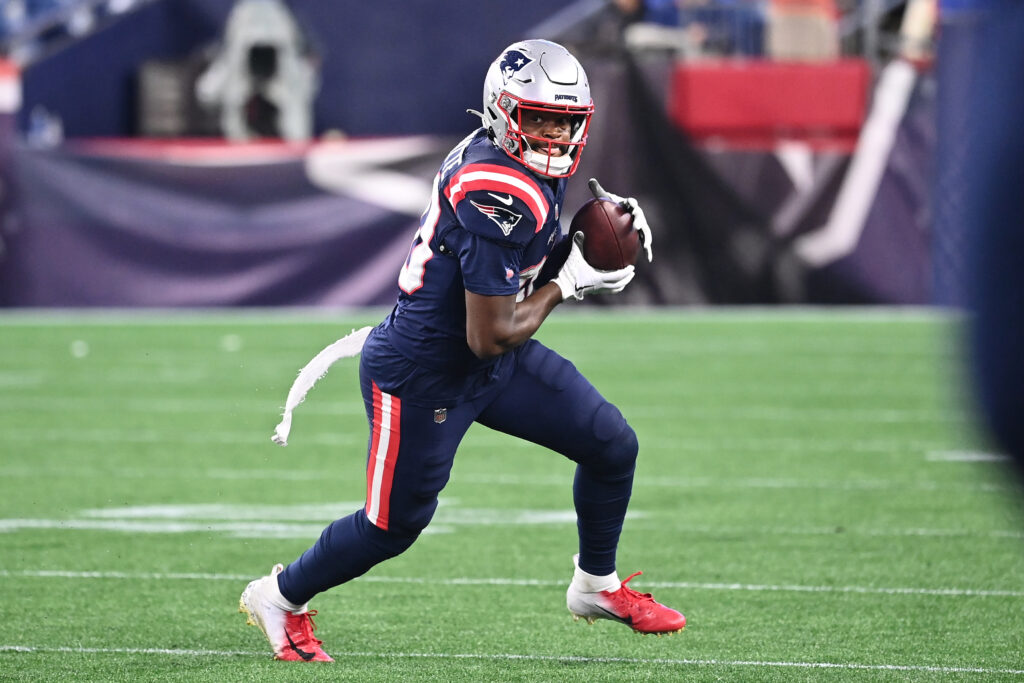
The Patriots completed the A.J. Brown acquisition last month and are now staring down a roster math problem: seven legitimate wide receivers competing for six regular-season spots. That logjam forces New England into one of two paths—trade a notable contributor or release one outright—and the decision will rewrite the team's passing-game allocation before Week 1.
Brown, who immediately claims the alpha role, and Romeo Doubs, locked in on a four-year, $68 million free-agent deal, are untouchable. Mack Hollins' elite blocking prowess and his emergence as a playoff target in 2025 also keep him safe. Kyle Williams, a third-round pick from 2025 valued for game-breaking speed, rounds out the protected tier. That leaves three candidates for the door: Kayshon Boutte, DeMario Douglas, and Efton Chism. Boutte is the most productive of the trio—33 catches, 551 yards, six receiving touchdowns, and a 16.7 yard-per-catch average in 2025—yet he's also the most expendable. He operates primarily on the outside, a role already populated with Brown, Doubs, Hollins, and Williams. His rookie contract expires after 2026, making him a short-term rental. The Patriots shopped him for a fifth- or sixth-round pick and found no takers, which suggests the market doesn't view him as a mid-tier commodity. If New England releases Boutte, they clear $3.6 million in cap space.
Douglas and Chism operate as slot depth, where the market inside is thinner but the usage has cratered. Douglas averaged 83 targets per year his first two seasons; that dropped to 46 in 2025, a signal that the Patriots are actively downweighting the inside game. Chism lacks Douglas's track record but holds superior contract flexibility through 2027 before hitting restricted free agency. Either could be cut with minimal dead money.
For bettors, the takeaway hinges on understanding target scarcity: whichever receiver survives the cut gets reps and opportunity; whoever exits loses them entirely. If Boutte departs, Doubs and Hollins absorb those 33 annual targets, lifting their baseline receptions and yards props. If Douglas is released, slot snaps migrate to Chism or get consolidated within Doubs and Hollins' route trees. The market hasn't yet priced the depth-chart volatility into individual receiver props because the final roster shape remains unsettled. Once the team makes the cut—likely in late July or early August—the first public lines will overcorrect to the previous season's volume for survivors. The angle exists in pre-cut lines for the protected three: Doubs, Hollins, and Williams will see meaningful target bumps once the room thins, but those lines are still anchored to 2025 usage. Lean overs on receiving yards and receptions for New England's top three threats if current lines reflect crowded-room splits.
The volatility window is narrow—late July through the first week of August, before training-camp depth charts firm up and the market reprices. After that, the edge compresses. Single-game NFL props don't go live until the week before, but season-long receiver props available now carry embedded overcrowding risk. That's the real asset: spotting which three emerge from the purge and backing their yards lines at pre-cut prices.