Raiders Backfield Depth Crunch Signals Potential Mid-Season Acquisition
By Ty Whitney ·
Las Vegas auditions Miles Sanders as insurance against a historically thin running back room that lacks experience beyond its premium draft pick.
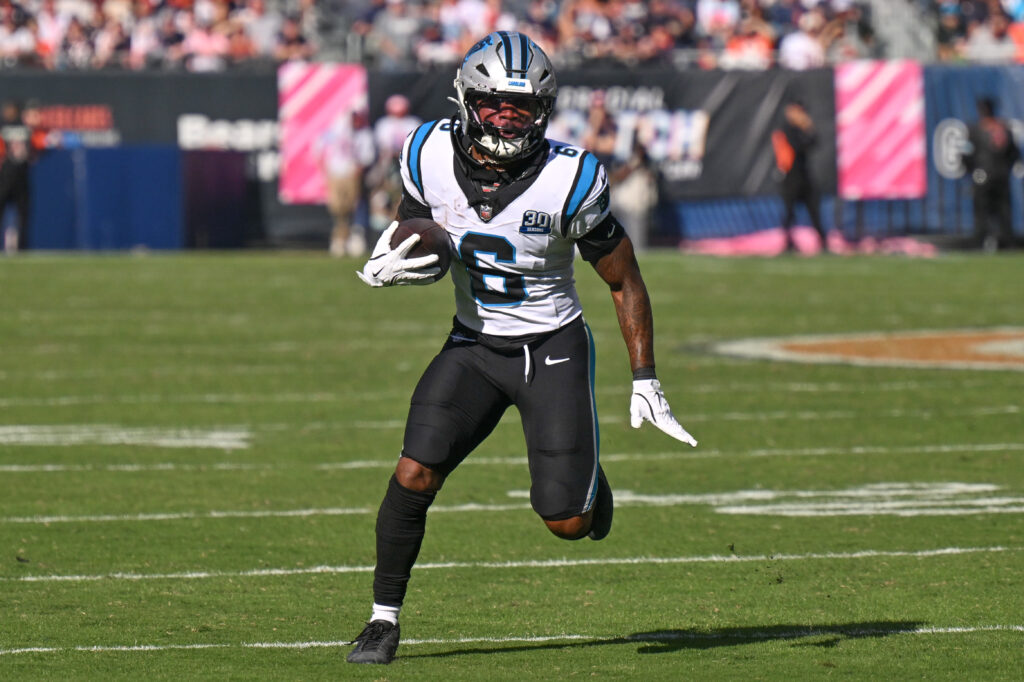
The Raiders brought in Miles Sanders for a workout this week, a low-cost probe into veteran depth at a position where the team's depth chart reads like a draft class waiting to happen. Behind 2025 first-round pick Ashton Jeanty, Las Vegas has little to no proven NFL production: Chris Collier and Dylan Laube, both 26 and in their third seasons, have combined for 13 career rushing attempts. That's not depth. That's a vulnerability.
Sanders, 28, spent the last two seasons in Carolina after four years with Philadelphia, where he averaged 4.2 yards per carry in a featured role. He's not a star—his career touched 1,700 rushing yards only once—but he represents the kind of change-of-pace back who can spell a bell-cow starter and absorb carries if injury strikes. The Raiders' interest isn't about finding the future; it's insurance against a backfield that depends almost entirely on Jeanty staying healthy through September and beyond.
Jeanty was the consensus top running back in the 2025 draft and profiles as a three-down weapon, but rookies and second-year backs still face the law of volume: even elite backs accumulate soft-tissue injuries, hyperextensions, and load management over a 17-game season. Sanders fills that gap. If Las Vegas signs him—likely on a reserve/future deal or a camp invitation—he becomes a functional hedge on Jeanty's workload.
For bettors, this move clouds the clearest edge in the Raiders backfield: Jeanty's receiving upside. A heavy workload assumption underpins any bet on Jeanty receptions or receiving yards, particularly in games where Vegas plays from behind (his receiving role expands in pass-heavy scripts). If the team brings in Sanders or another veteran, the volume thesis weakens slightly—carries and targets get distributed. Early-season Jeanty receiving props are priced on a concentrated-volume floor; adding a proven backup erodes that certainty. The passing game implication matters more: if Sanders soaks up early-down work, Jeanty sees more third-and-long opportunities, which tilts his receiving mix toward short-yardage conversion passes rather than explosive downfield targets.
Watch the roster move closely. A signing elevates the backfield's floor but softens the ceiling on any single back's volume-dependent prop. Jeanty's touchdown probability may hold steady or improve (more time in the end zone), but reception and receiving yard totals contract. If Sanders remains unsigned and Laube remains the only proven backup, Jeanty's workload becomes the prop market's single-biggest lever—and the window to buy his ceiling-case receiving props at unpriced levels closes fast.