Raiders Flip Script on Jeanty: Kubiak Pivots From Committee Back to Workhorse Model
By Ty Whitney ·
Two weeks after floating a two-back rotation, the Raiders head coach signals a full commitment to featuring Ashton Jeanty as the lead back—a reversal that reshapes his touchdown and yardage prop value.
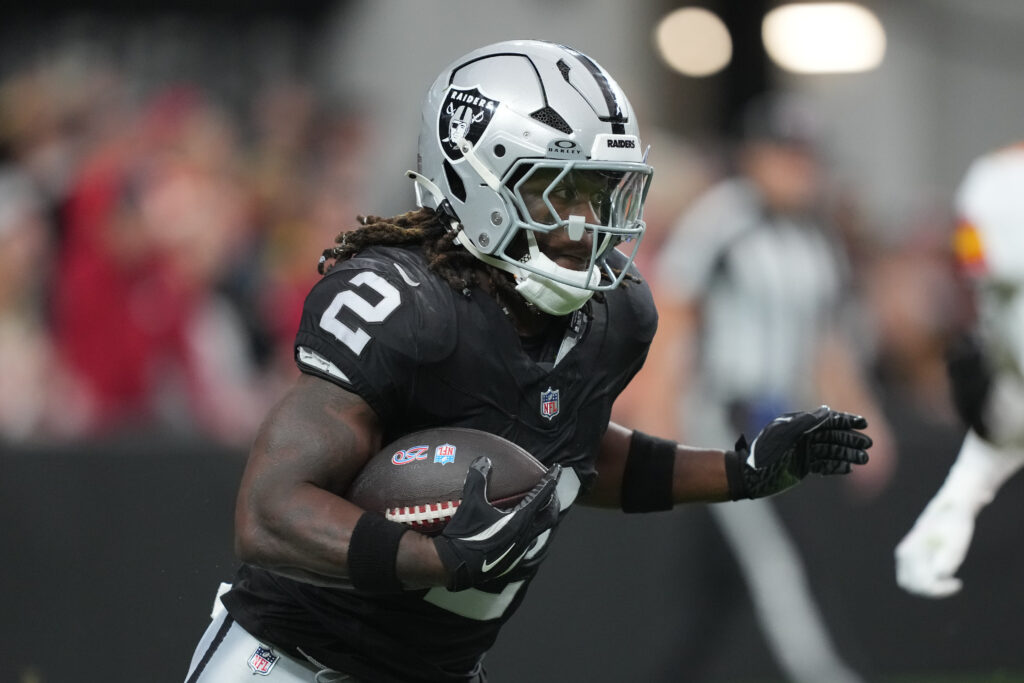
Klint Kubiak's messaging on Ashton Jeanty has shifted sharply. After telling ESPN's Ryan McFadden two weeks ago that he wanted to build a two-running-back system to lighten Jeanty's workload, the new Raiders head coach has now signaled a different approach: Jeanty will operate as the featured back, with a snap share modeled on Christian McCaffrey's role in San Francisco. The change matters because it removes the biggest uncertainty hanging over Jeanty's prop profile since the draft—whether Las Vegas would cap his volume to preserve him.
Kubiak's reversal likely reflects what three weeks of camp tape revealed: Jeanty's receiving ability and pass-protection polish make him too valuable to park on the sideline. The dual-threat profile that made him a round-one pick does more damage than a traditional thumper, and that versatility justifies usage in the 65-70% snap-share range rather than the 45-55% committee split the coach initially preferred. That level of assignment is also how you actually maximize a premium asset—you ride the hot hand when it's this talented, not manage it into underperformance.
From a roster construction angle, the Raiders' investment reinforces the shift. Kubiak chose Jeanty at pick 15 after spending the offseason strengthening the offensive line and adding interior pass-catchers. The team built the system around him, not around sharing carries. Reversing the committee plan and pivoting to a McCaffrey model says the organization views Jeanty as a centerpiece, not a prospect to be carefully managed. That internal valuation—reflected in draft capital and schematic design—typically outlasts early-season hedging talk.
For prop bettors, the swing from committee back to workhorse reshapes the betting landscape. Rushing yards totals set at the draft assumed a 45-50% snap share and mid-15-carry range; a McCaffrey-scaled role (18-22 carries per game in favorable matchups) would push Jeanty into 100-plus-yard territory far more regularly. His receiving floor also lifts in a workhorse model—McCaffrey averaged 5.2 receptions per game last season; even a moderately competent offense hitting 70% of that pace yields 3-plus receptions on most Sundays. The upside edge exists in the 90+ rushing yards and 4-plus receptions angles, where volume assumptions were previously depressed by the committee talk. The market has likely not fully priced the snap-share increase because Kubiak's earlier comments created anchor bias toward lighter usage.
The durability concern Kubiak cited two weeks ago—the stated reason for a committee—has not disappeared. Jeanty carries injury risk like any back. But the coach's pivot signals that managing that risk through reduced snaps was never the real plan, only the contingency. The workhorse model is the play.