Stroud's Extension Standoff: Why Houston's QB Patience Could Reshape 2026 Prop Markets
By PropBetEdge Editorial Team ·
C.J. Stroud is content waiting until after the 2026 season for his next contract, but his confidence in his résumé—and the Texans' financial squeeze—will matter far more to playoff performance props than the timing of any deal.
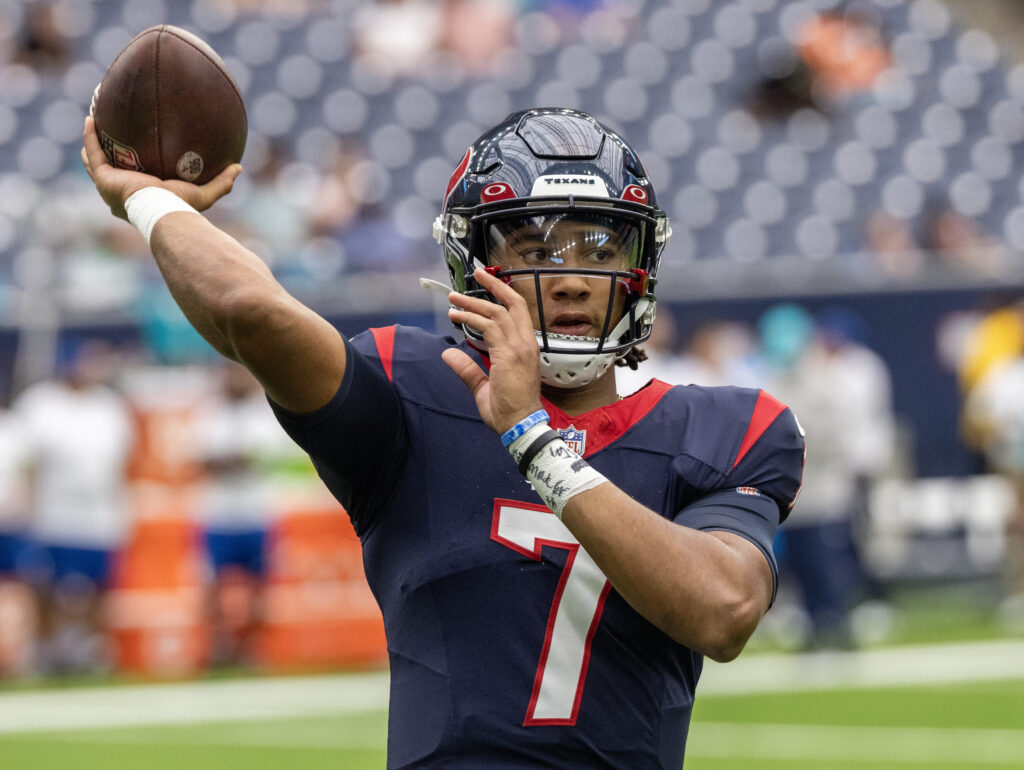
C.J. Stroud has made clear he believes his three-year track record warrants a second contract, but Houston won't move until the 2026 season concludes. Per ESPN, the 24-year-old acknowledged that his representatives have discussed extension terms with the Texans, though no formal negotiations have materialized. "I let my agent handle that," Stroud told reporters. "My job is football." The subtext is pointed: he's held up his end.
On the surface, Stroud's case is defensible. In three seasons, he's delivered double-digit wins each year and playoff berths in all three. His 2023 Offensive Rookie of the Year award still stands as one of the cleanest evaluations in recent memory. But the substance behind his confidence matters less than the organizational calculus. Houston's defense is locked into expensive long-term deals—Will Anderson Jr. signed his extension earlier this spring—and receiver Nico Collins just received a short-term pay bump. General manager Nick Caserio is managing a salary cap crunch. Delaying Stroud's extension by one season buys time and removes pressure from an already tight structure. The current QB market sits at $60 million annually. Waiting through 2026 doesn't cost the Texans material dollars if no new supernova emerges, and it shifts risk entirely onto Stroud's shoulders.
That risk calculus becomes relevant to how we model Stroud's 2026 performance. A QB playing out a final year of his rookie deal—with $200 million+ in guaranteed money hanging on playoff success and statistical validation—operates under different leverage than one who's already collected his payday. Stroud's 2025 was marked by seven turnovers across two playoff games and a three-game absence due to concussion, catalyzing criticism despite his regular-season numbers. A prove-it season in 2026 typically correlates with aggressive game-planning and higher variance: more deep shots, more fourth-quarter heroics, fewer conservative check-downs. Houston's coaching staff, led by DeMeco Ryans, will be keenly aware of the narrative. For bettors, this translates to elevated passing volume and touchdown volatility.
Stroud's passing yards prop should carry slight upside bias in early-season markets. His motivation is structural—not circumstantial—and his supporting cast (Collins, a sharpened run game if the Texans invest) remains intact. More consequential is interceptions thrown: a QB playing for validation under pressure tends to test coverage downfield more freely, which increases INT risk in tighter playoff matchups. Markets will price Stroud's 2025 playoff struggles as a blip, but the combination of unresolved contract status and a defensive line burdened by cap commitments means Houston's ceiling in 2026 may be lower than his individual stats suggest. Late-season team total props and divisional spreads become valuable hedges once the Texans' actual cap flexibility (or lack thereof) becomes apparent.