Patriots' Edge-Rushing Gamble: Jacas' Health Gambit and the Cost of Inaction
By Erik Schwartz ·
New England's reluctance to add pass-rush help despite bottom-third production hinges entirely on a second-round rookie who remains unsigned and recovering from multiple procedures.
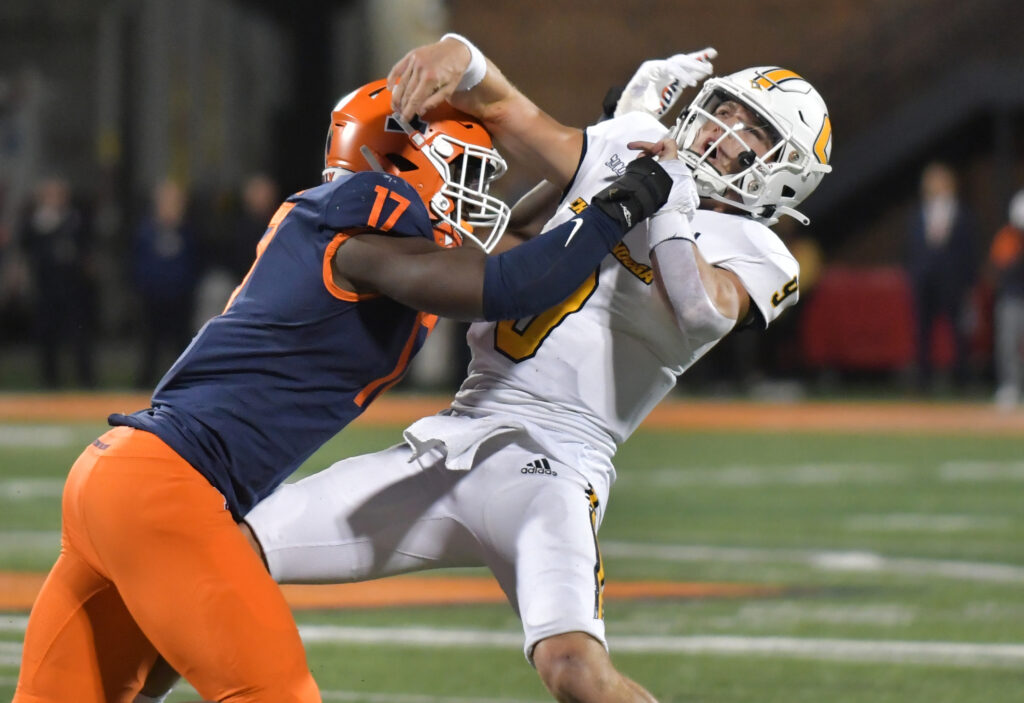
The Patriots finished last season ranked 19th in pass rush win rate and 26th in sacks, a defensive embarrassment that should have triggered urgent free-agent reinforcement. Instead, Mike Vrabel's offseason upgrades amount to swapping K'Lavon Chaisson for Dre'Mont Jones and betting their 2026 season on Gabe Jacas—a 55th-overall pick who has spent the last six weeks away from the facility and remains unsigned as of mid-June.
Jacas' situation is a house of cards built on optimistic medical prognosis. Per ESPN, the Illinois edge rusher had arthroscopic knee surgery—a cleanup procedure the team describes as non-threatening to his 2026 availability. Vrabel suggested Jacas could be ready for training camp, which begins in roughly 10 weeks. But the knee surgery is layer one of a troubling health profile. Jacas missed the Combine and his pro day due to a hamstring injury, carries a labral tear in his shoulder that may require intervention, and has a stress fracture in his foot that sources worry could "worsen over time." Despite those red flags, two NFL teams gave him a medical clearance. The Patriots have not. That's why Jacas remains unsigned—New England is withholding a standard participation agreement, the kind most rookies accept as a formality. Those agreements guarantee a rookie gets paid their slot value even if injured before signing. Jacas is owed roughly $8.6 million over four years; with his injury complications, the Patriots are demanding more negotiating leverage on guaranteed money before committing.
The decision to stay passive on the veteran edge market—passing on accomplished free agents like Von Miller, Jadeveon Clowney, Leonard Floyd, and former Patriot Kyle Van Noy—is indefensible if Jacas' multiple surgeries delay his availability past September. Harold Landry anchored New England's pass rush last season with 8.5 sacks; Jones is a lateral replacement at best. After those two, the Patriots are counting on an unproven 2025 seventh-rounder (Quintayvious Hutchins), marginal internal candidates (Elijah Ponder, Bradyn Swinson, Jesse Luketa), and a health-question-mark second-rounder who isn't even contractually obligated yet. That roster construction against a top-10 schedule demand is betting the farm on a player who hasn't taken a full-speed rep since the draft.
For prop bettors, this dynamic creates a countervailing pressure on New England's defensive totals. The consensus heading into 2026 positioned the Patriots' defense as a modest step backward from their AFC-winning 2025 edition—a reasonable take given that Landry's 8.5 sacks represented elite edge efficiency on a weak roster. If Jacas returns to full health and develops immediately, New England's pass-rush rate could jump materially in weeks 7-17 once he gains in-game snap count. But the first four to six weeks—September through mid-October—represent genuine dead weight on the edge, a window in which the Patriots could spiral defensively if their schedule front-loads premier passing attacks. Landry and Jones alone cannot sustain 2025's production if facing elite offensive lines without Jacas' contribution. The line for New England's pass rush win rate and sacks total will initially assume full-health Jacas by Week 1; it will overprice that assumption because medical timelines in June almost always slip.
Anyone looking at Patriots sacks or team defense props this summer should recognize the single-variable bet embedded in the lineup: Jacas' healing timeline. If training camp revelation confirms he's healthy and participating in 11-on-11, the market will correct sharply. If he limps through camp or misses weeks 1-4, the unders on New England defensive volume become high-conviction plays. For now, the Patriots' public posture is confidence masking a negotiation. The market hasn't priced the medical risk yet.