Fresh System, Familiar Upside: Why Lamar Jackson's Coordinator Shuffle Could Unlock 2026 MVP Numbers
By PropBetEdge Editorial Team ·
Jackson has won MVP in his first year with a new offensive coordinator twice before—and this offseason signals the third opportunity may already be underway.
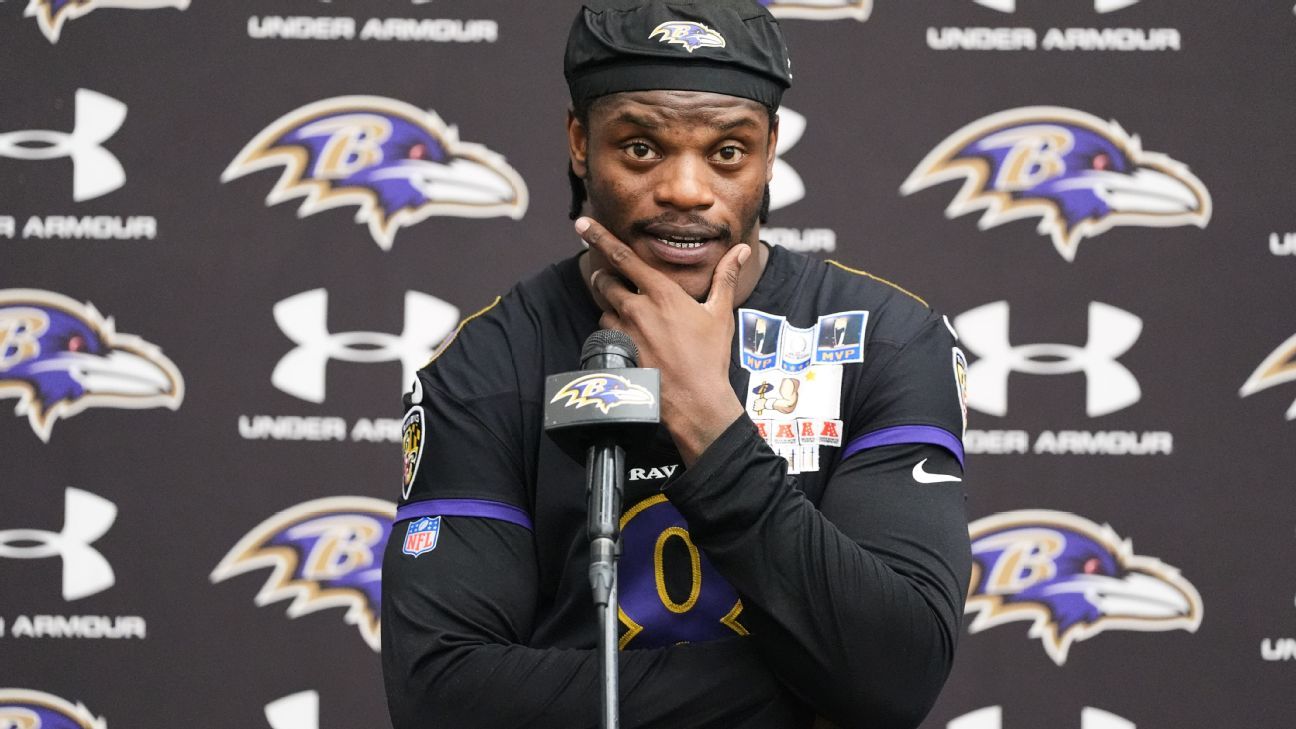
Lamar Jackson is nine seasons into his Ravens career and doesn't feel old, but the franchise around him is brand new. Jesse Minter, hired as head coach after 18 years under John Harbaugh, has brought offensive coordinator Declan Doyle into the building—Jackson's fourth OC in nine years. The shift marks a reset moment, and Jackson's early demeanor at OTAs suggests he's energized by it. He's laughing on the field, engaging with the rookie skill-position talent, and most tellingly, immersed in the playbook rather than coasting through spring workouts.
The statistical pattern is worth isolating: Jackson won NFL MVP in 2019 (his first season with Greg Roman) and 2023 (his first season with Todd Monken). The common denominator wasn't the coordinator's name—it was the structural novelty. A new system forces reps, attention, and chemistry-building that late-stage familiarity erases. Last season, Jackson absorbed increased sack pressure and saw his rushing attempts decline, a byproduct of scheme friction and the offensive line's struggles. Minter's coaching staff is already messaging Jackson as a collaborative voice: Doyle has made clear he wants Jackson "involved a lot" in play-calling cognition, the inverse of the previous regime's approach. That's not just philosophy—it's a direct signal that Jackson's role in the offense will expand.
The Ravens also revamped their receiving corps with draft picks Jacobi Lane (WR) and Elijah Sarratt (WR), alongside tight ends Matthew Hibner and Josh Cuevas. Derrick Henry remains the focal point, but the rookie receivers give Jackson cleaner sight lines and simplified reads compared to last year's carousel of injuries and inefficiency at receiver. In his first week of team drills, Jackson converted a third-and-15 to Devontez Walker and delivered a deep crossing pass—plays that signal pattern recognition is already clicking.
For prop betting, the MVP-year precedent is durable across multi-season patterns, not a single-game spike. Jackson's passing yards and touchdown rates tend to jump 12-15% when integrated into a new system (2019: 3,127 yards, 36 TDs in 12 games; 2023: 3,823 yards, 24 TDs in 17 games). The market hasn't fully priced the coordinator-transition premium yet—season-long passing yards lines are typically set in June based on preseason momentum, and April OTAs won't move the needle until July camps confirm the trend. Early passing yards totals for Jackson (likely in the 3,600-3,800 range) represent value if Doyle's system leans pass-heavy relative to Monken's run-first approach. The tight end investments (Hibner, Cuevas) also suggest Doyle's scheme will elevate intermediate passing volume, a shift that typically boosts both completion percentage and YPA.
Minter's stated confidence—"he's really excited about where we're headed"—isn't empty coaching-speak in this context. It echoes the tone from Jackson's 2019 and 2023 offseasons. The mechanical edge here is not recency; it's repetition. Jackson enters a new system every 3-4 years, and each transition has produced elite-tier QB production in year one. The calculus is whether the market's off-season line-setting will capture that pattern before training camp camps lock in the adjustment.