Samuel Returns to 49ers on Incentive-Heavy Deal; Brissett's Cardinal Raise Signals Confidence
By Ty Whitney ·
Deebo Samuel's San Francisco reunion hinges entirely on usage, while Jacoby Brissett's restructure into starter money reshuffles Arizona's QB confidence hierarchy.
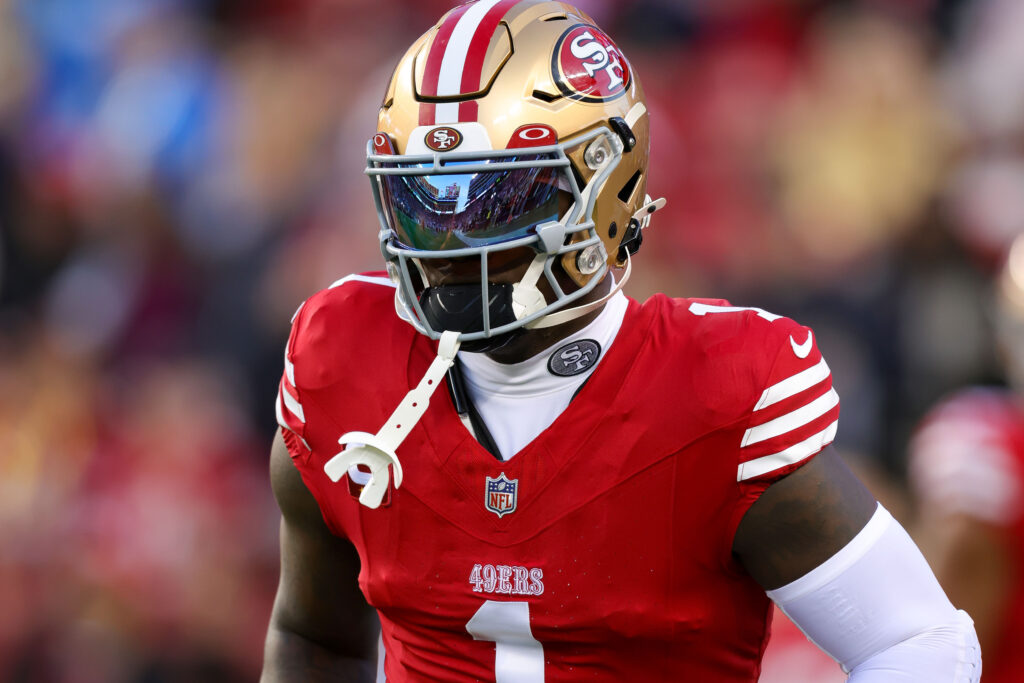
Deebo Samuel is back in red and gold, but on terms that reveal exactly how much the 49ers value his all-purpose role versus his aging market value. The veteran receiver inked a $7MM maximum deal with just under $4MM guaranteed—a $3.27MM base salary, $490K signing bonus, and $20K per game appearance. That floor-and-ceiling structure matters: San Francisco isn't betting on Samuel at 30 years old. They're betting on usage.
The incentive architecture tells the real story. Samuel collects $250K if he reaches 600 scrimmage yards, and $450K more if he hits 803. Both bonuses double if the 49ers make the playoffs. Another $250K unlocks if he places top-10 in kick-return yards per attempt, and a fourth $250K tier activates if he exceeds 68% of offensive snaps. That's $1MM in ancillary earnings available—nearly 25% of his maximum value—contingent on snap share and cumulative output. Lynch's public statement that Samuel will line up "at receiver, at running back, and in the return game" is organizational validation that the Niners plan heavy rotation. Washington used Samuel exclusively as a returner last season with just 17 carries; San Francisco's track record shows 37 to 59 carries per year in his previous stint. If the 49ers restore him to that earlier volume—and the bonus structure suggests they're incentivizing it—Samuel becomes a volume-dependent receiving and rushing asset.
Meanwhile, Jacoby Brissett's Arizona restructure from $4.88MM to $15.5MM fully guaranteed tells a different market signal. The Cardinals moved from $1.5MM guaranteed to $15.5MM guaranteed, a swing that only happens when a team commits to a player as a franchise starter. For Brissett, this is his largest guarantee since his 2019 Colts deal. The restructure seats him as Arizona's QB1 without question, even with the void year for cap mechanics. A $9.7MM dead-cap charge looms if he's unsigned past the 2027 league year, which means Arizona has structural incentive to keep him through 2026 and likely into 2027. The Cardinals are projecting through Brissett, not shopping him.
For prop bettors, Samuel's incentive thresholds create a clear operational vector: his snap share percentage and carry volume will be managed in real time against those bonuses. If San Francisco reaches 600 scrimmage yards early, watch for potential snap-count reduction to protect the $450K threshold bonus (why spend snaps on the $803 target if the playoff bonus already primed?). Alternatively, if the team races ahead early in games, game scripts may limit his carries, suppressing the rushing volume that earned 37-59 carries in his prior tenure. Samuel's receiving yards and anytime TD props should reflect median usage—he won't spike above his historical ceiling if the Niners control gamescript—but could compress if the 68% snap-share incentive goes unmet. Track his Week 1 snap allocation carefully; it will signal whether San Francisco is engineering his role for maximum bonus realization or capping his workload for salary discipline.
Brissett's restructure doesn't immediately change his arm-talent ceiling, but it removes the queue of backup-eligible scenarios. Arizona has committed starter money, starter guarantees, and starter-length cap obligation. His passing volume and TD upside are now a roster-construction statement, not a mercenary audition.