Giants' Receiving Depth Play Reshapes Slayton's Volume Ceiling for 2026
By Ty Whitney ·
Darius Slayton's core-muscle surgery clears him for training camp, but the Giants' aggressive receiver additions—including Malik Nabers' return—will compress his target share regardless of health status.
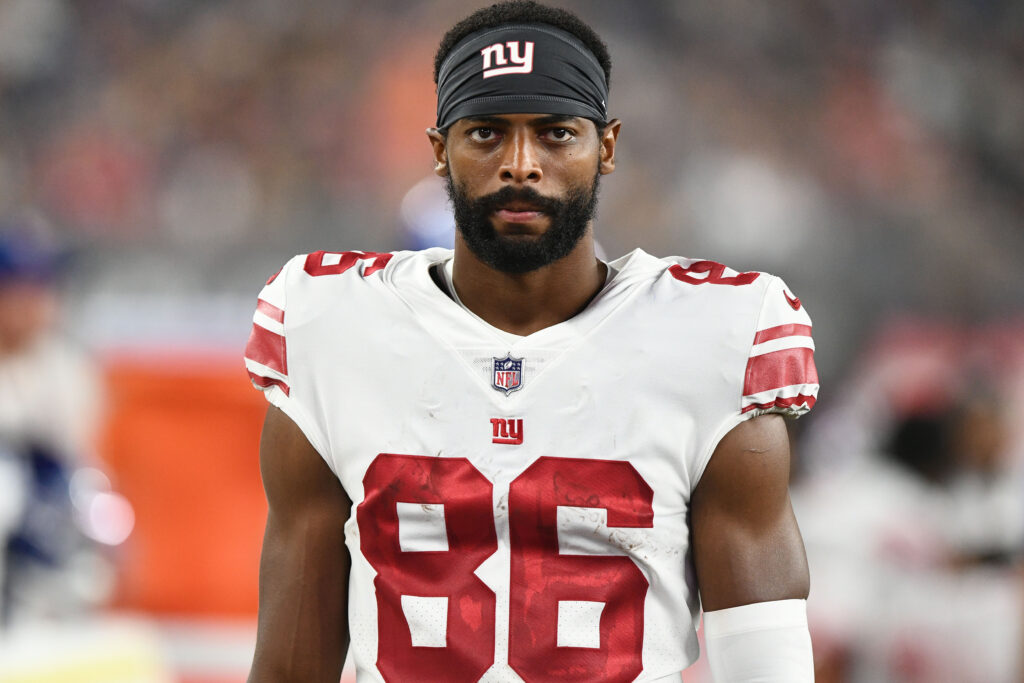
Darius Slayton had minor core-muscle surgery, and the Giants expect zero impact on his availability for training camp. The procedure carries no timeline risk; Slayton will be ready for organized team activities as scheduled. The real constraint on his 2026 workload arrives not from the operating table but from the receiver room itself.
Slayton caught 37 passes for 538 yards and a touchdown across 14 games last season—a viable WR3 in volume terms and a fixture in the Giants' pass-game architecture. That architecture has just shifted. New York is welcoming back Malik Nabers from a torn ACL that cost him most of 2025. Nabers, the team's No. 1 receiver and the sixth overall pick in 2024, was a 76-catch pace player before injury. Alongside him sit new acquisitions Darnell Mooney (signed as a veteran free agent) and Calvin Austin III (who emerged as a deep threat in Pittsburgh), plus third-round rookie Malachi Fields. The receiving corps has gone from a top-heavy dependency on Slayton to a four-deep talent stack.
This is a textbook volume displacement scenario. Slayton's 4.4% target share last season will almost certainly decline once Nabers returns to full-time snaps and the coaching staff distributes balls across an expanded menu. Nabers will command 25%+ of targets; Mooney traditionally runs 18-22% in non-injured seasons; Austin and Fields will carve out roles. The pie is not growing—quarterback Daniel Jones threw 259 passing attempts in 14 games last season—so incremental additions create zero-sum pressure on existing contributors.
For prop bettors, this manifests in two directions: Slayton's receiving-yards ceiling compresses even if he remains healthy, and his anytime-TD line (which may carry modest implied odds given his red-zone usage history) faces volume drag. If oddsmakers price him on 2025 production benchmarks—37 catches, 538 yards, extrapolated to 17 games—they will be bidding up a baseline that the depth chart no longer supports. The market's natural drift is to assume continuity; the Giants' roster construction explicitly rejects it. Any preseason line on Slayton's season receiving yards above 650 warrants skepticism, as it assumes either Nabers' continued absence or a usage profile the team's investments contradict.
Slayton remains a functional NFL receiver, but he is no longer the default target in a thin room. The Giants have built redundancy specifically to solve that problem.