Dulcich's Dolphins Priority Signals a Shift in Miami's Passing-Game Architecture
By Ty Whitney ·
The Dolphins' aggressive re-signing of Greg Dulcich and deployment of Malik Willis at quarterback reshape target distribution in a receiver room stripped of Hill and Waddle.
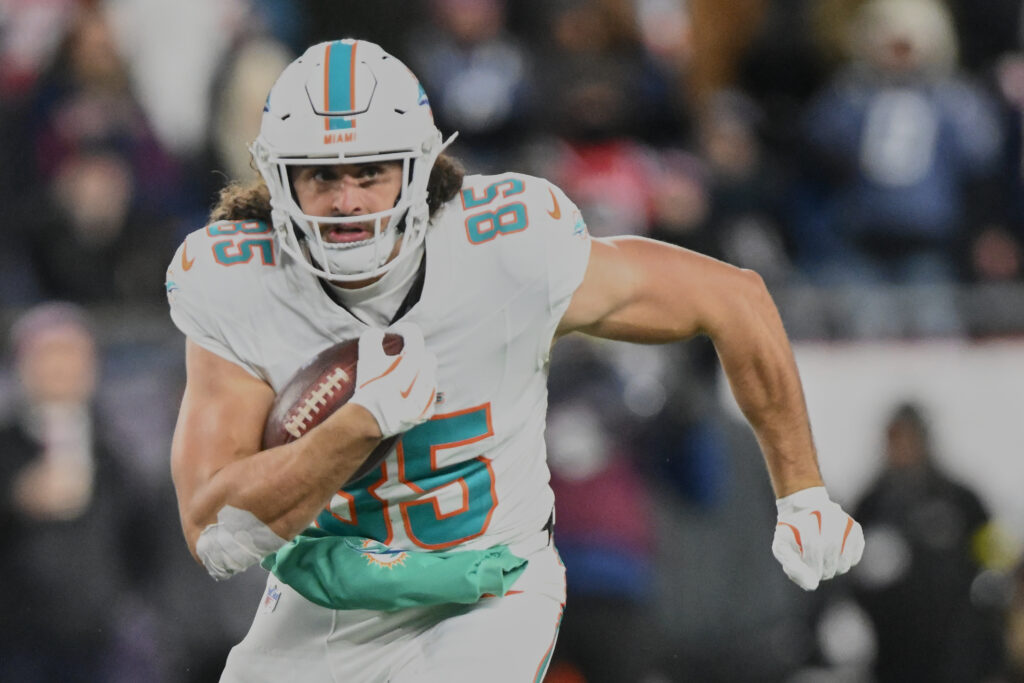
Miami's front office has made its passing-game priorities clear this offseason: re-signing tight end Greg Dulcich ahead of nearly every other returning free agent signals a structural commitment to the position that extends beyond typical roster maintenance. GM Jon-Eric Sullivan identified Dulcich as the returning player he most wanted to develop in 2026, while tight ends coach Rob Middleton called him a prospect with unlimited upside. The team locked him in on a one-year, $3.25MM deal—modest in absolute terms but substantial in relative priority when cap constraints forced Miami to lose depth elsewhere.
Context matters here. Dulcich is not an elite talent. He's a 26-year-old journeyman who bounced from Denver to the Giants' scrap heap and into Miami's practice squad before landing 26 catches in 10 games last season. But what he represents is functional—a capable intermediate target in a passing offense that just lost its two alpha receivers. With Tyreek Hill and Jaylen Waddle gone, the Dolphins' vertical and horizontal spacing collapses without a secondary creator. New quarterback Malik Willis, a former third-round pick known for arm talent but inconsistent decision-making, enters an offense laden with Day 2 and Day 3 rookies. Dulcich becomes a default safety valve and a measured intermediate option—exactly what a younger QB needs when the outside is sparse.
The two tight ends Miami drafted in the spring—Will Kacmarek (third round) and Seydou Traore (fifth round)—do not solve this year's problem. Kacmarek projects as a blocker first, receiver later; Traore is raw and developmental. Dulcich steps into a starting role by default and design. In 10 games last season, he ran 62 routes according to league data, averaging 6.2 routes per game. With the two receiving slots now occupied by depth-chart fillers and reclamation projects (Tutu Atwell, Jalen Tolbert), Dulcich's route count will climb sharply in 2026. Willis will need a reliable third-option target, and Dulcich's reprieve from waivers into a prioritized contract extension signals Miami's internal valuation: they see him as a quasi-plug-and-play starter, not a competition-level prospect.
For prop bettors, the mechanism is straightforward. Dulcich's receiving total—currently unmarked by most books given his modest 2025 volume—will climb into the 60-70 catch range if he maintains target share and increased playing time. Willis averaged 6.8 targets per start to tight ends in his limited 2025 action; Dulcich accounted for approximately 2.4 of those in Miami's system. If Willis accounts for 8-9 targets to the tight end position weekly (a reasonable expectation given the receiver losses), Dulcich's share likely holds at 30-35%, landing him in the 4.5-5.5 receptions per game range over a full season. His season receiving-yards total will reflect the same dynamic: more routes, more targets, more volume. Books have not yet priced in Miami's structural pivot around Dulcich; the contract priority and coaching praise represent front-office information already in motion. Early totals on receiving yards in the 700-800 range carry value on the over, as the path to 900-1,000 yards exists if Willis stays healthy and Dulcich avoids injury.
The kicker competition is noise by comparison. Riley Patterson's 27-of-29 accuracy deserves job security, and special teams coach Chris Tabor's prior relationship with Zane Gonzalez introduces competitive pressure but not existential threat. Patterson's skill set remains stable; Patterson FG makes and extra points are reliable holdings at current market rates, though expect modest regression from 27/29 in a full season.