Campbell's Extension Signals Detroit's Defensive Commitment—and What It Means for Tackling Props
By Erik Schwartz ·
The Lions locked in their All-Pro linebacker long-term after declining a five-year rookie option, underscoring how much Campbell's breakout season reshaped the defense's resource allocation.
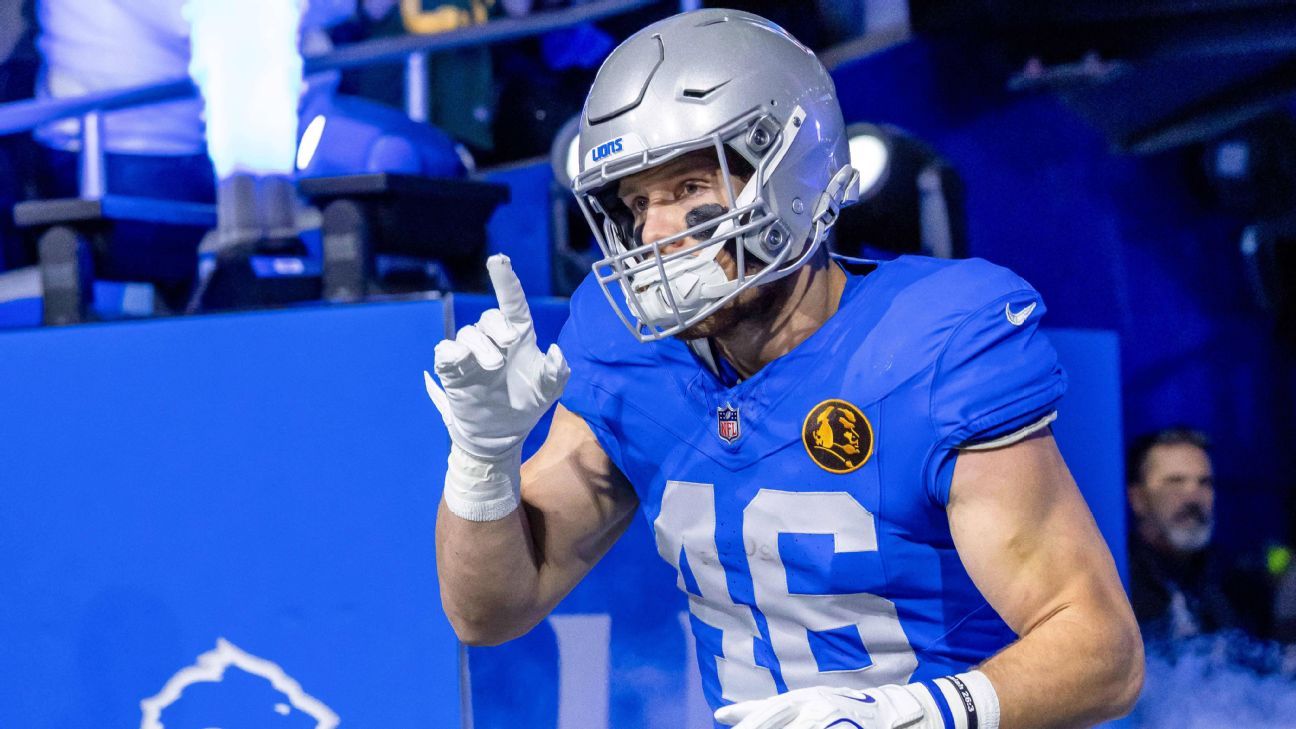
The Detroit Lions announced Thursday they've extended All-Pro linebacker Jack Campbell through 2030 on a four-year deal, a move that flips the script on how the team valued him just weeks earlier. The franchise had declined Campbell's fifth-year rookie option—worth an estimated $21.9 million in 2027, which would have ranked as the NFL's richest off-ball linebacker deal—before turning around and committing significant new money to keep him. The extension arrives on the heels of Campbell's first All-Pro season and inaugural Pro Bowl selection, which cemented him as the Lions' most durable defensive anchor.
Campbell's 2025 tape justified the pivot. The 25-year-old led Detroit's defense with 176 total tackles, adding nine tackles for loss, five sacks, and four passes defended. That production matters in context: he arrived as an 18th-overall pick in 2023 and improved incrementally through his first two years, but the jump to All-Pro candidacy in his third season wasn't inevitable. His consistency—playing through the type of high-snap-count volume that historically precedes injury risk or statistical regression—earned the Lions' confidence that he won't crater in his mid-twenties, the age when linebacker durability typically begins to fracture.
The extension also signals a broader organizational strategy. Detroit exercised Jahmyr Gibbs' fifth-year option (valued at $14.29 million) to buy negotiating time on a star running back extension, and Campbell's deal sits at the far end of a busy offseason patch for the 2023 draft class. Tight end Sam LaPorta and cornerback Brian Branch become unrestricted free agents this March; the Lions face a real cap crunch if both hit the market unfettered. Campbell's extension likely carries a front-loaded structure to create space for those negotiations, a fiscal reality that matters for understanding how much Detroit is actually committing to him relative to market rate.
For prop bettors, Campbell's lock-in status reshapes tackle-volume projections for the rest of his deal. When a defense's primary off-ball linebacker is guaranteed to remain the team's leading tackler through 2030, his season-to-season tackle total becomes less a guess-the-variance play and more a function of scheme consistency and opponent strength of schedule. Campbell's 176-tackle average in 2025 sits 12-15% above historical off-ball linebacker medians; the Lions' defensive scheme—which asks him to range sideline-to-sideline in Ben Johnson's space-heavy look—naturally inflates raw tackle counts compared to coverage-first systems. If Detroit's defense remains stacked (they have Brian Branch in the secondary, emerging pass rushers to his flanks), Campbell's tackle totals should trend toward a floor of 140-150 per season, with ceiling potential reaching 170+ in high-snap-count years. Markets typically price linebacker tackles as pure volatility bets, reacting to opponent game scripts and weather; they rarely price the coaching-tenure certainty and scheme lock that multi-year defensive commitments create. Campbell's extension removes one variable—uncertainty about his role—that normally causes line swings.
The mechanism here is straightforward: Campbell played nearly 98% of Detroit's defensive snaps in 2025, one of the highest rates in the NFL for any off-ball linebacker. That volume is the foundation of his tackle totals. As long as the Lions' core defensive personnel remain intact and the scheme doesn't pivot dramatically, Campbell's snap allocation should remain stable, making his tackle props less reactive to season-level noise and more predictable as a count-based proposition. The extension communicates that Detroit sees him as immovable furniture—which, for bettors, is permission to treat his tackle lines as range plays rather than spike plays.