McNeill's Second Spring: Why Detroit's D-Line Reset Matters for 2026 Defense
By Erik Schwartz ·
The Lions' interior disruptor is fully recovered from last season's ACL limitations, arriving at training camp as a different player—and that changes how defenses will attack Detroit's pocket.
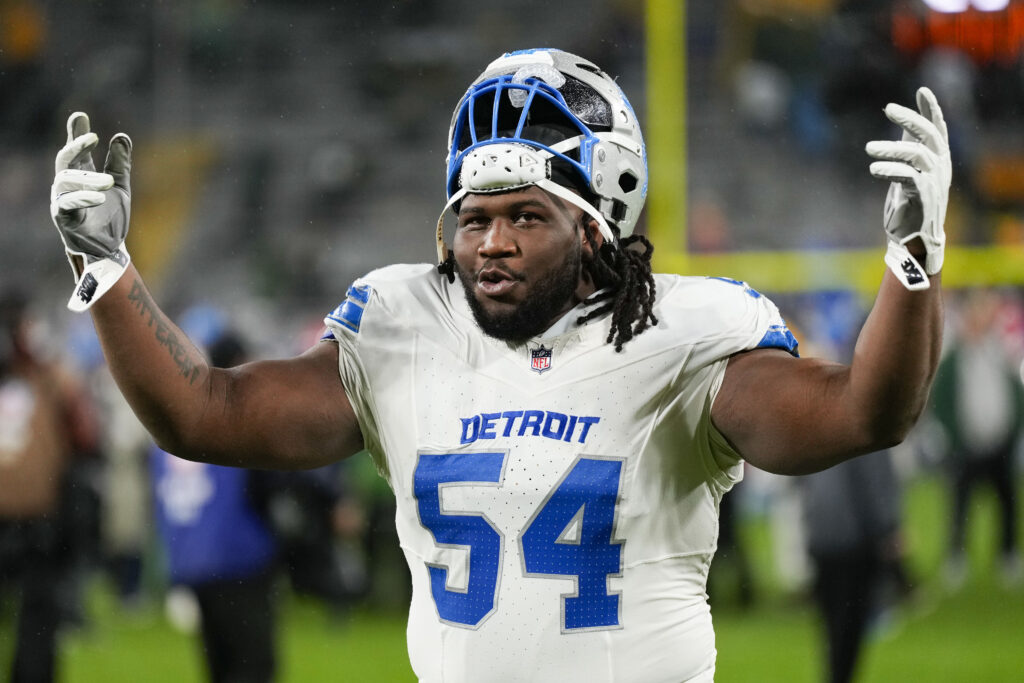
Alim McNeill is no longer operating on a rebuilt leg. Per the team's announcement, the Lions' defensive tackle—now seven months removed from the end of his 2025 season—describes a "night and day" difference between his limited self last year and his current physical state. He's cleared for full participation in offseason work, and his mind has finally caught up to his body: McNeill can now plant and drive without hesitation, the kind of micro-mechanical recovery that doesn't show on scans but transforms on-field production.
Last season's numbers buried the real story. McNeill logged just one sack, two tackles for loss, and three quarterback hits across 10 games—career lows across the board. In the three seasons before his ACL tear (2022-24), he averaged 6.3 TFLs annually and 8.0 QB hits per year. The drop wasn't carelessness; it was a player rationing his plant leg, avoiding aggressive downhill angles, and operating at 70 percent conviction. The Lions extended him to a four-year, $97 million deal just before the injury in 2024, a valuation that now comes due. Detroit's front office didn't pay for a rotational pass rusher—they paid for interior disruption. McNeill is finally positioned to deliver.
Detroit's defensive line infrastructure has evolved around his recovery. First-rounder Tyleik Williams figures into the long-term plan, and free-agent addition Jay Tufele provides immediate depth. But McNeill is the anchor—the player designed to collapse the pocket and force quarterbacks into mistakes. With McNeill restored to full health heading into training camp (roughly five weeks before Week 1), the Lions' interior can operate as originally architected: two high-caliber threats up the middle, each capable of generating pressure without relying on secondary help.
For NFL prop bettors, McNeill's return to full health functions as a stealth defensive line reset. His sack and TFL lines will likely open with last season's depressed baseline—books may project him for 4-5 sacks and 8-10 TFLs based on 2025's floor. That's a material error. His 2022-24 average (5.7 sacks, 6.3 TFLs per 16-game pace) is the true comparison set. When a player recovers from surgery and explicitly states his conviction in his physical plant has returned, the bookmakers' cautious opening reflects lag, not insight. McNeill's usage rate and snap count will tick upward as his reps deepen in camp—expect the Lions to build load gradually through preseason before going full-bore in Week 1. Early-season TFL props should carry value if McNeill is priced at his 2025 floor; the market is discounting a known recovery arc.
The domino effect extends to Detroit's pass rush as a unit. With McNeill operating at full capacity, edge rushers like Aidan Hutchinson face fewer chip blocks and more one-on-one opportunities—a subtle structural upgrade to the entire defense. This isn't a projection bet; it's a recognition that a high-priced, fully healthy McNeill performs at a measurably different level than a McNeill still rebuilding trust in a reconstructed knee.