Geno Smith's Decline and the Jets' Backup Gamble: Why Zappe's Competition Matters for Game Variance
By Erik Schwartz ·
New York banking on a declining 35-year-old QB while holding an open backup competition signals organizational doubt—and creates volatile prop opportunities in games where Smith underperforms.
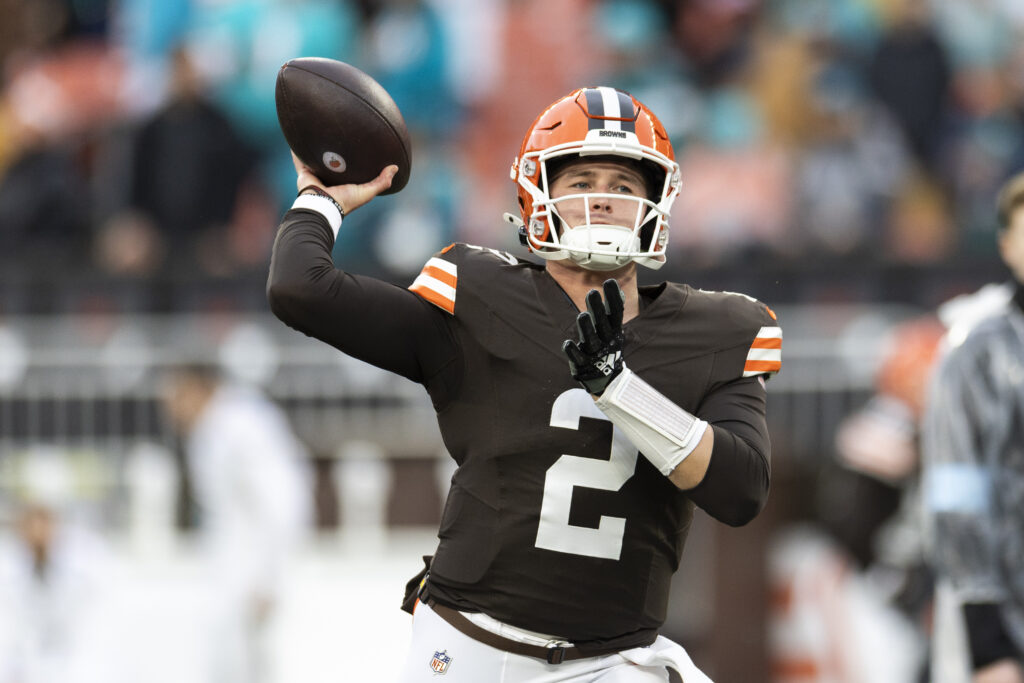
The Jets acquired Geno Smith from the Raiders on a cost-controlled late-round pick swap, but the numbers they inherited tell a bleak story. Smith went 2–13 last season, posted a 34.1 QBR (27th among 28 qualifiers), and threw 17 interceptions against 19 touchdowns in what amounts to a career collapse at 35 years old. Yet head coach Aaron Glenn has declared Smith the starter without hesitation—a statement of organizational faith that feels more like damage control than conviction. Behind him, the Jets are holding an open competition for the backup slot among Bailey Zappe, Brady Cook, and fourth-round rookie Cade Klubnik, signaling that nobody in the building is confident in the depth.
Zappe carries the thinnest résumé among the contenders. His nine career starts (most recent: a 35–10 loss to Baltimore in the 2024 season finale) yielded a 76.0 passer rating, 62.1% completion rate, and 14 interceptions against 12 touchdowns over 15 total appearances. Cook, a 2025 undrafted free agent, made four starts last season in dire circumstances, posting a 55.4 rating with a 57.5% completion rate. The only wild card is Klubnik, a 22-year-old Clemson starter whom the Jets traded up to grab in the fourth round—a modest investment that suggests they see upside worth developing quietly. Glenn held off adding a proven free agent backup (Russell Wilson remains available) because the organization wants extended time to evaluate Klubnik's NFL transition. The calculus is clear: the Jets are not confident in either Smith or the roster around him.
For bettors, this setup creates a specific vulnerability. Smith's decline is multi-faceted—not just age, but mechanical regression and decision-making collapse against pressure. When he struggles early (which his recent tape suggests is the baseline), the Jets face a choice: ride it out or dip into a backup depth chart that has no proven competence at any position. In games where the Jets fall behind by two or more scores, expect volatility in second-half play-calling and personnel. The backup competition also means the team is testing players in practice reps and preseason, which will leak into Vegas's injury/status decisions and game scripts. Cook and Zappe's lottery-ticket opportunities to play in real games should not be priced as if they're legitimate NFL passers.
The prop angle focuses on total passing yards and interceptions for Smith in weeks where the Jets are favored or within three points at opening. Smith's YPA (yards per attempt) dropped to 6.2 last season in a supporting cast that was marginally better than New York's current roster. His interception rate (4.6% last year) has no floor in an offense with minimal receiver talent and a suspect offensive line. Take unders on Smith's passing yards in early-season games (Weeks 1–4) at lines north of 245 yards; the market will initially price him as a league-average passer in a fresh system, but his mechanical issues and the Jets' likely game scripts (early deficits) will suppress volume. Conversely, interceptions above 1.5 become playable once the market settles and bookmakers account for Smith's turnover profile. The backup competition provides downside protection on Smith props because if he truly implodes, the narrative shifts to Zappe or Cook seeing reps—a scenario that suppresses team efficiency metrics overall.