Travis Hunter's Weight Gain Paradox: Muscle Addition Unlocks Elite Speed for Jaguars' Two-Way Weapon
By Erik Schwartz ·
Hunter's rehab from knee surgery produced an unexpected outcome—he's 10 pounds heavier but clocking nearly 23 mph, placing him in rare air with Hill and Mostert.
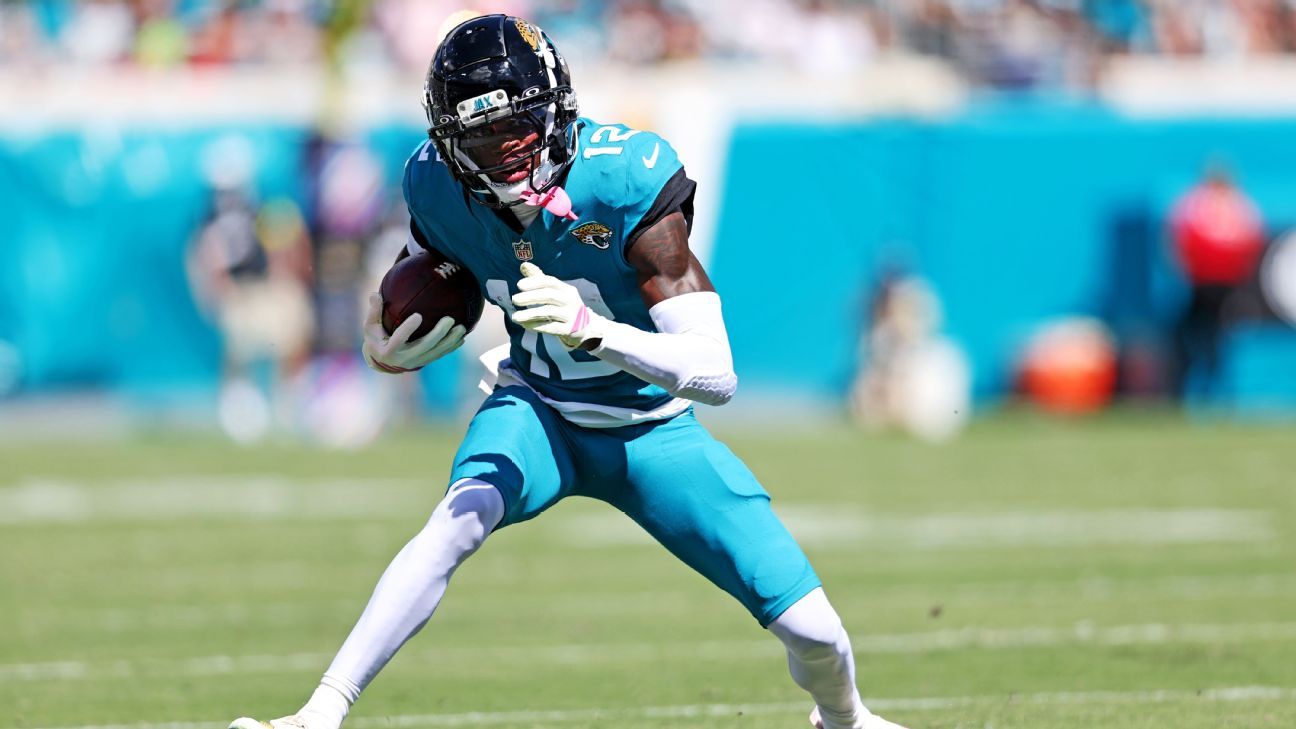
Travis Hunter reported to Jacksonville's third training camp practice Friday noticeably more muscular than when his rookie season ended in October, yet he's moved faster than at any point in his career. The Jaguars' two-way cornerback-receiver gained 10 pounds during his nine-month recovery from right knee surgery (lateral collateral ligament repair, suffered Oct. 30, 2025) and recorded a 22.6 mph top speed during offseason conditioning—a figure that places him in elite company. Since the NFL began tracking player speeds via NextGen Stats in 2016, only Tyreek Hill and Raheem Mostert have exceeded 22.6 mph in game action.
The mechanics of Hunter's transformation center on composition, not raw weight. During rehab, he built considerable upper-body and core strength while his knee healed, an adaptation that fundamentally changed how he moves. When he returned to on-field work, that added muscle mass translated into a lighter feel on his feet rather than the sluggishness he feared. Head coach Liam Coen gave Hunter autonomy on weight targets—"play at whatever weight you're happy at"—which removed the typical trade-off between mass gain and lateral mobility. Hunter's own assessment tracks with Campanile's evaluation: the cornerback looks "really physical" and appears to have retained (or gained) the explosive trait that made him a No. 1 overall prospect.
The injury timeline matters for context. Hunter appeared in only seven games as a rookie before the Oct. 30 knee injury shelved him for the remainder of last season. He caught 28 passes for 298 yards and one touchdown in that abbreviated role, playing both positions but never settling into rhythm with either the offense or the defensive scheme. His return to full-speed practice this week—he's already logged 24 defensive snaps and 15 offensive snaps during 11-on-11 periods—signals a genuine recovery, not a managed return. The speed numbers validate that signal: if Hunter were still nursing the injury or moving cautiously, his max velocity would not approach Hill-Mostert territory.
For prop bettors, the consequence is material. Hunter's receiving role hinges on (1) his ability to separate from defenders and (2) his chemistry with the quarterback on short-area passing concepts. Speed is foundational to both. At 23 mph, he becomes a genuine threat on go routes and vertical stems—plays the Jaguars didn't feature much with him last season due to his late arrival. His rookie snap count on offense (28 receptions across seven games extrapolates to roughly 12-15 targets over a full season at that pace) suggests he was a complementary piece, not a primary target. But elite speed changes the calculus: route trees expand, coverage windows shrink, and target share typically follows. The relevant prop is not Hunter's raw yardage (still likely in the 4-6 target range weekly), but rather his anytime touchdown probability. Faster receivers who gain trust in the system tend to see an uptick in red-zone touches, and Hunter's ability to create separation in tight spaces—where 22.6 mph provides a genuine advantage—is now measurable.
The durability question is secondary. One full training camp practice is not validation of full health, but the fact that he's hitting top speeds comparable to the league's fastest runners, just eight months post-surgery, suggests the rehab was comprehensive and well-executed. The Jaguars' decision to play him at both positions simultaneously, even in these early practices, indicates medical confidence. Any prop edge on Hunter will ride primarily on his target volume rising as the offense gains confidence in his knee—a multi-week adjustment rather than an immediate season-opener spike.