Gibbs' Efficiency Edge Over Robinson Reshapes 2026 RB Valuation
By Ty Whitney ·
With Montgomery gone and red-zone work up for grabs, Gibbs' historic touch efficiency gives him a clearer path to league-winning production than Robinson's volume alone.
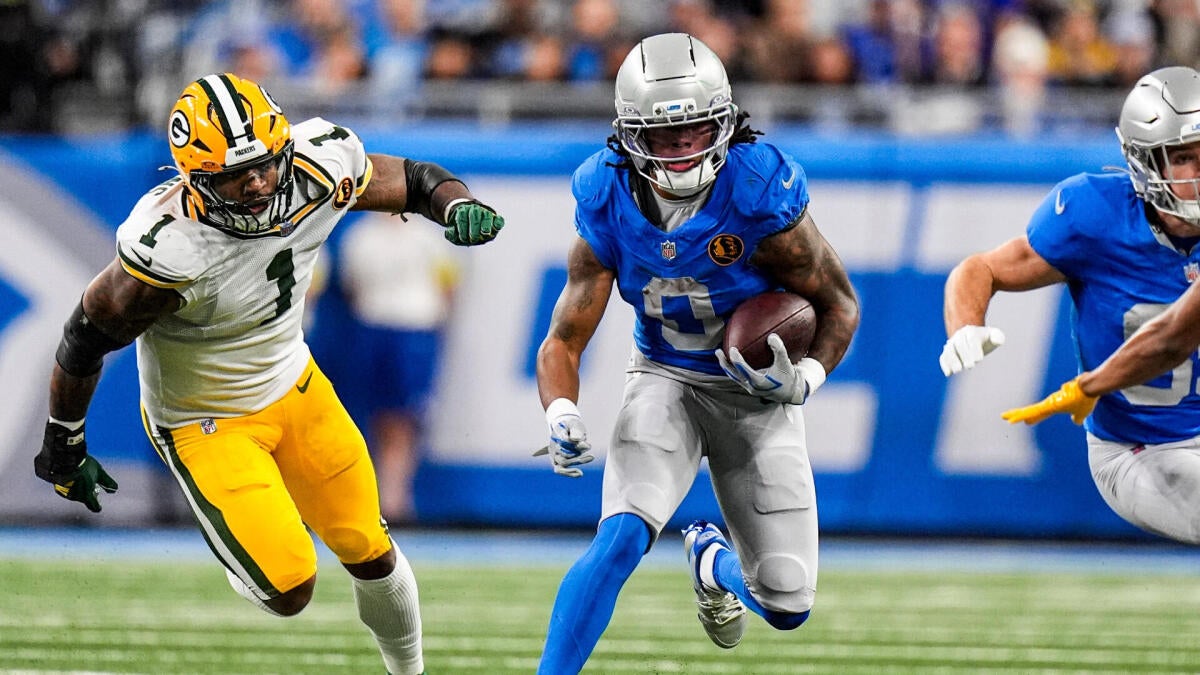
The 2026 fantasy football season opens with two generational running backs competing for the first overall selection, and the gap between them is narrower than their draft capital suggests. Jahmyr Gibbs and Bijan Robinson have dominated the position since 2023—ranking third and fourth respectively in fantasy points among running backs over a three-year span—but recent roster moves have fundamentally altered their 2026 paths. Detroit traded David Montgomery to Houston, clearing the bell-cow role for Gibbs, while Atlanta shed Tyler Allgeier, opening space in the Falcons backfield for Robinson. The question isn't whether either player is elite. It's who gets the cleaner runway to historic production.
Gibbs' advantage sits in a metric the market has undervalued: touch efficiency. Over the past two seasons, he produced 729.8 fantasy points on 622 touches while Robinson posted 712.5 points on 731 touches—meaning Gibbs squeezed 0.20 more fantasy points per touch out of the same offensive ecosystem. Career-wide, Gibbs ranks second among all running backs with 15+ touches per game since 1970 in fantasy points per touch (1.135), trailing only De'Von Achane. He's achieved this efficiency without ever touching 30 carries in a single game. Even Robinson's volume advantage—which was genuine in Atlanta's committee approach—can't erase a structural gap in how productively each player converts opportunity into yardage and touchdown probability.
The red-zone split matters more than headline volume. Montgomery absorbed 51 goal-to-go rushes, 31 inside-the-5, and 12 at the 1-yard line over two seasons in Detroit. Gibbs, running parallel routes from the same backfield, drew only 36 goal-to-go opportunities, 24 inside-the-5, and 10 at the 1-yard line. That's a 15-touchdown swing in high-leverage situations that should vanish in 2026. Robinson, by contrast, already commanded the lion's share of Atlanta's red-zone work (40 goal-to-go, 21 inside-the-5, 9 at the 1-yard line) while splitting with Allgeier. The Falcons added Brian Robinson to the backfield—not a primary option, but enough to muddy assignment certainty. Gibbs walks into a cleaner offensive mandate.
For prop bettlers, this efficiency pattern projects across specific seasonal markets. If Gibbs reaches 350-375 touches (below Montgomery's historic 403 carry load), he approaches or exceeds 2,150 scrimmage yards and 20+ touchdowns—numbers that move team totals, O/U lines, and individual player ceiling bets meaningfully higher. Robinson would need a significantly larger workload to match that output, and Atlanta's backfield additions suggest that touch ceiling is now contested rather than Gibbs' would be. Gibbs has recorded 3,768 scrimmage yards in a two-year span without a single 30-touch game; expanding that touch floor to 17.8 per game (his 2024 average) on a full-season basis while preserving efficiency creates a floor of 1,850+ yards with upside to 2,200+. That's not projection territory anymore—it's forensic calculation based on three seasons of sub-30-touch game data.
The market has treated this as a coin flip with Gibbs at 1.62 average draft position versus Robinson at 1.94. It shouldn't be. Gibbs' efficiency edge is persistent across sample sizes, repeatable regardless of whether he hits 320 or 400 touches, and now backstopped by the removal of competition. Robinson faces a cleaner secondary backfield but without the touch-efficiency moat. Fantasy season is a long runway, but the gap widens immediately in PPR formats where Gibbs' reception efficiency (already elite) will accelerate the separation.