Seahawks' O-Line Continuity Faces Its First Real Test: Myles Garrett Twice a Year
By PropBetEdge Editorial Team ·
Seattle's improved offensive line will spend 2026 proving it's elite enough to handle the league's most disruptive pass rusher, and that matchup reshapes how to value Seahawks passing volume.
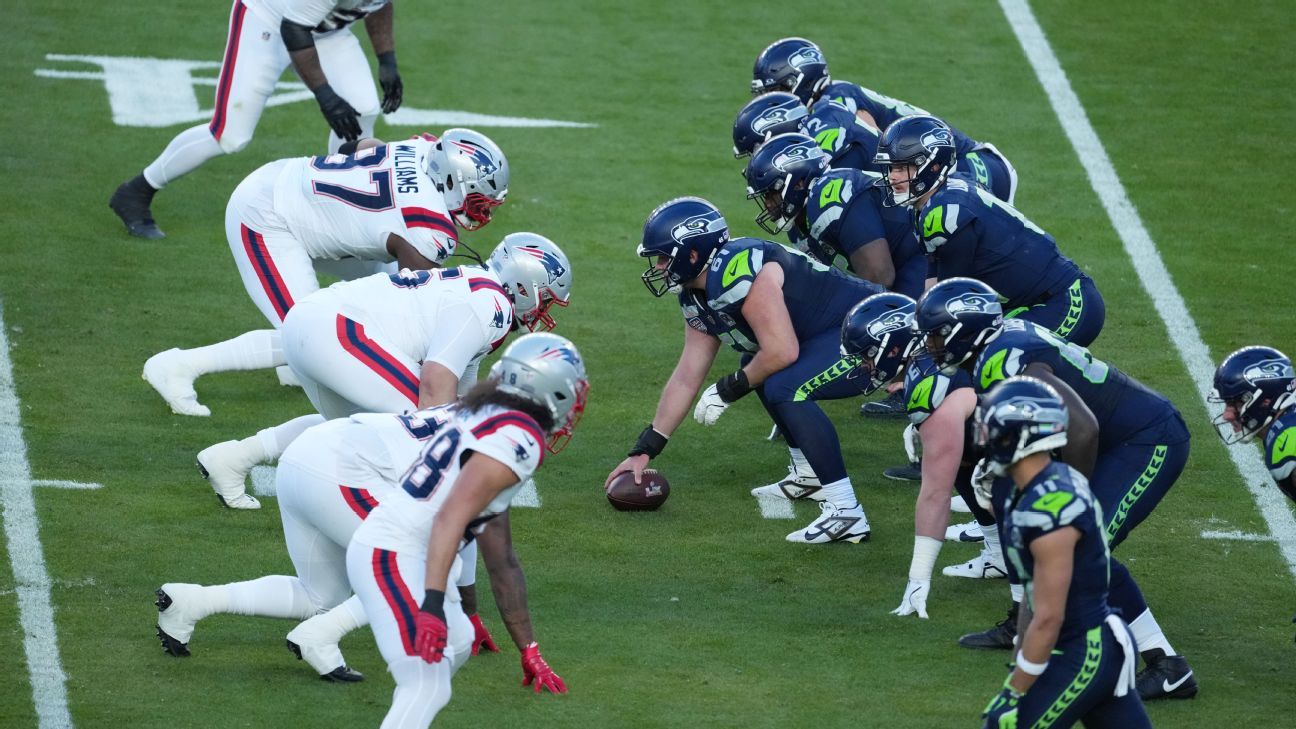
The Los Angeles Rams acquired Myles Garrett from Cleveland on Monday, paying a haul that included Pro Bowl edge rusher Jared Verse and three future picks to bring the reigning Defensive Player of the Year into the NFC West. Garrett finished 2025 with 23 sacks — the league lead — and now the Seattle Seahawks will face him twice annually starting this fall. The timing, however, cuts against the narrative of panic. Seattle's offensive line is not the Swiss-cheese structure that tormented Russell Wilson a half-decade ago. It's become a competitive advantage.
The Seahawks re-signed or extended every meaningful piece from their 2025 roster. Left tackle Charles Cross locked in on a four-year, $104.4 million deal in January; right tackle Abraham Lucas signed a three-year, $46 million extension last summer. Grey Zabel, their first-round left guard pick in 2025, is a rookie anchored in place. Center Jalen Sundell (second year) and right guard Anthony Bradford (third year) round out a unit that finished the regular season eighth in run block win rate (72.8%) and 12th in pass block win rate (64.8%) — respectable numbers for a line that played together for less than a full season. General manager John Schneider, who spent years watching continuity compound in Green Bay, has intentionally built depth and stability here. All 11 offensive linemen who took a snap last season remain on the roster.
Garrett's arrival doesn't blow this narrative apart, but it does test it. A 64.8% pass block win rate is solid when your competition rotates. Against Garrett in two games per season, that number will likely dip. The Seahawks will face one of the few edge rushers capable of beating Elite talent consistently — a man who produced 23 sacks on sub-6% of snaps because he's that disruptive. Cross and Lucas are good; Garrett is a different tier. Seattle's front office is betting that youth and cohesion can close the gap that elite talent alone commands.
For prop bettors, the Garrett trade creates a two-game tax on Seahawks passing volume and quality. In weeks where Seattle faces the Rams, expect offensive line assignment sheets to tighten, with more chip blocks and occasional max-protect schemes. Cross will see his snap count either locked in (if the team plans to showcase him through the pressure) or his workload could shift toward run situations. More pressuringly, Geno Smith's passing attempts may contract slightly in Garrett games — not a full-game trend, but situationally in the second half when the Seahawks game script tightens. Smith's passing yards line at 260+ in a neutral matchup could drift lower to 245–250 when the Rams are on deck. The market will likely price this conservatively at first, but after the first Seahawks-Rams game, that line will recalibrate sharply downward. Early-week Seahawks passing lines in Garrett weeks represent value sells, not buys.
The Seahawks' O-line did not become fragile overnight. They still have structural advantage over most of the league. But Garrett is the exception that proves the rule: elite individual talent defeats good team continuity in isolated matchups. Bettors who chase Seahawks passing overs in Garrett weeks are paying a hidden Rams tax that the market hasn't yet fully accounted for.