Jefferson's Receiving Yards Props Face a Minnesota Reckoning
By Erik Schwartz ·
The Vikings' receiving talent remains elite, but quarterback volatility and a 2025 production dip create sharper edges on Jefferson's season-long receiving volume.
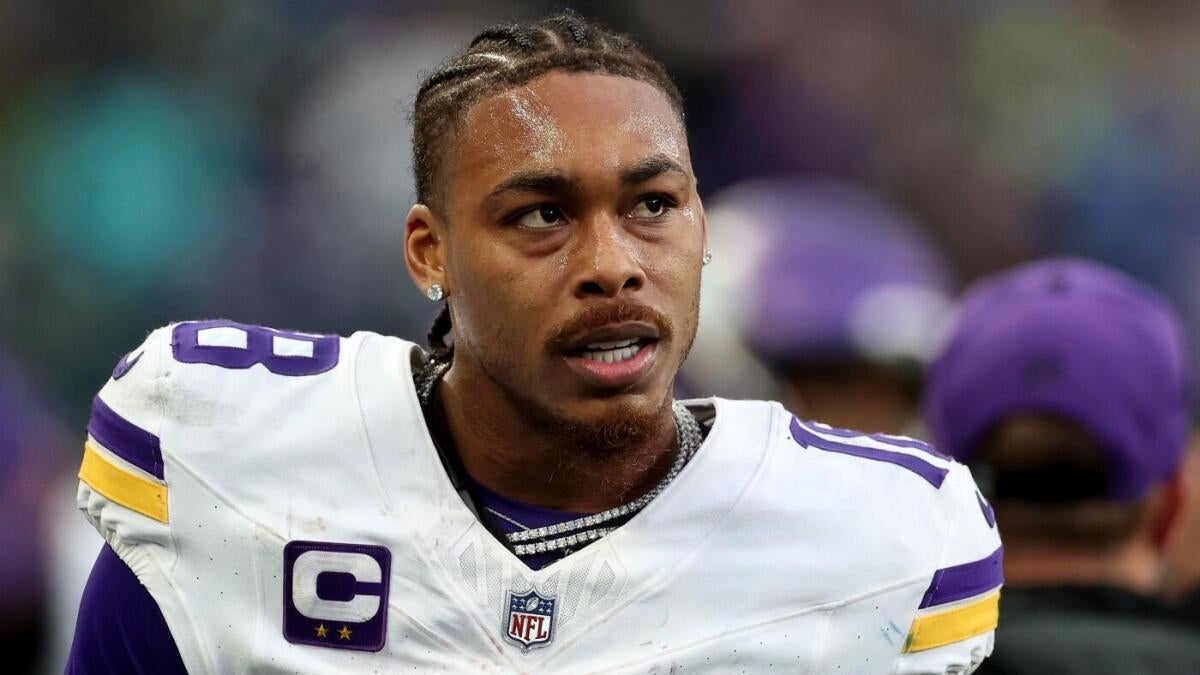
Justin Jefferson posted his lowest-efficiency season as a pro in 2025, finishing 12th in NFL receiving yards with 1,048 on 141 targets—a stark decline from the 8,480 yards he accumulated over his first four seasons. His 2 receiving touchdowns marked a career low for a healthy season. The Minnesota passing game produced exactly the kind of ambient instability that suppresses elite receiver volume: J.J. McCarthy, Carson Wentz, and Max Brosmer combined for some of the league's worst quarterback play, forcing Jefferson into a survival-of-the-fit situation where opportunity didn't translate into typical production.
The broader receiving hierarchy has genuinely shifted. Jaxon Smith-Njigba won 2025 Offensive Player of the Year with 1,793 receiving yards. Puka Nacua exploded into that tier with career bests across categories. Ja'Marr Chase—operating under far worse signal-caller circumstances than Jefferson faced, splitting time between Joe Burrow, Jake Browning, and a 40-year-old Joe Flacco—still outpaced Jefferson by nearly 400 yards and six touchdowns. That last data point matters because it isolates quarterback context: Chase's floor remained higher even when his supporting cast deteriorated. Jefferson's didn't.
The quarterback situation heading into the 2026 season offers two divergent paths. If J.J. McCarthy takes a sizable developmental step forward—moving from bottom-five accuracy and decision-making into league-average efficiency—Jefferson's target volume normalizes and his receiving yards bounce back to 1,200+ range territory. If Minnesota pivots to Kyler Murray, the upgrade is steeper, but Murray has his own inconsistency issues. If neither materializes and the Vikings roll with another journeyman carousel, Jefferson's 2025 becomes the new baseline, not the outlier.
For prop wagering, this creates a clear arbitrage opportunity. The market priced Jefferson's preseason receiving yards line for 2026 based on five-year body of work, not recent performance. An 8-season average anchored heavily by his years 1-4 peaks doesn't account for the structural offense degradation. If McCarthy doesn't show measurable improvement in summer practices and preseason, Jefferson's actual receiving volume line should settle 150-200 yards lower than what books opened. The under on season-long receiving yards props is underpriced relative to the probability that Minnesota's quarterback play remains bottom-five again; conversely, overs only make sense if you're betting McCarthy reaches average-starter efficiency within the first month.
Jefferson isn't a fading talent—the reception of target opportunities remains the constraint, not hand-speed or route-running. But receiver props live or die on volume, and volume requires quarterback confidence. Until McCarthy proves he can sustain drives, Jefferson's receiving yards props carry elevated risk on the over side.